
Status of the Reorganization

As is well known, the NOS Region’s reorganization team, which has been active for about two years, began its work by surveying five members from each of the 40 model flying clubs (a random sample) and will conclude its work at the upcoming chairpersons’ conference. The survey—now limited to the region—can essentially be summarized as follows:
Members expect a lean organization that provides services to the groups and their members. They have little interest in the association structure itself.
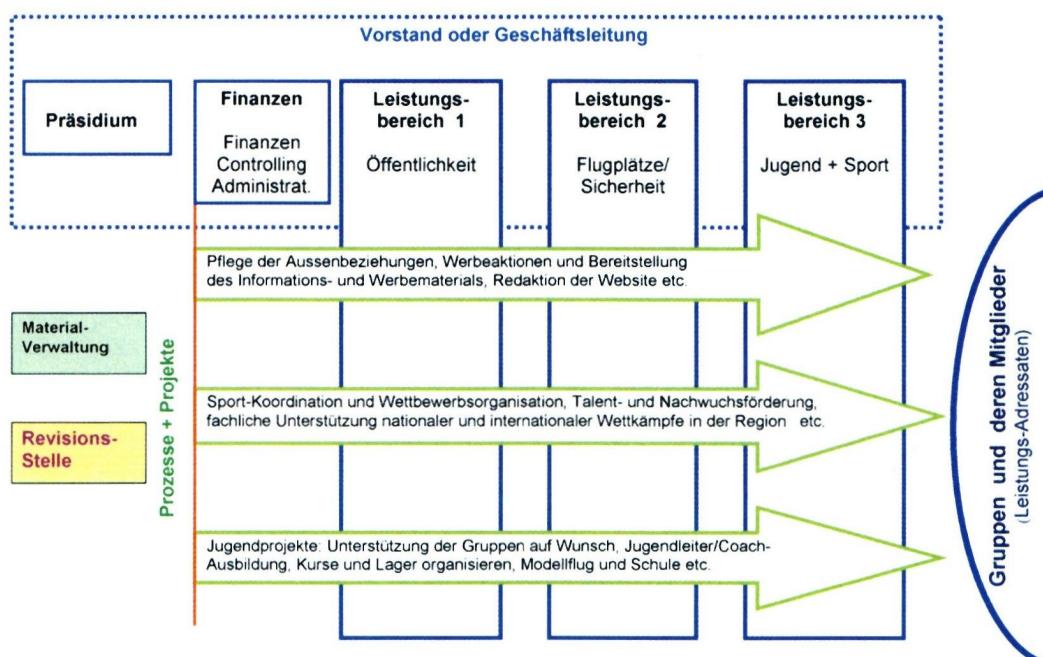
Youth development, sports promotion and organization, public relations, political advocacy, and support related to airfields and safety.
The survey clearly showed that the senior citizen demographic will become increasingly important within our organizations and that there is significant potential here in terms of broad expertise. Another major area can be summarized under the heading of “knowledge management,” which simply means that stakeholders in the field share their knowledge and information with one another at all organizational levels so that not every staff member has to start from scratch.
Based on these guidelines, the team subsequently proposed organizational and substantive changes, namely that the Executive Board should be downsized and no longer consist of the flight directors from the various categories. The five-member Executive Board will now consist of the heads of the three functional areas—“Public Relations,” “Youth+Sports,” and “Airfields/Safety”—as well as the Head of Administration/Finance and the President. These changes can be better implemented through an amendment to the bylaws.
In terms of content, the team has formulated four subprojects, some of which are already underway—see “Wings of Friendship,” and, in the longer term, a senior citizens’ project—and are to be presented at the upcoming chairpersons’ conference.
At the special chairpersons’ conference held on November 22, 2001, the organizational model—comprising the three aforementioned areas of responsibility—was approved in principle, and the team was tasked with further developing this model. The team will conclude its work by proposing amendments to the bylaws for the upcoming chairpersons’ conference, establishing the relevant committees, and approving the budgets for the subprojects. Most team members, however, will continue to be available for individual subprojects, which is, of course, a great blessing.
Emil Giezendanner

EURO CONTEST GLIDER ACRO TOUR AUSTRIA 2026

THE PC-21 STORY
 Emil Giezendanner

TWIN TOWN PARTNERSHIP
 Wolfgang Voeller

SUMMER FUN 2026 AT MG USTER
Martin Wunderli
CORSAIR F4U – A WARBIRD WITH A MEMORABLE LOOK
Jürgen Rosenberger, Jürgen Prinz
52. 2026 ALPS CUP
Emil Giezendanner
YOU KNOW WHAT I MEAN? 125 YEARS OF THE SWISS AERO CLUB
Emil Giezendanner
News from HEBU

TEAM MANAGER "THIS" BOSSHARD
Rodito Nussbaumer
ATOM, THE NEW DOUBLE-DECKER FROM CPLR
 Matthias Bosshard

F3A EUROPEAN CHAMPIONSHIPS IN ST-MACAIRE, FRANCE
Matthias Bosshard
INSIGHTS INTO THE HISTORY OF SEAPLANES

WELCOME, NEW MEMBER!
Andrea Bolliger
What's New at Leomotion.com

PRIDE AND GOOD IDEAS
 Markus Nussbaumer

SMALL, MODEL-LIKE SAILBOATS
Res Dauwalder
FREE FLIGHT IN THE MIDDLE OF SUMMER
Urs Muntwyler
BY YOUTH, FOR YOUTH
Lorena Betschen
34th HAHNENMOOS ALPINE MODEL AIRPLANE CAMP
Res Dauwalder
HORIZON HOBBY/LEMACO NEWS: MICRO OV-10 BRONCO 645 MM BY E-FLITE

COUPE DES ALPES – OBSERVE AND LEARN
Rodito Nussbaumer
TRY-OUT DAY AT MFV WETTINGEN
 Urs Keller

NEWS FROM HEBU
 Julia Bucher

NOS REGION – A HUB FOR ELECTRIC AVIATION
Emil Giezendanner
MEMORIES
 Wolfgang Völler

70 YEARS OF THE NIDWALDEN MODEL AIRPLANE CLUB
Martin Barmettler
A SPECTACULAR F3A WORLD CUP IN THE PRINCIPALITY OF LIECHTENSTEIN
Emil Giezendanner
FROM 0 TO 100
Markus Nussbaumer