
Free Flight
Free flight is the oldest discipline in model aviation and, after hot-air ballooning, also the oldest form of flight! As early as 1871, the Frenchman Alphonse Pénaud developed an uncontrolled rubber-powered model. The principles he established for stable flight are still valid today.
Free-flight models are not remote-controlled. When certain functions need to be triggered during flight, this is done via a timer. The most important function is the thermal brake, which initiates a stable glide after a certain amount of time. Without this brake, models could be carried away by updrafts.
Some models are controlled by magnets. In this system, the Earth’s magnetic field acts on a small magnet, which in turn moves a small rudder at the nose of the fuselage. In addition, purely aerodynamic principles are utilized, which—depending on the flight conditions—cause the model to behave differently without any mechanical functions at all. Something for aerodynamic specialists!

In terms of construction, free-flight models have also evolved significantly. Typical beginner models are still made of balsa, plywood, pine strips, and covering paper. In the competitive arena, these materials are supplemented by a wide selection of more modern materials. Instead of pine strips, carbon fiber tubes or boxes are used, which absorb the stresses encountered in competition much more reliably.
Even the tail sections of competition models are no longer made of balsa but of carbon, aramid, and fiberglass mesh. These materials are not only lighter but also shatterproof and resistant to warping. A perfectly trimmed model no longer needs to be readjusted before every flight.
Traditional covering paper is often replaced by special, very lightweight films. These are less affected by moisture—which can sometimes be a problem in adverse weather conditions or when the model is left on a tree overnight.
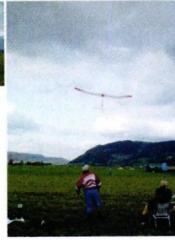
There are championships in 15 internationally recognized classes. In some of these, world or European championships are held every year. Switzerland has already produced several title winners!
Unpowered glider models are pulled up by a launcher using a line on flat ground. The hook for the line is closed at the start to prevent the line from slipping out. The launcher runs while towing the model until there are signs of a thermal. Only then is the model given a final burst of speed, at which point the hook opens.
Rubber-powered models have a fairly large propeller driven by a twisted rubber cord. The models climb vertically at the start and transition to gliding at maximum altitude. Internal combustion engines are also used as propulsion. Models in this class climb to a starting altitude of over one hundred meters in exactly 5 seconds of engine runtime. All functions are precisely controlled by timers.
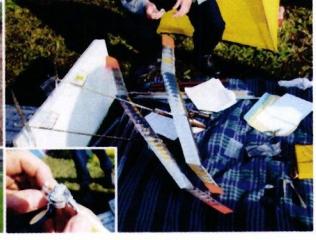
Flying sites require open, obstacle-free areas that are as spacious as possible. In Switzerland, due to extensive urban development, there are now only a few suitable areas left. Farmers generously make these available, as flights are scheduled primarily in the spring and fall to protect their crops. Military airfields also occasionally allow us to use their large open spaces.
Finding flying spaces for indoor free-flight enthusiasts is not quite as straightforward. Their delicate rubber-powered models must be flown in large, preferably unused halls to protect them from wind and weather. Even large mine caverns have been used for competitions!
Outdoor competitions on flat terrain consist of several rounds. In each round, the goal is to achieve the maximum flight time of three minutes. Once this time has elapsed, a timer ends the flight. If several participants are tied, tiebreakers are held with extended target flight times. Exciting? You bet!

EURO CONTEST GLIDER ACRO TOUR AUSTRIA 2026

THE PC-21 STORY
 Emil Giezendanner

TWIN TOWN PARTNERSHIP
 Wolfgang Voeller

SUMMER FUN 2026 AT MG USTER
Martin Wunderli
CORSAIR F4U – A WARBIRD WITH A MEMORABLE LOOK
Jürgen Rosenberger, Jürgen Prinz
52. 2026 ALPS CUP
Emil Giezendanner
YOU KNOW WHAT I MEAN? 125 YEARS OF THE SWISS AERO CLUB
Emil Giezendanner
News from HEBU

TEAM MANAGER "THIS" BOSSHARD
Rodito Nussbaumer
ATOM, THE NEW DOUBLE-DECKER FROM CPLR
 Matthias Bosshard

F3A EUROPEAN CHAMPIONSHIPS IN ST-MACAIRE, FRANCE
Matthias Bosshard
INSIGHTS INTO THE HISTORY OF SEAPLANES

WELCOME, NEW MEMBER!
Andrea Bolliger
What's New at Leomotion.com

PRIDE AND GOOD IDEAS
 Markus Nussbaumer

SMALL, MODEL-LIKE SAILBOATS
Res Dauwalder
FREE FLIGHT IN THE MIDDLE OF SUMMER
Urs Muntwyler
BY YOUTH, FOR YOUTH
Lorena Betschen
HORIZON HOBBY/LEMACO NEWS: MICRO OV-10 BRONCO 645 MM BY E-FLITE

34th HAHNENMOOS ALPINE MODEL AIRPLANE CAMP
Res Dauwalder
COUPE DES ALPES – OBSERVE AND LEARN
Rodito Nussbaumer
TRY-OUT DAY AT MFV WETTINGEN
 Urs Keller

NEWS FROM HEBU
 Julia Bucher

NOS REGION – A HUB FOR ELECTRIC AVIATION
Emil Giezendanner
MEMORIES
 Wolfgang Völler

70 YEARS OF THE NIDWALDEN MODEL AIRPLANE CLUB
Martin Barmettler
A SPECTACULAR F3A WORLD CUP IN THE PRINCIPALITY OF LIECHTENSTEIN
Emil Giezendanner
FROM 0 TO 100
Markus Nussbaumer