
Review: The Only New Thing Is the Engine
New Engine Replaces Gasoline Engine in Extreme Flight's Yak 54
It was a sunny Saturday afternoon at the airfield. I have to admit, my attention was focused more on my pilot friend’s beautiful date than on my Depron plane. I’d already heard, read, and seen a lot about it. At just under 1.9 meters long, it fits easily into any station wagon, and I’d had my eye on it for quite some time.
Since my beloved Fliton Extra 300 was unfortunately lost, I was on the hunt for a replacement. So I watched jealously as Urs tried to start the gasoline engine on his Extreme Flight Yak 54. But even after nearly an hour of intensive attention, the engine still wouldn’t start. That was my chance, and so it came to pass. The Yak didn’t take to the skies that day; instead, after a brief price negotiation, it ended up in my car. There it was, that beauty, now in my hobby room. The gasoline engine under the hood was immediately removed. But what would replace it? Electric—that much was clear—but which powerplant? After all, this model requires at least 2.5 kW of electric power for decent 3D flying. I had no experience with electric powerplants of this size. So I needed help, which e-flight provided quickly and competently. I chose the NeuMotor 1514-F3A with a Reisenauer gearbox, which should fit my Yak perfectly. The expected
thrust of approximately 11 kg at standstill, using 10 LiPo cells in series (10S1p) with a 22×10 propeller, should be a breeze for the aircraft, which weighs 5.6 kg ready to fly.
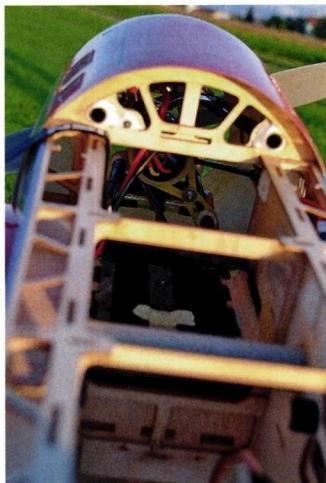
At first glance, the motor with the Reisenauer gearbox seems a little too small to me. I’m surprised—I had expected something bigger. Will it have enough power? To get right to the point: It has more than enough power. I’ve rarely had a model this overpowered. It easily spins the 2×10 propeller at 6,480 rpm while stationary, and in the process pulls
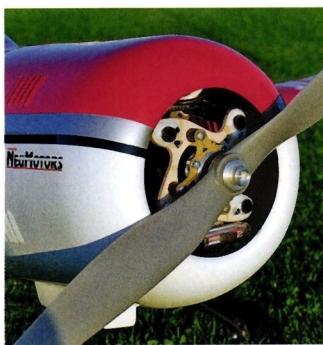
with 75 A connected to the large batteries. The compact design gives the impression of robustness. The three connection cables are routed to the outside through rubber grommets at the rear. The motor was also equipped with a cooling fan. During operation, I noticed that the gearbox got warmer than the motor itself. However, the temperatures always remained within a safe range. The drive shaft fits into a cone at the front, and the counterplate of the propeller mount sits on this cone. The propeller mount, with its M8 fine-threaded aluminum screw, is also of high quality and clearly indicates the forces expected here. With a conical power transmission, the precision and quality of both parts are very important. For one thing, the engine’s entire power is transmitted through this force-fit connection, and the propeller must not come loose. Even after several flights, the center screw had not loosened at all and did not need to be retightened. Nevertheless, I think it’s advisable to check the propeller mount regularly.
For my Yak, I used the Phoenix 110-HV speed controller from Castle Creation. With a maximum continuous current rating of 110 amps, it should be sufficiently rated for continuous operation. The package contents are standard, except for the included USB cable.
Also included is a detailed user manual printed in English, as well as a CD containing the standard software for programming various Castle Creation speed controllers. I didn’t use this CD at all; instead, I immediately downloaded and installed the very latest version from the manufacturer’s website (www.castlecreations.com). For programming, the controller can be connected directly to the computer via a USB cable, allowing all parameters to be conveniently adjusted on the screen. I find the helpful explanations—which are accessible directly next to each menu option for the corresponding setting—truly excellent. This makes all programming options immediately clear and easy to understand, allowing you to make adjustments without having to consult the user manual. Of course, most functions can also be programmed via the remote control. Since that “Dada” and “Dadi” beep code system is far too complicated, I make certain adjustments—such as deactivating the factory-set brake—not at the airfield, but later in the evening on my PC. As for flying, the ESC never got more than lukewarm, even during intense 3D maneuvers. Handling the ESC is actually exactly the same as with a 15-amp ESC for a park flyer. This is surprising: With a powerful motor, accidentally moving the throttle stick at the wrong moment is enough to cause trouble. When an internal combustion engine is chugging away, everyone present notices it and behaves accordingly. But an activated electric motor is indistinguishable from a deactivated one!
The new Extreme Power Evo tires were set to prove their performance in the Yak
At first, the two 5s packs—each consisting of two 10s packs—with a capacity of 5,000 mAh seemed completely underutilized. They barely got warm and handled the demanding 3D flying with ease and without any fanfare. A friend has already flown 80 cycles with the same batteries in a helicopter, and without any signs of fatigue. It’s worth noting that these batteries can be charged at up to 5C—in my case, 25 Am-
. Provided you have the appropriate charging equipment, you can fly all day with these power packs without any major flight breaks. The new ePower X10 charges the 10s pack to full capacity in just 40 minutes.
Since the Yak was supposed to be as light as possible, weight had to be saved, especially in the motor mount. However, the existing motor dome was designed for internal combustion engines and was therefore quite impractical for my long, front-mounted gearmotor. The existing motor dome was promptly sawed off and replaced with a carbon-tube solution featuring plywood struts. The result was an extremely rigid yet lightweight motor mount. The matching
motor mounting kit offered by e-flight includes a second support for the motor at the rear. This allows lateral pull and motor pitch to be conveniently adjusted at the rear support ring, while the angle change is absorbed at the front by the four rubber mounts.
Minutes before the first takeoff, I felt a certain connection to this engine. For both of us, it was a true maiden flight. Not so for the Yak. In the past, it had already been thoroughly shaken up by the gas engine. All the vibration-damping felt pads could now be safely removed. The silky-smooth new engine showed off its power and, after a thorough range test, propelled the Yak into its element at just over half throttle. What
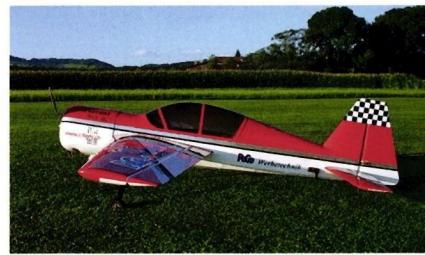
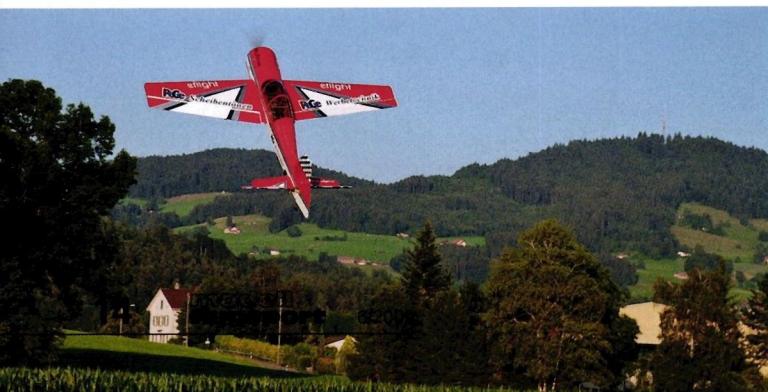
What followed was spectacular. The first few laps were flown at about half throttle and above. Since this was a maiden flight, the entire configuration was first tested for center of gravity and low-speed flight characteristics. The NeuMotor, with its enormous power, was always in complete control, and its aggressive throttle response is overwhelming. With proper cooling, it barely gets warmer than lukewarm even during 3D maneuvers.
Thomas Graf


News from HEBU

TEAM MANAGER "THIS" BOSSHARD
 Rodito Nussbaumer

YOU KNOW WHAT I MEAN? 125 YEARS OF THE SWISS AERO CLUB
 Emil Giezendanner

PRIDE AND GOOD IDEAS
 Markus Nussbaumer

ATOM, THE NEW DOUBLE-DECKER FROM CPLR
 Matthias Bosshard

SUMMER FUN 2026 AT MG USTER
Martin Wunderli
F3A EUROPEAN CHAMPIONSHIPS IN ST-MACAIRE, FRANCE
Matthias Bosshard
52. 2026 ALPS CUP
Emil Giezendanner
HORIZON HOBBY/LEMACO NEWS: MICRO OV-10 BRONCO 645 MM BY E-FLITE

TWIN TOWN PARTNERSHIP
Wolfgang Voeller
CORSAIR F4U – A WARBIRD WITH A MEMORABLE LOOK
Jürgen Rosenberger, Jürgen Prinz
TRY-OUT DAY AT MFV WETTINGEN
Urs Keller
EURO CONTEST GLIDER ACRO TOUR AUSTRIA 2026

BY YOUTH, FOR YOUTH
Lorena Betschen
INSIGHTS INTO THE HISTORY OF SEAPLANES

SMALL, MODEL-LIKE SAILBOATS
Res Dauwalder
What's New at Leomotion.com

COUPE DES ALPES – OBSERVE AND LEARN
Rodito Nussbaumer
34th HAHNENMOOS ALPINE MODEL AIRPLANE CAMP
Res Dauwalder
WELCOME, NEW MEMBER!
Andrea Bolliger
FREE FLIGHT IN THE MIDDLE OF SUMMER
Urs Muntwyler
THE PC-21 STORY
Emil Giezendanner
NEWS FROM HEBU
 Julia Bucher

FROM 0 TO 100
Markus Nussbaumer
MEMORIES
Wolfgang Völler
NOS REGION – A HUB FOR ELECTRIC AVIATION
Emil Giezendanner
Have you almost forgotten about aircraft that take off and land vertically?
Emil Giezendanner
DO YOU KNOW WHAT I MEAN IN THE LAND OF SMILES?
Emil Giezendanner