
A Second Life for Your Gliders ...
Many modelers own a medium-sized semi-scale glider (about 3 m) that’s gathering dust in the basement or attic. Once very popular, this type of model is now less common because tow-launch enthusiasts are turning to much larger and more realistic aircraft, while slope-soaring enthusiasts prefer more agile and less de-
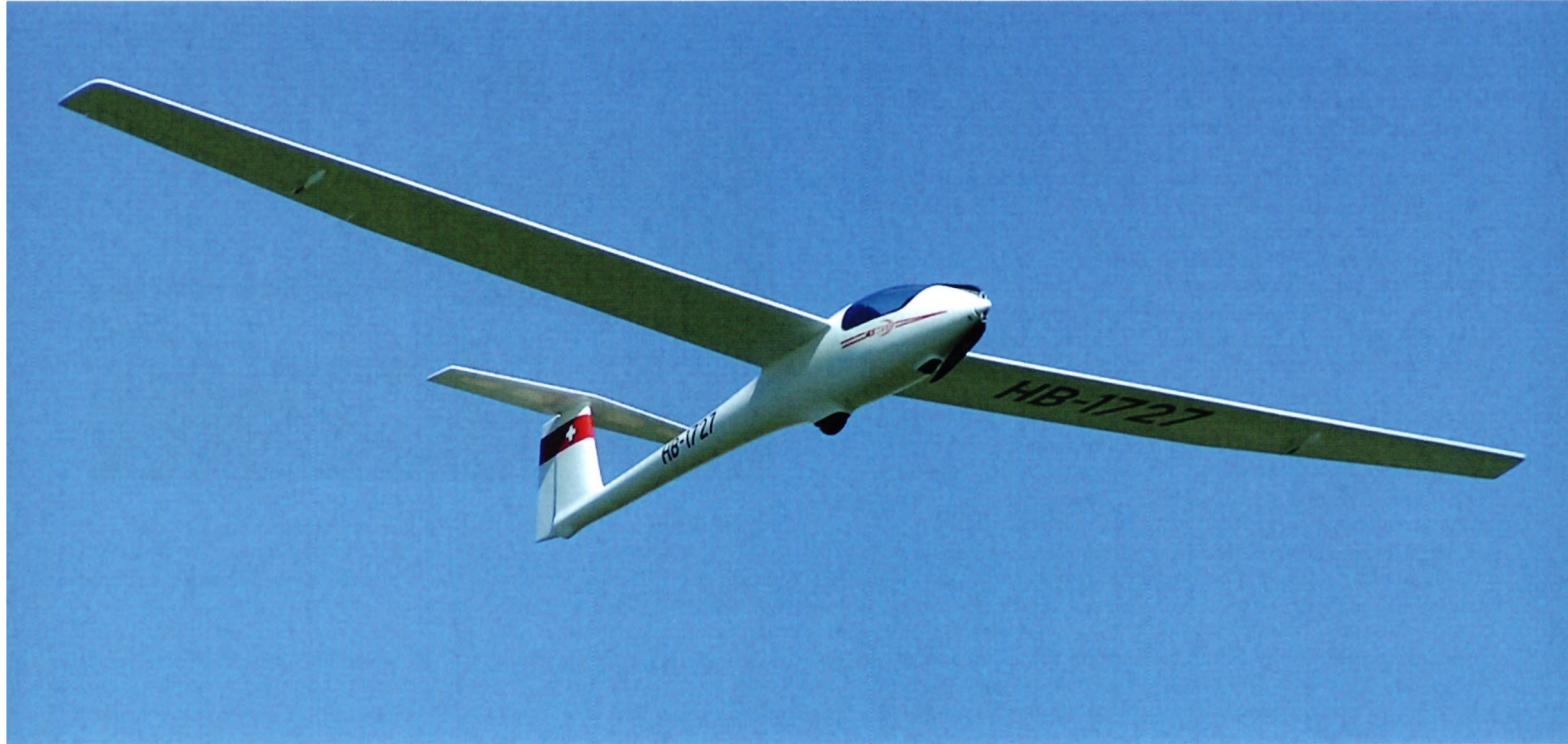
can be damaged in the event of a slightly rough landing. To breathe new life into these easy-to-fly models—which are characterized by their generous size, spacious fuselage, and reasonable wing loading—the solution is to equip the glider with a modern electric powerplant and take advantage of your club’s runway to practice cross-country flying.
Two examples will illustrate this point, in which a single battery is used for simplicity and cost-effectiveness. This choice means limiting each model to 8 cells and 4 servos to avoid overloading the BEC system.
This model, purchased at a model airshow, is about ten years old. It has a wingspan of 3.20 m and weighs 2,800 g. Its design is typical of the era, featuring flat wing spars, a thick, high-lift airfoil (Eppler 201), and a pronounced longitudinal camber. The fuselage is a beautiful piece featuring a fixed landing gear with a nose wheel, and it took 120 g of lead—in addition to the tow hook and tow servo—to balance the bird.
Given the model’s considerable drag and to improve thrust, the following powerplant was selected:
- Hacker B-40 L motor + Maxon 4.4:1 ceramic gearbox
- 16 × 8 propeller (in inches!)
- Hacker Master40 B Flight ESC
- 8-cell GP 3300 NiMH battery
With the conversion complete, the airframe weight is only 3,200 g. The glider flies undeniably better, especially in the wind. The motor replaces the ballast and allows for towing without overloading. The only adjustments required are arranging the battery in a square configuration (4 cells in 2 tiers) to fit in front of the landing gear and slightly moving the center of gravity backward, as the flight speed is slightly higher. A throttle-and-elevator mix for diving (10%) works well.
This is a newer, faster model with a wingspan of 2.10 m, which was recovered—slightly damaged—from a club member. The glider’s design is sound, but the length of the nose poses a major problem with the center of gravity. A lightweight motor is an absolute necessity. The chosen motor is therefore very different:
- AXI 2820/10 motor (rotating cage)
- 11 × 6 propeller
- Hacker Master 40 B Flight ESC
- 8-cell 1600 CP NiCd battery
The elevator control must be moved to the side of the fuselage (i.e., the wing and fairing) to allow access to the battery and the steel wing spar, and replaced with a carbon rod, saving 90 g. The final weight is 1,870 g, which is within the manufacturer’s specifications for the pure glider version (1,600 to 2,000 g). Flight performance is remarkable—tight and precise—and there are no unpleasant surprises at low speeds.
In both cases mentioned, the motor is not used to its full potential due to the choice of a moderately sized propeller. However, the power is more than sufficient to reach the desired altitude in 30 to 45 seconds. Current draw in both cases is slightly over 30 amps, and flight time is satisfactory. Experience shows that a rapid climb for a short duration (with a powerful motor) is preferable in terms of flight duration.
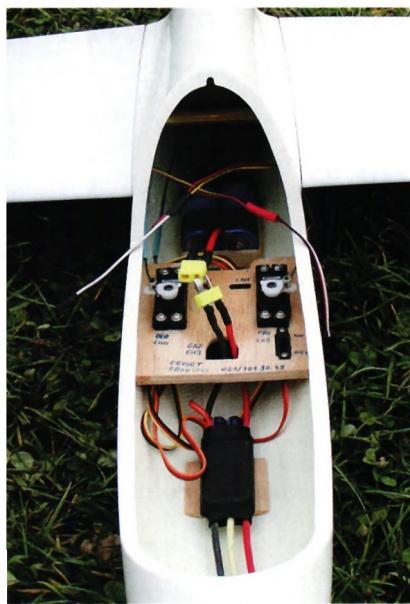
Converting a glider into a motor glider is therefore a simple process. As a reminder, here is a list—which may not be exhaustive—of a few points to keep in mind:
- Choose a nose cone that matches the fuselage
- Make a template before cutting the nose of the glider, taking into account the desired anti-pitch and pitch-down forces
- Plan the placement of components to maintain proper center of gravity
- Keep the antenna and receiver away from other electrical components
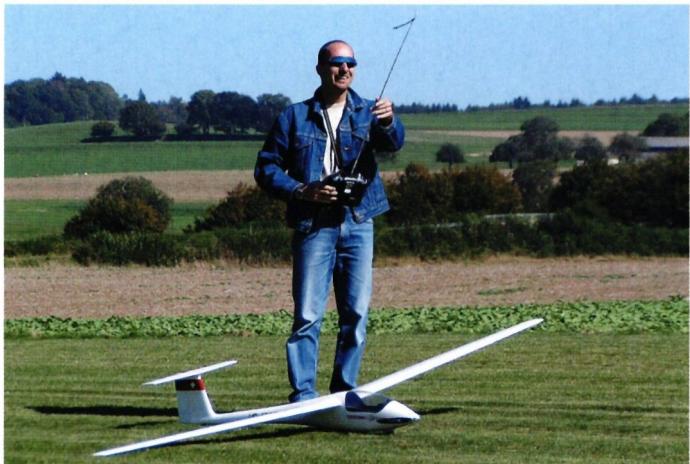
- As the airspeed increases, check the controls and the angle of attack on both wings (there can be some surprises with the Swift!)
- Do not use any mixers during the first flight
- Expect to have to move the center of gravity back and reduce the longitudinal trim.
It’s clear that there’s an effective solution for every model.
So all you have to do is make a small investment (a brushless motor is supposedly indestructible!), bring your old gliders up to date, and enjoy flying as often as you like with your original aircraft...
The efficiency of electric propulsion systems is well established, and
François Croset GAM Bournens

EURO CONTEST GLIDER ACRO TOUR AUSTRIA 2026

THE PC-21 STORY
 Emil Giezendanner

TWIN TOWN PARTNERSHIP
 Wolfgang Voeller

SUMMER FUN 2026 AT MG USTER
Martin Wunderli
CORSAIR F4U – A WARBIRD WITH A MEMORABLE LOOK
Jürgen Rosenberger, Jürgen Prinz
52. 2026 ALPS CUP
Emil Giezendanner
YOU KNOW WHAT I MEAN? 125 YEARS OF THE SWISS AERO CLUB
Emil Giezendanner
News from HEBU

TEAM MANAGER "THIS" BOSSHARD
Rodito Nussbaumer
ATOM, THE NEW DOUBLE-DECKER FROM CPLR
 Matthias Bosshard

F3A EUROPEAN CHAMPIONSHIPS IN ST-MACAIRE, FRANCE
Matthias Bosshard
INSIGHTS INTO THE HISTORY OF SEAPLANES

WELCOME, NEW MEMBER!
Andrea Bolliger
What's New at Leomotion.com

PRIDE AND GOOD IDEAS
 Markus Nussbaumer

SMALL, MODEL-LIKE SAILBOATS
Res Dauwalder
FREE FLIGHT IN THE MIDDLE OF SUMMER
Urs Muntwyler
BY YOUTH, FOR YOUTH
Lorena Betschen
HORIZON HOBBY/LEMACO NEWS: MICRO OV-10 BRONCO 645 MM BY E-FLITE

34th HAHNENMOOS ALPINE MODEL AIRPLANE CAMP
Res Dauwalder
COUPE DES ALPES – OBSERVE AND LEARN
Rodito Nussbaumer
TRY-OUT DAY AT MFV WETTINGEN
 Urs Keller

NEWS FROM HEBU
 Julia Bucher

NOS REGION – A HUB FOR ELECTRIC AVIATION
Emil Giezendanner
MEMORIES
 Wolfgang Völler

70 YEARS OF THE NIDWALDEN MODEL AIRPLANE CLUB
Martin Barmettler
A SPECTACULAR F3A WORLD CUP IN THE PRINCIPALITY OF LIECHTENSTEIN
Emil Giezendanner
FROM 0 TO 100
Markus Nussbaumer