
Commentary on the New National F4H Scale Helicopter Regulations
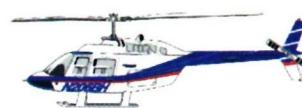
In Switzerland, Germany, and Austria, semi-scale and scale competitions have been held since 1992 in accordance with established regulations. The goal of these competitions is to build a model that resembles the original as closely as possible and then to perform flight maneuvers that are true to the original.
Germany and Austria have adhered to these regulations to this day; they were slightly amended in 1997. The Swiss regulations were revised several times in 1995, 1996, and 1999 and now differ significantly from the others. These changes have led to a steady decline in participant numbers over time, and pilots from neighboring countries no longer take part. Today, the rules are heavily based on the design and construction of the models, which has prevented some pilots from entering this competition class to this day. As a result, in recent competitions, only a handful of pilots have been competing for a good ranking. It’s actually a shame, because the F4H category is interesting—it’s all about replicating many beautiful full-size helicopters with great respect and skill and showcasing them to the public. That’s why we active pilots, together with the FAKO F4, drafted new rules last fall that offer both newcomers and professionals alike the opportunity to get started in this wonderful hobby.
Here are a few highlights from the rules that were put to the test at this year’s Swiss Championship on October 26 in Interlaken: The construction evaluation will now account for only 50% (down from 75%) of the total score. Due to technical and safety considerations, the rotor system will now be evaluated solely based on the number of blades and the correct direction of rotation. This ensures that the models can be controlled safely. The complexity of special models, such as the “open-frame” Lama, was initially assigned the highest factor under the code “S.” This requirement has also been eliminated. Every model has its own unique characteristics. These should be evaluated individually, thereby giving every participant the opportunity to compete. The types of propulsion have been expanded. NiCd batteries with up to 30 cells are now permitted. There are no longer any restrictions on internal combustion engines. Turbine propulsion is also permitted.
The aerobatic maneuvers have also been revised and reorganized accordingly. They are now divided into three categories: compulsory maneuvers, optional maneuvers, and special maneuvers.
For the optional and special maneuvers, pilots select those that correspond to their individual skill level. To ensure a level playing field, the coefficient for all maneuvers has been set to 4.
The maneuvers were selected so that they are easy to fly and the pilot can freely choose his or her starting position. However, once chosen, this position must be maintained throughout all maneuvers.
Further details can be found in the F4H Rules, January 2002 edition. This is available at www.modellflug.ch/f4.
Furthermore, the competitions will once again be held in conjunction with the F4C “Motorized Aircraft,” F4J “Jet,” and “Large-Scale” classes. On the one hand, this makes the events more interesting and varied; on the other hand, it allows us to leverage synergies in competition management and organization.
We scale pilots and the FAKO F4 would be delighted to welcome new pilots who would like to share this interesting hobby with us. For more information, please contact me via email at eric.ribak@bluewin.ch, by phone at 055 293 58 14, or directly through FAKO F4.
Eric Ribak
8717 Benken

EURO CONTEST GLIDER ACRO TOUR AUSTRIA 2026

THE PC-21 STORY
 Emil Giezendanner

TWIN TOWN PARTNERSHIP
 Wolfgang Voeller

SUMMER FUN 2026 AT MG USTER
Martin Wunderli
CORSAIR F4U – A WARBIRD WITH A MEMORABLE LOOK
Jürgen Rosenberger, Jürgen Prinz
52. 2026 ALPS CUP
Emil Giezendanner
YOU KNOW WHAT I MEAN? 125 YEARS OF THE SWISS AERO CLUB
Emil Giezendanner
News from HEBU

TEAM MANAGER "THIS" BOSSHARD
Rodito Nussbaumer
ATOM, THE NEW DOUBLE-DECKER FROM CPLR
 Matthias Bosshard

F3A EUROPEAN CHAMPIONSHIPS IN ST-MACAIRE, FRANCE
Matthias Bosshard
INSIGHTS INTO THE HISTORY OF SEAPLANES

WELCOME, NEW MEMBER!
Andrea Bolliger
What's New at Leomotion.com

PRIDE AND GOOD IDEAS
 Markus Nussbaumer

SMALL, MODEL-LIKE SAILBOATS
Res Dauwalder
FREE FLIGHT IN THE MIDDLE OF SUMMER
Urs Muntwyler
BY YOUTH, FOR YOUTH
Lorena Betschen
HORIZON HOBBY/LEMACO NEWS: MICRO OV-10 BRONCO 645 MM BY E-FLITE

34th HAHNENMOOS ALPINE MODEL AIRPLANE CAMP
Res Dauwalder
COUPE DES ALPES – OBSERVE AND LEARN
Rodito Nussbaumer
TRY-OUT DAY AT MFV WETTINGEN
 Urs Keller

NEWS FROM HEBU
 Julia Bucher

NOS REGION – A HUB FOR ELECTRIC AVIATION
Emil Giezendanner
MEMORIES
 Wolfgang Völler

70 YEARS OF THE NIDWALDEN MODEL AIRPLANE CLUB
Martin Barmettler
A SPECTACULAR F3A WORLD CUP IN THE PRINCIPALITY OF LIECHTENSTEIN
Emil Giezendanner
FROM 0 TO 100
Markus Nussbaumer