
Swiss F1E Championship – SK and F1E 2001
On November 17, 2001, the Swiss F1E – SK Special Construction Championship was held in Wikartswil, Bern, amid cold winter weather.
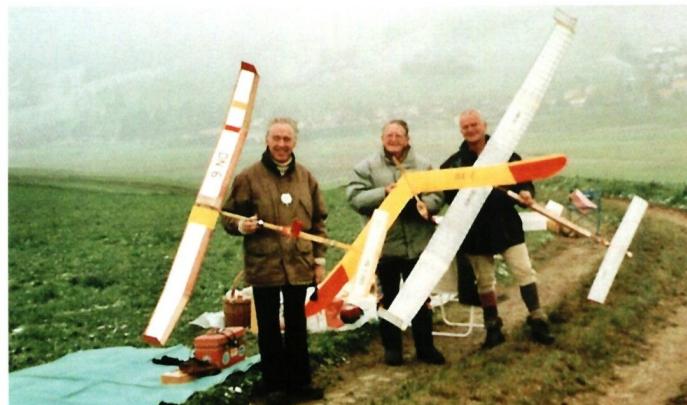
Fog prevented the competition from starting at the scheduled time. As a result, most pilots spent the first hour at the Metzgerhüsli restaurant engaging in technical discussions and enjoying hot coffee. Shortly before noon, the fog lifted high enough that we were able to begin the competition just a few meters above the valley floor.
The flight time of 180 seconds was set a bit too high given the rather poor weather conditions. With a light tailwind and a launch altitude of approximately 30 m, flight times ranged from only 35 to 90 seconds.
Since the fog remained stationary about 50 m above the valley basin and the cool wind mostly blew down the slope, the launch site could not be moved to a higher elevation. These conditions contributed to the fact that the “Ducks” and larger SK models did not have a significant advantage over the smaller flying-wing models. All models were pushed into the valley basin by the tailwind with similar flight times. Model setup and flight tactics ultimately made the small differences.
The Swiss F1E Championship, which had been scheduled for the summer at the Hahnenmoos Pass, had to be canceled due to poor visibility.
For this reason, MG Bern rescheduled the championship for late fall, on November 24, 2001. The event took place in a lower-lying area in Wikartswil near Walkringen.
The second date was also plagued by unfavorable weather; consequently, launches could not take place at the usual free-flight site.
Passing banks of fog affected visibility so severely that it was impossible to track the models all the way down to the valley floor. The fog prompted the pilots to set up the launch site halfway up the slope, about 45 meters above the valley floor, on a small hill.
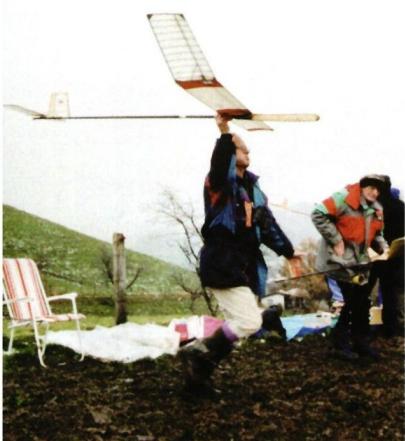
At this altitude, it was difficult to achieve the maximum flight time of 300 seconds specified in the rules. For this reason, the competition director set the flight time for the first flight at 180 seconds. Half of the pilots achieved this flight time. Consequently, in the second and third rounds—under better conditions—the flight time was increased to 240 seconds. With a light crosswind from the west-southwest, those pilots had the
pilots with the right “instinct” who launched their models at the optimal moment to avoid stalling. For the last two rounds, the flight times were increased again to 300 seconds per flight. Pilots with large, lightweight model airplanes thus had a clear advantage.
Heinz Schellauf flew a model with a wingspan of over 3 m and a wing loading of about 8 g/dm². He was the only participant who was still able to achieve the required maximum flight times.
| Rank | First Name/Last Name | Group | D1 Secondary | % | D2 Secondary | % | D3 Secondary | % | D4 Secondary | % | D5 Secondary | % | Total sec. | % |
|---|---|---|---|---|---|---|---|---|---|---|---|---|---|---|
| 1 | Heinz Schellauf | ABB | 180 | 100.00 | 240 | 100.00 | 240 | 100.00 | 300 | 100.00 | 300 | 100.00 | 1,260 | 500.00 |
| 2 | Michael Bleuer | Rüttenen | 180 | 100.00 | 233 | 97.08 | 240 | 100.00 | 259 | 86.33 | 240 | 80.00 | 1,152 | 463.42 |
| 3 | Werner Hauenstein | Dietikon | 180 | 100.00 | 230 | 95.83 | 229 | 95.42 | 223 | 74.33 | 258 | 86.00 | 1,120 | 451.58 |
| 4 | René Pfister | Dübendorf | 180 | 100.00 | 240 | 100.00 | 240 | 100.00 | 238 | 79.33 | 190 | 63.33 | 1,088 | 442.67 |
| 5 | Bruno Kindler | Rüttenen | 180 | 100.00 | 240 | 100.00 | 213 | 88.75 | 240 | 80.00 | 220 | 73.33 | 1,096 | 442.08 |
| Rank | First Name/Last Name | Group | D1 Sec. | % | D2 Sec. | % | D3 Sec. | % | D4 Sec. | % | D5 Sec. | % | Total Sec. | % |
|---|---|---|---|---|---|---|---|---|---|---|---|---|---|---|
| 1 | Karl Meier | Bern | 67 | 95.71 | 51 | 83.61 | 77 | 90.59 | 85 | 98.84 | 94 | 100.00 | 374 | 468.75 |
| 2 | Heinz Schellauf | ABB | 70 | 100.00 | 56 | 91.80 | 85 | 100.00 | 66 | 76.74 | 91 | 96.81 | 368 | 465.36 |
| 3 | Peter Glur | Dintikon | 64 | 91.43 | 61 | 100.00 | 63 | 74.12 | 63 | 73.26 | 60 | 63.83 | 311 | 402.63 |

EURO CONTEST GLIDER ACRO TOUR AUSTRIA 2026

THE PC-21 STORY
 Emil Giezendanner

TWIN TOWN PARTNERSHIP
 Wolfgang Voeller

SUMMER FUN 2026 AT MG USTER
Martin Wunderli
CORSAIR F4U – A WARBIRD WITH A MEMORABLE LOOK
Jürgen Rosenberger, Jürgen Prinz
52. 2026 ALPS CUP
Emil Giezendanner
YOU KNOW WHAT I MEAN? 125 YEARS OF THE SWISS AERO CLUB
Emil Giezendanner
News from HEBU

TEAM MANAGER "THIS" BOSSHARD
Rodito Nussbaumer
ATOM, THE NEW DOUBLE-DECKER FROM CPLR
 Matthias Bosshard

F3A EUROPEAN CHAMPIONSHIPS IN ST-MACAIRE, FRANCE
Matthias Bosshard
INSIGHTS INTO THE HISTORY OF SEAPLANES

WELCOME, NEW MEMBER!
Andrea Bolliger
What's New at Leomotion.com

PRIDE AND GOOD IDEAS
 Markus Nussbaumer

SMALL, MODEL-LIKE SAILBOATS
Res Dauwalder
FREE FLIGHT IN THE MIDDLE OF SUMMER
Urs Muntwyler
BY YOUTH, FOR YOUTH
Lorena Betschen
HORIZON HOBBY/LEMACO NEWS: MICRO OV-10 BRONCO 645 MM BY E-FLITE

34th HAHNENMOOS ALPINE MODEL AIRPLANE CAMP
Res Dauwalder
COUPE DES ALPES – OBSERVE AND LEARN
Rodito Nussbaumer
TRY-OUT DAY AT MFV WETTINGEN
 Urs Keller

NEWS FROM HEBU
 Julia Bucher

NOS REGION – A HUB FOR ELECTRIC AVIATION
Emil Giezendanner
MEMORIES
 Wolfgang Völler

70 YEARS OF THE NIDWALDEN MODEL AIRPLANE CLUB
Martin Barmettler
A SPECTACULAR F3A WORLD CUP IN THE PRINCIPALITY OF LIECHTENSTEIN
Emil Giezendanner
FROM 0 TO 100
Markus Nussbaumer