
Bell 429 Nassau, NY, Original Police Helicopter – Scale Model
Following the limited success of the Bell 427, the U.S. manufacturer focused its efforts on designing a new light twin-engine helicopter that would best meet the growing demand from the air rescue sector. Consequently, priority was given to a spacious cabin, with the ability to load a stretcher through rear doors, a flat floor level with the cargo area, and a significant rotor-to-ground clearance. The first prototype took flight on February 27, 2007, at the Bell facilities in Mirabel, Canada. On June 1, 2009, the helicopter received certification from Transport Canada, followed by FAA certification on July 7 and European EASA certification on September 24, 2009.
The landing gear is of the skid type, but a wheeled option is also available—a retractable front tricycle landing gear—which is expected to increase the helicopter’s maximum speed by 5 knots. The main rotor is a four-blade design, while the tail rotor features a unique configuration with two overlapping two-blade rotors arranged in an “X” pattern to reduce noise. Power is provided by two Pratt & Whitney Canada PW207D1 turbines, equipped with FADEC, which propel the helicopter to a maximum speed (VNE) of 155 knots. The 429 features a glass cockpit with a 3-channel autopilot (a 4-channel autopilot is available as an option) and is certified for single-pilot operation.
The 429 is primarily used in air medical rescue operations, where, thanks to its spacious cabin, it can accommodate up to two stretchers, in addition to two or three medical personnel and the pilot. Optional features include rear doors mounted under the tail boom to facilitate stretcher loading (known as clamshell doors), a rescue winch, and a barycentric hook. The launch customer is Air Methods, a U.S. company specializing in air medical services. The first helicopter (N911ED, c/n 57006) entered service at Mercy Medical Center in Des Moines, Iowa. The Nassau Police Department has also been operating a helicopter rescue service for several years with two helicopters (N604PD and N603PD).
Thanks to its cabin, which can accommodate six or seven passengers, the Bell 429 is particularly well-suited for offshore operations (transporting personnel to oil platforms). This version will be equipped with emergency floats and multi-person inflatable life rafts in the event of an emergency ditching. The launch customer is Chevron.
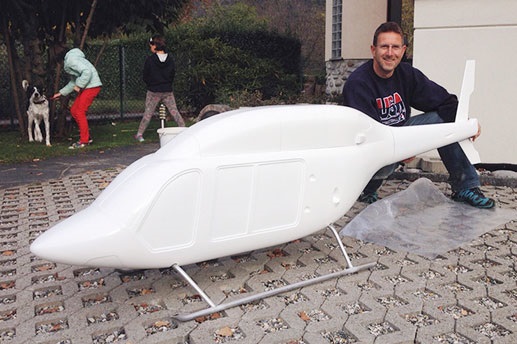
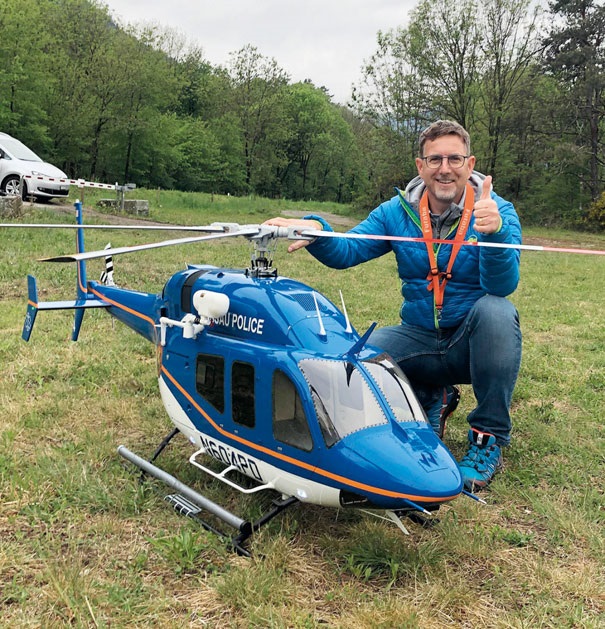
My new project got its start at the 2015 Rotor Live rotary-wing trade show in Germany, where Vario Helicopter was showcasing its new model. This helicopter is already in service in Switzerland with Air Zermatt (HB-ZSU). In fact, my initial idea was to reproduce the model with the Vallesana livery, but over time, that idea evolved into an American Nassau Police Department livery, which immediately caught my eye because of its various details and color scheme—such as the searchlight, the FLIR, and the float system for a potential water landing, given its offshore missions as well.
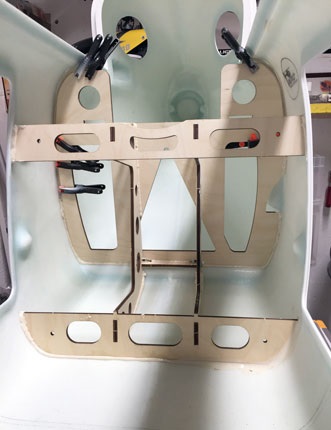
I ordered the assembly kit in the fall of 2015. Construction began immediately with the mechanical components—also from Vario Helicopter in an electric version—though there were a few minor issues due to some parts being supplied in an improperly machined state. Thanks to my mechanical knowledge, everything was resolved, and the mechanical components were ready after a few days to be installed in the model at a later stage. For the Vario Helicopter fuselage—this being my third project—work began by cutting out the windows, doors, and all the various openings, such as inspection hatches, by copying the real aircraft from photographs. Next, I focused on cutting the wooden ribs—supplied in the assembly kit—and assembling them directly into the fuselage. To position the main rotor at the same angle of inclination as the original, I had to modify a few parts. Everything was glued together using a two-component adhesive; it’s very important at this stage to sand the areas where the adhesive will bond the ribs to the fuselage to ensure excellent adhesion.
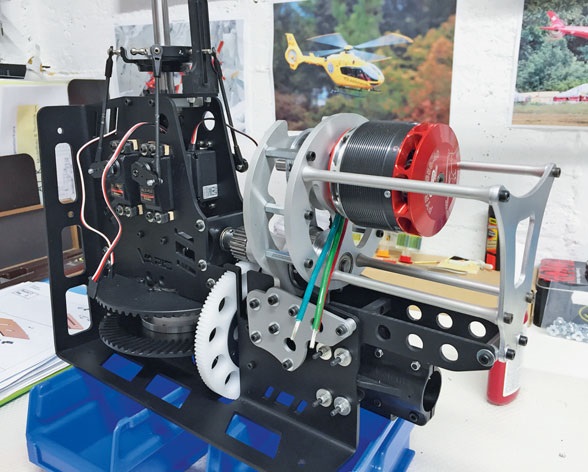
Once the ribs are installed, the fuselage achieves the proper rigidity, allowing all the various construction tasks to be carried out optimally. Another detail that took a few days to work out was finding a way to detach the tail from the model, since Vario does not provide this option. Clearly, for me—and to ensure optimal transport even in my car—the ability to remove the tail was a priority. This issue was resolved by applying reinforcing ribs to both flanges and creating a connection using four M5 screws. The tail is centered relative to the fuselage thanks to the cone on the mold.
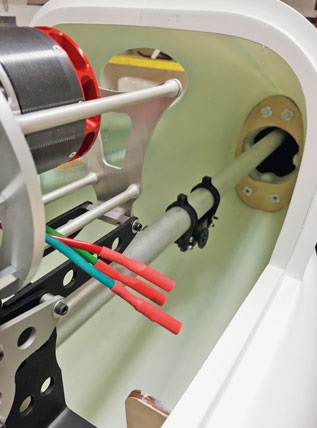
Subsequently, after permanently positioning the main rotor mechanism, work shifted to the rear of the helicopter to position and mount the tail rotor, which on the Bell 429 consists of two two-bladed counter-rotating rotors, known as scissor rotors. This unusual configuration was first implemented by Hughes Helicopters in the late 1960s to reduce noise on the OH-6 helicopter. The OH-6 had a single double-bladed counter-rotating tail rotor, which Hughes wanted to rotate more slowly to reduce noise. To connect the main rotor to the tail rotor, the drive shaft consists of a two-part gimbal: a short, removable section and a fixed section in the tail, along with the corresponding control for the tail servo. On the model, Futaba BSL 452 servos were used for the swashplate and Futaba BSL 451 servos for the tail, while for the power system, namely the motor and ESC, I opted for Kontronik, installing a Kosmik 160 HV Cool ESC and a Pyro 850-40L motor with a power output of 5 kW.
| Original | Model (1:5) | |
|---|---|---|
| Rotor diameter: | 10.98 m | 2.30 m |
| Length: | 11.73 m | 2.28 m |
| Height: | 4.04 m | 0.51 m |
| Width: | 2.67 m | 0.73 m |
| Curb weight: | 2,025 kg | |
| Takeoff weight: | 3,629 kg | 20.5 kg |
| Speed: | 278 km/h | |
| Range: | 761 km | 7 minutes |
made of aluminum by Baumann Helicopter. To ensure they stay closed, small magnets were glued into the doors and their respective door frames.
Now that the purely structural part of the model is complete and the numerous details—such as the footrests, cable cutters, various antennas, radar, kerosene cap, and the winch on the right side with its cables and hooks—have all been positioned, all of which were made using a 3D printer; some designed independently and others in collaboration with Finescale Modela in England—it was time to take the helicopter for its first test flights and make the necessary adjustments. The stabilization system I chose—since I’ve had great results with it on all my models, even if it’s not the latest and greatest—is the RigidV2 from Bavarian Demon, paired with the Futaba Gyro 401 gyroscope for tail control. Of course, the market currently offers more modern solutions (Axon, 3SX), but having gained solid experience with this setup and knowing how to adjust the various parameters, I found it convenient to use this solution on this model as well. As for the batteries, they are positioned toward the front of the lower fuselage to achieve optimal model balance (center of gravity), which is very important for allowing the model to take off and fly stably—resulting in the most realistic flight possible. To ensure a flight time of about 6–7 minutes, two 6-cell LiPo batteries, each with a capacity of 10,000 mA, were installed in parallel, with an in-flight current draw of around 55–60 A. The four-blade main rotor rotates at 980 g/min with single-hole blades, also from Vario. To ensure proper efficiency of the tail rotor, the original 1:1 gear set provided by Vario was replaced with helical gears with a 1:1.2 ratio to increase the tail rotor’s rotational speed.
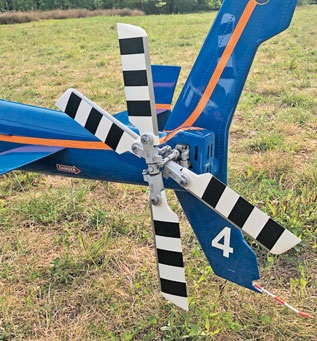
I aimed to faithfully reproduce every single detail, as far as possible, of course.
In early 2019, the painting phase finally began. It was carried out at a body shop over the course of a few weeks, and the various faithfully reproduced decals were applied. Thanks to the numerous photographs found online and received directly from overseas, the replica became a true copy of the real helicopter. The final step in early 2020 was the creation of the cockpit, which involved a visit to the Air Zermatt base to gather all the necessary photographs.
Since spring 2020, the completed Bell 429 model in the colors of the New York Nassau Police has been on display at the Stabio airfield—where I am a member—and at various events both in Switzerland and abroad, pandemic permitting. ■
Text and construction photos: Luca Jardini Flight photos: Mirko Zanni Editor: Wolf Völler


News from HEBU

TEAM MANAGER "THIS" BOSSHARD
 Rodito Nussbaumer

YOU KNOW WHAT I MEAN? 125 YEARS OF THE SWISS AERO CLUB
 Emil Giezendanner

HORIZON HOBBY/LEMACO NEWS: MICRO OV-10 BRONCO 645 MM BY E-FLITE

PRIDE AND GOOD IDEAS
 Markus Nussbaumer

34th HAHNENMOOS ALPINE MODEL AIRPLANE CAMP
Res Dauwalder
TRY-OUT DAY AT MFV WETTINGEN
Urs Keller
F3A EUROPEAN CHAMPIONSHIPS IN ST-MACAIRE, FRANCE
 Matthias Bosshard

52. 2026 ALPS CUP
Emil Giezendanner
ATOM, THE NEW DOUBLE-DECKER FROM CPLR
Matthias Bosshard
CORSAIR F4U – A WARBIRD WITH A MEMORABLE LOOK
Jürgen Rosenberger, Jürgen Prinz
SUMMER FUN 2026 AT MG USTER
Martin Wunderli
What's New at Leomotion.com

THE PC-21 STORY
Emil Giezendanner
COUPE DES ALPES – OBSERVE AND LEARN
Rodito Nussbaumer
TWIN TOWN PARTNERSHIP
Wolfgang Voeller
EURO CONTEST GLIDER ACRO TOUR AUSTRIA 2026

BY YOUTH, FOR YOUTH
Lorena Betschen
SMALL, MODEL-LIKE SAILBOATS
Res Dauwalder
WELCOME, NEW MEMBER!
Andrea Bolliger
FREE FLIGHT IN THE MIDDLE OF SUMMER
Urs Muntwyler
INSIGHTS INTO THE HISTORY OF SEAPLANES

NEWS FROM HEBU
 Julia Bucher

FROM 0 TO 100
Markus Nussbaumer
MEMORIES
Wolfgang Völler
NOS REGION – A HUB FOR ELECTRIC AVIATION
Emil Giezendanner
DO YOU KNOW WHAT I MEAN IN THE LAND OF SMILES?
Emil Giezendanner
A SPECTACULAR F3A WORLD CUP IN THE PRINCIPALITY OF LIECHTENSTEIN
Emil Giezendanner