
Gyroscope Skookum Robotics – SK360
During a symposium, I was finally able to see helicopters equipped with the latest generation of gyroscopes, which allow the aircraft to be stabilized along the longitudinal and lateral axes. This type of stabilizer was already the subject of much discussion on forums, but it was hard to gauge its true effectiveness when everyone had their own opinion.
So one pilot installed such a gyro on a 5-blade Hugues 500 with a gasoline engine. Flight paths as smooth as if on rails and perfect turns without nose-diving undeniably proved the formidable effectiveness of this type of stabilizer. All the undesirable effects of a multipole gyro were eliminated during flight, thanks to this little magic box.
Convinced after a few tips from the pilot, I launched a quick online search to gather information on all the gyro models available on the market.
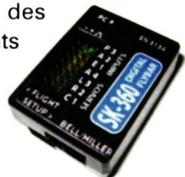
In the end, I chose the Skookum Robotics 360 gyro (www.skookumrobotics.com) for practical reasons: it came with an instruction manual in French, a significant detail for fully understanding how it works and, above all, all the configuration settings.
The SK360 comes with a clear manual, a USB cable for direct programming via computer, and multilingual programming software. A nice bonus is that when you install the software, sample programming files are already ready to use with pre-set operational values.
- the type of swashplate (2-, 3-, or 4-point; i.e., H1, H3, H4)
- the servo travel (for their stops)
- Check the direction of servo movement, similar to the adjustment required for a conventional swashplate in the software and on the
remote control - Set the gyro’s correction direction: the swashplate must correct in the correct direction when the model veers off in a certain direction.
The examples are organized by flight style rather than by helicopter type: standard flight, basic 3D, and scale. Based on these preset values, you can, of course, fine-tune your settings to achieve the desired response characteristics:
- control rate
- Bell gain
- Hiller gain
- Other, more granular values can also be adjusted if necessary.
(For details, refer to the user manual.)
Before the first flight, it is essential to remember to reprogram the swashplate style on the remote control to H1 mode. The transmitter’s commands must be set as if for a 90° swashplate with 3 servos, regardless of the helicopter’s actual configuration. The onboard electronics handle the correct conversion based on these input commands. The cyclic plate servo travel on the remote control must be set to 100%, since it is now also managed by the new onboard electronics.
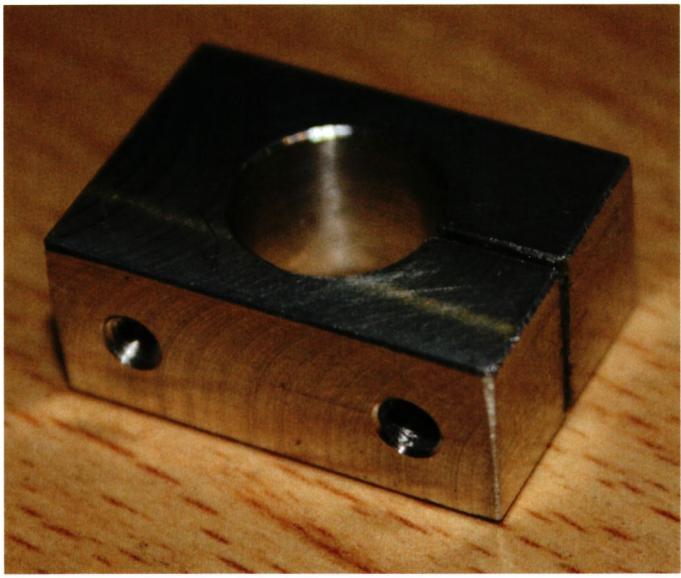
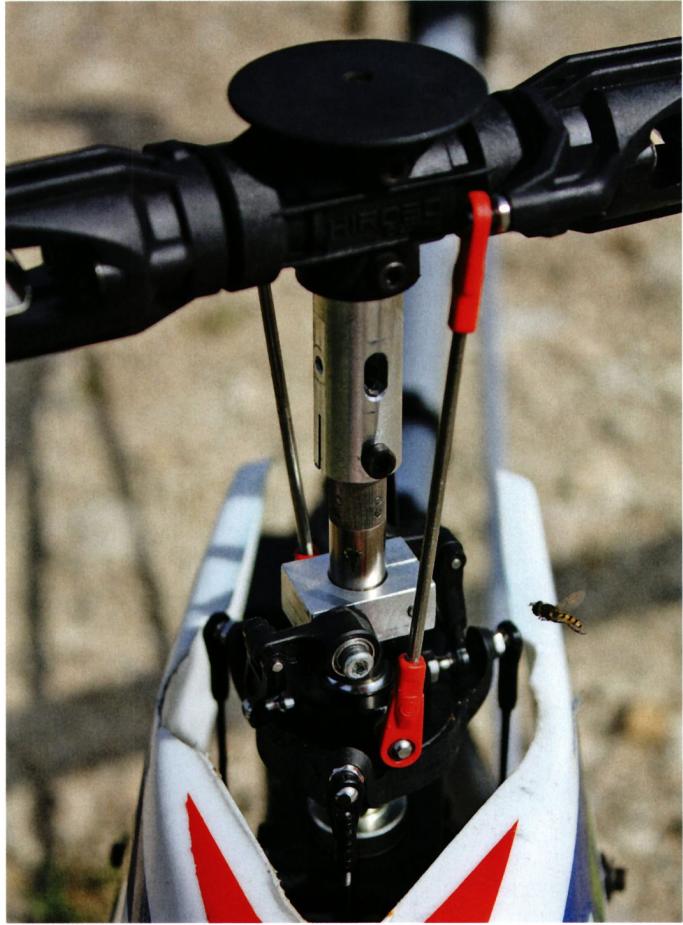
The temptation to convert my Sceaudu to flybarless (removing the Bell bar) before taking my Hughes 500 out of service was just too great. After removing the Bell bar, the washout, and the linkages, I fabricated a small aluminum part to drive the upper swashplate (see the illustrative photo) using the main shaft. Then, all that remained was to connect the two swashplate controls to the struts. My Sceadu 50 was finally ready for its first outdoor test flights.
During the first flight, some oscillations occurred while hovering; I corrected them using the Hiller gain. On the second attempt, the oscillations reappeared during translation. Another small adjustment was needed to eliminate this effect. Once the basic flight was stable, I
performing acrobatic maneuvers. At that moment, I noticed that, given the engine’s increased power, the radio mix between throttle and cyclic had become virtually unnecessary. I readjusted the servo travel on the SK360 to achieve response rates consistent with my flying style. Finally, when exiting a very tight maneuver, tracking began to occur. Despite numerous tests with all the gyro settings, it was not possible to eliminate this dangerous effect. To minimize any possible play in the cyclic servos at the tail boom, I converted my Sceadu from an H1 to an H3 configuration (120° swashplate) to keep the swashplate and its three servos aligned at all times. What a treat to be able to modify this model so easily. Victory! The tracking is gone for good. My Sceadu has gained in agility and responsiveness, with more engine power to spare and lower methanol consumption. It’s a real joy to fly my plane in the open sky in this configuration—with astonishing grace and without the Bell bar. Aerobatic maneuvers go off without a hitch. This SK360 offers the most enjoyable flying experience.
Pierre-André Grossenbacher/
AMJD

EURO CONTEST GLIDER ACRO TOUR AUSTRIA 2026

THE PC-21 STORY
 Emil Giezendanner

TWIN TOWN PARTNERSHIP
 Wolfgang Voeller

SUMMER FUN 2026 AT MG USTER
Martin Wunderli
CORSAIR F4U – A WARBIRD WITH A MEMORABLE LOOK
Jürgen Rosenberger, Jürgen Prinz
52. 2026 ALPS CUP
Emil Giezendanner
YOU KNOW WHAT I MEAN? 125 YEARS OF THE SWISS AERO CLUB
Emil Giezendanner
News from HEBU

TEAM MANAGER "THIS" BOSSHARD
Rodito Nussbaumer
ATOM, THE NEW DOUBLE-DECKER FROM CPLR
 Matthias Bosshard

F3A EUROPEAN CHAMPIONSHIPS IN ST-MACAIRE, FRANCE
Matthias Bosshard
INSIGHTS INTO THE HISTORY OF SEAPLANES

WELCOME, NEW MEMBER!
Andrea Bolliger
What's New at Leomotion.com

PRIDE AND GOOD IDEAS
 Markus Nussbaumer

SMALL, MODEL-LIKE SAILBOATS
Res Dauwalder
FREE FLIGHT IN THE MIDDLE OF SUMMER
Urs Muntwyler
BY YOUTH, FOR YOUTH
Lorena Betschen
HORIZON HOBBY/LEMACO NEWS: MICRO OV-10 BRONCO 645 MM BY E-FLITE

34th HAHNENMOOS ALPINE MODEL AIRPLANE CAMP
Res Dauwalder
COUPE DES ALPES – OBSERVE AND LEARN
Rodito Nussbaumer
TRY-OUT DAY AT MFV WETTINGEN
 Urs Keller

NEWS FROM HEBU
 Julia Bucher

NOS REGION – A HUB FOR ELECTRIC AVIATION
Emil Giezendanner
MEMORIES
 Wolfgang Völler

70 YEARS OF THE NIDWALDEN MODEL AIRPLANE CLUB
Martin Barmettler
A SPECTACULAR F3A WORLD CUP IN THE PRINCIPALITY OF LIECHTENSTEIN
Emil Giezendanner
FROM 0 TO 100
Markus Nussbaumer