
Information Sessions at the GAL Office in Manno
Last year, with the aim of offering a different kind of gathering than the usual Wednesday-evening social get-together at the club, the GAL organized a series of informational evenings during which some members presented specific topics. These events, which were fairly well-attended (about 15 participants per evening) and varied in content, provided an opportunity for those interested to share their experiences and to learn about or deepen their understanding of certain techniques. During the first evening, a series of slides and several practical demonstrations were presented on the topic of “balsa-expanded polystyrene construction,” ranging from traditional wings and fuselages made of individual components (F3A aerobatic multi-control) to wings with an integrated carbon-fiber spar (5.5-meter replica glider). Subsequently, in his role as regional F3A judge, Jaroslav Vala reviewed the regional aerobatic program using a series of slides, discussing it in great detail. It was an interesting opportunity to compare the judges’ evaluations with the pilots’ impressions. On the third and final evening, Guido Bianchi presented the fascinating topic of batteries, covering everything from basic principles and rules to techniques for increasing their efficiency—techniques familiar to the F3E and F5B (electric flight) categories.
Given the positive experience in 2001, as well as the interest shown by several modelers who frequently visit our headquarters, four dates have been scheduled for 2002 for informational evenings open to all modelers (see the regional calendar). Two of these events have already taken place, with approximately 25 participants per evening.
March 2, 2002
Construction of a Model Aircraft Made Entirely of Fiber (3-meter F3B Glider)
Numa Induni and Fabrizio Pedrinis presented a project they had completed several years ago. Using a series of slides and a display of various materials, they illustrated the individual steps involved in constructing the “positives” for the wings and fuselage, before moving on to the construction of the corresponding molds from which the fiberglass/carbon fiber parts that make up the model aircraft are formed.
These techniques, particularly common in the F3B category (land-based gliders, multiple trials), allow for the creation of model airplanes capable of withstanding high stresses and delivering excellent flight performance.
May 2, 2002
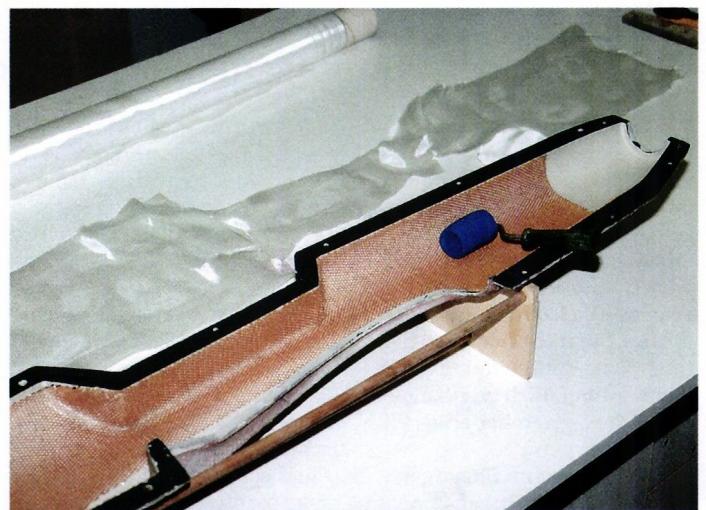
Use of composite materials (fiberglass), construction of a fiberglass fuselage, painting
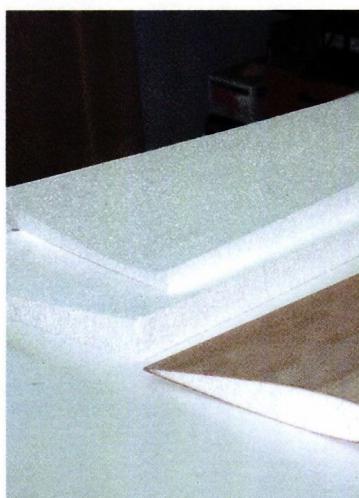
During this evening session, the procedures for creating expanded polystyrene (“Sagex”) parts covered with balsa wood were first presented. Once the polystyrene core has been cut, the covering is bonded using a vacuum bag—an alternative to a conventional press.
The bag ensures that a uniform force is applied across the entire surface, pressing the balsa veneer against the polystyrene core.
The second topic covered some simple applications as an introduction to composite materials, using ABS parts (original parts) as molds to build the equivalent part in fiberglass or carbon fiber (fairings, canopies). This is followed by a presentation on the construction of a fuselage (fiberglass/honeycomb/fiberglass sandwich construction) using the corresponding molds (2-meter F3A multi-control, 15 cm³).
The same process is used to fabricate the internal components, such as the flame shield, servo plate, wing mount, etc. (carbon fiber/honeycomb/carbon fiber panels). This technique provides remarkable structural rigidity and strength at weights lower than those of conventional constructions (balsa, balsa/expanded polystyrene, fiberglass). In this example, a 355-gram fuselage was produced.
The evening concludes with a discussion of painting and surface preparation procedures (balsa fuselage). In the example, a 44 g/m² fiberglass covering, an epoxy primer, and a polyurethane paint were used, resulting in a total weight increase of 180 g (2-meter F3A multi-control fuselage, 23 cm³).
The evening featured a series of slides and an exhibition of materials.
Two additional events are scheduled for October 2 and December 4. One of the planned topics is electric flight. The GAL is, of course, happy to welcome anyone interested in presenting a topic related to model aircraft in the future. For more information, please visit the Group’s website at http://www.gal.ch or contact the secretary, Fabrizio Albonico, at info@gal.ch or 076 540 87 87.
Gianmaria Tagliabue
(text and photos)

EURO CONTEST GLIDER ACRO TOUR AUSTRIA 2026

THE PC-21 STORY
 Emil Giezendanner

TWIN TOWN PARTNERSHIP
 Wolfgang Voeller

SUMMER FUN 2026 AT MG USTER
Martin Wunderli
CORSAIR F4U – A WARBIRD WITH A MEMORABLE LOOK
Jürgen Rosenberger, Jürgen Prinz
52. 2026 ALPS CUP
Emil Giezendanner
YOU KNOW WHAT I MEAN? 125 YEARS OF THE SWISS AERO CLUB
Emil Giezendanner
News from HEBU

TEAM MANAGER "THIS" BOSSHARD
Rodito Nussbaumer
ATOM, THE NEW DOUBLE-DECKER FROM CPLR
 Matthias Bosshard

F3A EUROPEAN CHAMPIONSHIPS IN ST-MACAIRE, FRANCE
Matthias Bosshard
INSIGHTS INTO THE HISTORY OF SEAPLANES

WELCOME, NEW MEMBER!
Andrea Bolliger
What's New at Leomotion.com

PRIDE AND GOOD IDEAS
 Markus Nussbaumer

SMALL, MODEL-LIKE SAILBOATS
Res Dauwalder
FREE FLIGHT IN THE MIDDLE OF SUMMER
Urs Muntwyler
BY YOUTH, FOR YOUTH
Lorena Betschen
34th HAHNENMOOS ALPINE MODEL AIRPLANE CAMP
Res Dauwalder
HORIZON HOBBY/LEMACO NEWS: MICRO OV-10 BRONCO 645 MM BY E-FLITE

COUPE DES ALPES – OBSERVE AND LEARN
Rodito Nussbaumer
TRY-OUT DAY AT MFV WETTINGEN
 Urs Keller

NEWS FROM HEBU
 Julia Bucher

NOS REGION – A HUB FOR ELECTRIC AVIATION
Emil Giezendanner
MEMORIES
 Wolfgang Völler

70 YEARS OF THE NIDWALDEN MODEL AIRPLANE CLUB
Martin Barmettler
A SPECTACULAR F3A WORLD CUP IN THE PRINCIPALITY OF LIECHTENSTEIN
Emil Giezendanner
FROM 0 TO 100
Markus Nussbaumer