
I am a legend: Kwik Fly MK3
Could these few words in the language of Shakespeare sum up the reputation of Phil Kraft’s Kwik Fly? I have memories from my childhood of my dad talking about two aircraft that were extraordinary in terms of their flight characteristics: the TAXI and the Kwik Fly.
Let's take a trip down memory lane. This plane was the world champion in 1967. That was a time when the performance of motors and radio controls was quite mediocre compared to today's technology. Yet it was a time not so long ago when pioneers like the Matts, Giezendanner, Kraft, and others competed neck and neck with their own designs. An era when flying a radio-controlled airplane was an event that sparked widespread interest and admiration. The Kwik Fly MK3 was marketed by Graupner in the 1970s and enjoyed considerable success.
There are several options available to those interested. You can find the original plans online, locate original kits on auction sites, or order short kits or CNC/laser-cut kits from individual craftspeople. Regarding this last option, I’ve explored three possibilities:
The Belgian short kit from CARAMBA MODEL contains all the necessary pre-cut parts, a thermoformed canopy, and an updated CAD plan (thermal version only), which provides an excellent understanding of the various assembly stages. Their website lists the planks and strips needed to complete the structure.
SG Model (Stefan Graupner) offers a complete model kit (featuring the original model’s canopy) in both thermal and electric versions, along with a wide range of accessories.
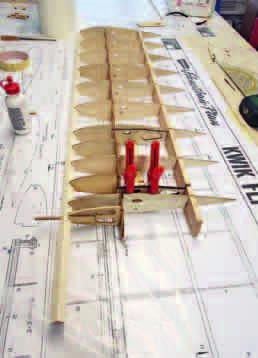
Aumann-RC offers a complete kit in either a gasoline or electric version, the details of which are listed below.
The unassuming kit box (electric version) is remarkably well-stocked. Inside, you’ll find the necessary balsa wood sheets and strips, a well-protected thermoformed canopy, carefully packaged laser-cut parts, the folded main landing gear, the two-legged nose landing gear, the aileron linkages, the two-sheet plan, and the assembly instructions. The only items needed to complete the build are the electronic components, the fabric covering, the control cables for the tail, the hinges, the propeller, the spinner, a latch for the access hatch, a vintage pilot figure, and three wheels.
Although the classic geometry of this aircraft seems simple, the assembly proves tricky due to the multitude of parts and gluing steps. The difficulty increases when one discovers that the vintage instructions and plans do not correspond to the design of Mr. Aumann’s electric version. Three resources prove invaluable: one’s own building experience, online forums, and the ability to call Mr. Aumann (who is kind enough to provide his phone number and availability schedule on a separate sheet attached to the instructions). As with the original, two types of wing attachment are offered: screws or rubber bands. On the model featured in the article, with the goal of optimizing weight, the tail surfaces are hollowed out (which ultimately proves unnecessary), the wing joints are reinforced with 60 g fiber, and a ventilation channel is created through the openwork propeller cone (with an outlet under the motor mount and one behind the wing attachment under the fuselage). As for the electronics, HS225 MG servos actuate the various control surfaces (the servo mounts are machined from the factory to accommodate components of this size), a Hacker A40-10L motor paired with a 75 A ESC powers the 2.5 kg aircraft (with a stated weight of 3 kg and a 4S 2600 LIPO battery, which provides a flight time of approximately 5 minutes).
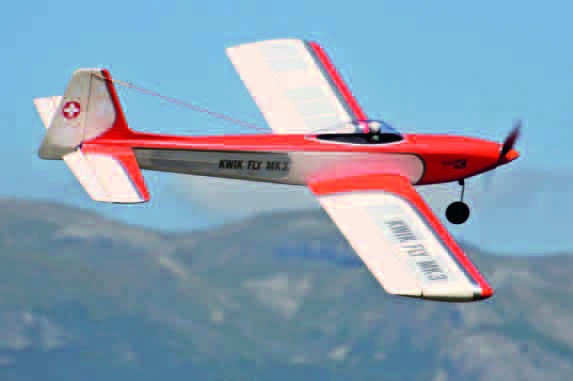
The first test flights took place on the beautifully maintained and unobstructed runway at GAM Geneva (Laconnex-Athénaz), in calm conditions. From the very first few meters in the air, one thing comes to mind: To all those who claim that the Kwik Fly was a machine with impressive flight characteristics, let me tell you just how right you are. The first impressions are stability, responsiveness, and precision. The A-40-10L provides sufficient power without being excessive. The best performance was achieved with an APC Electro propeller.
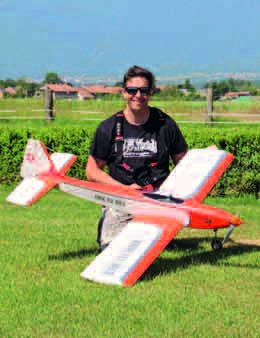
14x10. In this configuration, the Kwik Fly performs aerobatics with the legendary elegance of its era. The rolls and loops are very clean. The side slip holds, but would benefit from a little more power to sustain it over a long distance. The 2-, 4-, and 8-facet rolls are executed perfectly. The triggered roll resembles a barrel roll more than a snap roll (is this due to weight or power? That question will remain open for future flights), but surprisingly, the spin initiates easily and stops after a quarter turn. The stall results in a gentle dip with slight wing oscillation. In fact, tight turns at low speeds pose no problems at all. In inverted flight, the Kwik Fly remains precise and enjoyable. With all these qualities, it goes without saying that landing is just a formality.
In conclusion, despite its simple design and excellent flight characteristics, I believe this wonderful model is best suited for experienced modelers whose nostalgia fuels their passion for vintage aircraft. I’d like to thank GAM Geneva for making its runway available, the Technic-Hobby Geneva store for supplying the high-quality parts needed for the build (electronics and fabric covering), and everyone who supported me in this project... with a special shout-out to my father, who taught me everything I know about this hobby (who passed away in August 1998), and my mother, whose moral support has been unwavering for 50 years (who passed away in January 2022). This plane was built as a tribute to them. Happy flying to all. ■
*François Ballis, photos by the Ballis family and Marc Humbert*


News from HEBU

TEAM MANAGER "THIS" BOSSHARD
 Rodito Nussbaumer

YOU KNOW WHAT I MEAN? 125 YEARS OF THE SWISS AERO CLUB
 Emil Giezendanner

F3A EUROPEAN CHAMPIONSHIPS IN ST-MACAIRE, FRANCE
 Matthias Bosshard

HORIZON HOBBY/LEMACO NEWS: MICRO OV-10 BRONCO 645 MM BY E-FLITE

PRIDE AND GOOD IDEAS
 Markus Nussbaumer

34th HAHNENMOOS ALPINE MODEL AIRPLANE CAMP
Res Dauwalder
TRY-OUT DAY AT MFV WETTINGEN
Urs Keller
52. 2026 ALPS CUP
Emil Giezendanner
EURO CONTEST GLIDER ACRO TOUR AUSTRIA 2026

ATOM, THE NEW DOUBLE-DECKER FROM CPLR
Matthias Bosshard
CORSAIR F4U – A WARBIRD WITH A MEMORABLE LOOK
Jürgen Rosenberger, Jürgen Prinz
SUMMER FUN 2026 AT MG USTER
Martin Wunderli
What's New at Leomotion.com

THE PC-21 STORY
Emil Giezendanner
COUPE DES ALPES – OBSERVE AND LEARN
Rodito Nussbaumer
TWIN TOWN PARTNERSHIP
Wolfgang Voeller
BY YOUTH, FOR YOUTH
Lorena Betschen
SMALL, MODEL-LIKE SAILBOATS
Res Dauwalder
WELCOME, NEW MEMBER!
Andrea Bolliger
FREE FLIGHT IN THE MIDDLE OF SUMMER
Urs Muntwyler
INSIGHTS INTO THE HISTORY OF SEAPLANES

NEWS FROM HEBU
 Julia Bucher

FROM 0 TO 100
Markus Nussbaumer
MEMORIES
Wolfgang Völler
NOS REGION – A HUB FOR ELECTRIC AVIATION
Emil Giezendanner
DO YOU KNOW WHAT I MEAN IN THE LAND OF SMILES?
Emil Giezendanner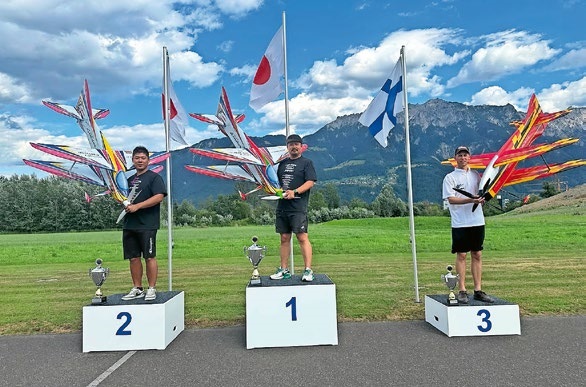
A SPECTACULAR F3A WORLD CUP IN THE PRINCIPALITY OF LIECHTENSTEIN
Emil Giezendanner