
World and European Tethered Flight Champions in Breitenbach
The Jura Cup is arguably the most traditional international tethered flight competition in Europe. For 50 years, it has been organized by the Breitenbach Model Aircraft Club at the Schwalbennest tethered flight site near Büsserach, Solothurn—alternating annually between the Acrobatics and Speed/Team Racing categories. On the weekend of June 22–23, 2024, it was once again time for the Speed/Team Racing categories. A true spectacle was in store, as some of the fastest pilots in Europe and the world were on the starting line.
Thirty-five competitors from Italy, France, Hungary, the Czech Republic, Switzerland, Ukraine, and the Netherlands had traveled to compete in the tethered flight racing categories Speed F2A, Speed F2G, and Team Racing F2C.
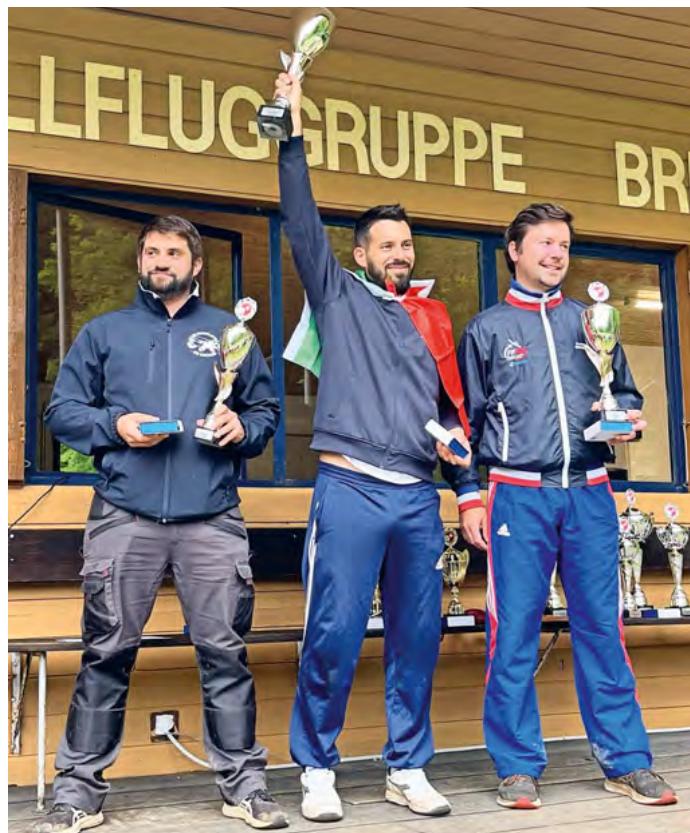
The big question among the speed specialists was: Which power systems allow you to fly faster? Until recently, models with electric power systems were the fastest, but a recently introduced rule change has reduced their speeds. After the three heats, it was clear—internal combustion engines currently have the upper hand again. Luca Grossi from Italy flew to victory in the F2A category with a speed of 297.7 km/h. In F2G, Daniel Rota from Switzerland won with a speed of 287.7 km/h.
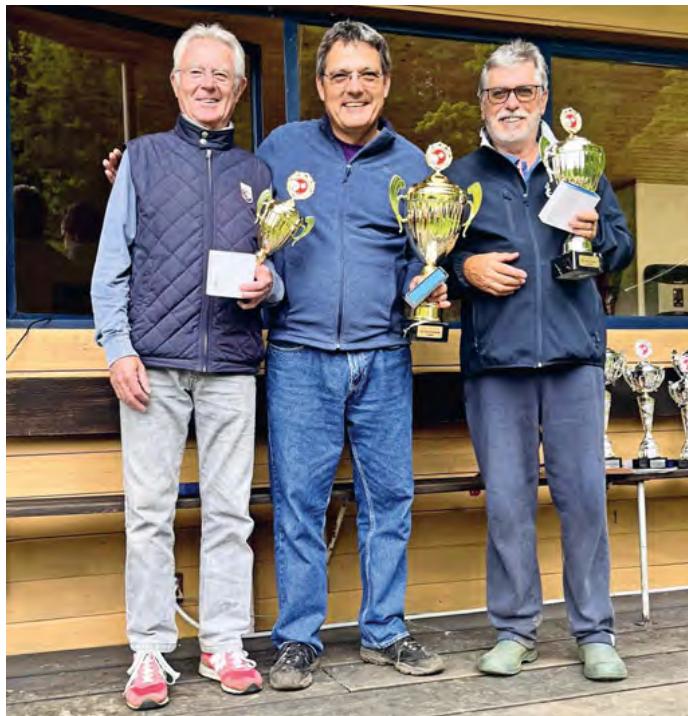
The F2G competition also counted toward the Swiss Championship. Daniel Rota took the title ahead of Guy Ducas and Toni Borer—all three members of MG Breitenbach.
The heavy rain on Saturday didn’t make life easy for the team racers or the jury. Hardly any race went off without an incident, and the jury had to repeatedly consult the video recordings to decide on disqualifications or re-flights.
Sunday brought the long-awaited improvement in weather, allowing the missed races from Saturday to be made up and the races scheduled for Sunday to proceed as planned. The schedule was therefore packed, putting the organizers to the test, and spectators were able to enjoy top-level tethered flight nonstop.
The Team Racing Final, consisting of 200 laps, is the highlight of every tethered flight race weekend. The three fastest teams from the preliminary rounds and the semifinals qualify for this event.
Team racing is even more exciting for spectators. Here, three pilots fly their models simultaneously in the same circle on 15.9-meter-long lines, completing over 100 laps—and in the final, even over 200 laps. The models reach speeds of around 200 km/h. And as if that weren’t enough, during the race the pilots must land their models several times, have them refueled by their mechanics, and take off again—just like in a Formula 1 race. At these speeds and with such frantic action, all kinds of incidents can happen. That’s why a jury closely monitors the race.
In a team racing competition, each team flies three preliminary heats. The fastest teams from those heats then compete in two semifinals, and the three fastest teams from the semifinals ultimately qualify for the final.
At the Jura Cup, these were:
- Makarenko/Osadchyi, the reigning world and European champions from Ukraine
- Bondarenko/Lerner, the multiple former world champions, also from Ukraine, and
- Grossi/Rossi—a very experienced and successful team from Italy.
On Sunday at 5:00 p.m., the spectacle began. It was a fantastic final with quick refueling stops—until the 82nd lap. Unfortunately, Igor Osadchyi missed his model during the landing, leaving only two teams to finish the final. The winners were ultimately Grossi/Rossi from Italy.
With victories in the Speed and Team Racing events, Luca Grossi was thus the big winner of the race weekend at Schwalbennest. He was celebrated frenetically by the Italian delegation.
The 2024 Jura Cup is now history. It was an exciting, turbulent weekend that required a great deal of flexibility from everyone involved, but ultimately led to a happy ending all around and an unforgettable experience. ■
Rankings available at: www.fesselflug.ch
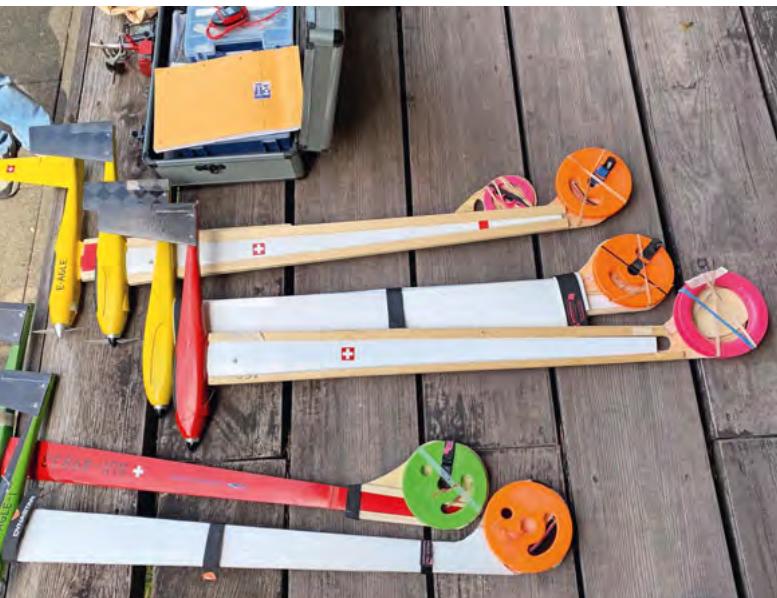
"Speed" is all about flying 1,000 meters as fast as possible using a high-tech speed model. The model flies in a circle and is controlled by a pilot who stands in the center of the circle and holds onto the “flying projectile” with two wafer-thin lines, each 17.6 m long. Speed models reach speeds of up to 300 km/h. It goes without saying that this places extreme demands on the pilot—since he spins in a circle along with the model. Tethered speed flying comprises two categories: In the traditional F2A category, models are flown with 2.5-cc glow plug engines. In the relatively new F2G category, the models are powered by a limited-capacity electric motor and a battery.
In a speed competition, pilots complete three runs. The highest speed recorded during these runs determines the final ranking.


News from HEBU

HORIZON HOBBY/LEMACO NEWS: MICRO OV-10 BRONCO 645 MM BY E-FLITE

PRIDE AND GOOD IDEAS
 Markus Nussbaumer

TEAM MANAGER "THIS" BOSSHARD
 Rodito Nussbaumer

YOU KNOW WHAT I MEAN? 125 YEARS OF THE SWISS AERO CLUB
 Emil Giezendanner

F3A EUROPEAN CHAMPIONSHIPS IN ST-MACAIRE, FRANCE
 Matthias Bosshard

ATOM, THE NEW DOUBLE-DECKER FROM CPLR
Matthias Bosshard
SUMMER FUN 2026 AT MG USTER
Martin Wunderli
What's New at Leomotion.com

52. 2026 ALPS CUP
Emil Giezendanner
TWIN TOWN PARTNERSHIP
Wolfgang Voeller
34th HAHNENMOOS ALPINE MODEL AIRPLANE CAMP
Res Dauwalder
CORSAIR F4U – A WARBIRD WITH A MEMORABLE LOOK
Jürgen Rosenberger, Jürgen Prinz
SMALL, MODEL-LIKE SAILBOATS
Res Dauwalder
TRY-OUT DAY AT MFV WETTINGEN
Urs Keller
WELCOME, NEW MEMBER!
Andrea Bolliger
FREE FLIGHT IN THE MIDDLE OF SUMMER
Urs Muntwyler
COUPE DES ALPES – OBSERVE AND LEARN
Rodito Nussbaumer
EURO CONTEST GLIDER ACRO TOUR AUSTRIA 2026

BY YOUTH, FOR YOUTH
Lorena Betschen
INSIGHTS INTO THE HISTORY OF SEAPLANES

THE PC-21 STORY
Emil Giezendanner
NEWS FROM HEBU
 Julia Bucher

FROM 0 TO 100
Markus Nussbaumer
MEMORIES
Wolfgang Völler
NOS REGION – A HUB FOR ELECTRIC AVIATION
Emil Giezendanner
DO YOU KNOW WHAT I MEAN IN THE LAND OF SMILES?
Emil Giezendanner
Have you almost forgotten about aircraft that take off and land vertically?
Emil Giezendanner