
20 Years of the LRK Engine
At the turn of the year 2000–2001, a new model motor made its debut. It made electric model motors even more powerful, while also making them more affordable and thus more popular. Its three creators gave it the short and snappy name LRK—after their initials. To date, it has been replicated hundreds of thousands (or millions) of times and installed in all kinds of model categories. A true success story! And it all began with a DIY guide.
“New ideas are first ridiculed, then fought against, until, after some time, they are taken for granted.”
This quote, coined by Arthur Schopenhauer, has lost none of its validity to this day. Christian Lucas—who contributed the first letter of the name—at least came to realize this as he went from one model-making company to the next, of which there were still quite a few in Germany at the time. He wanted to introduce them to a new motor design that he had become familiar with during his previous career in the field of large electrical machinery, and which he—as a model racing boat enthusiast—was convinced would prove itself in the world of model aircraft. They listened to his pitch, thanked him politely, but showed no further interest. The same thing happened when he approached the small manufacturers of Mo-
Dellmotoren was also there. They, too, had a strong presence. And their products weren’t even outdated, because after all, there were already bust-less motors that had come over from the U.S. as NASA derivatives and had been modified and further developed here to fit the model. The original was called Aveox; Robbe renamed it Rovox. This motor carried its controller piggyback, a design that ultimately failed to catch on. Very early on, the Bavarian company Lehner (LMT) had already developed a highly efficient brushless motor system, which later found its way into Hacker’s lineup as well. Kontronik pursued a very similar concept, though, of course, in addition to the motor, they always offered a properly matched controller—which was already sensorless at the time. Even the Plettenberg motor, which was very popular among competitors, had already “done away with” the troublesome carbon brushes. The corresponding controllers came from Matthias Schulze. All of these motors were already smaller, lighter, and more efficient than their brush-commutated predecessors, but they still had the remaining drawback of their power—
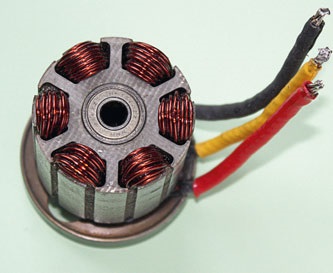
Design sketch for the LRK motor built directly into the spinner.
Already feeling a bit frustrated, Christian finally turned to me—since I had already published several technical articles on brushless motors—with the request that I perhaps write something about it. What he proposed sounded interesting, at least. From an electric-flyer’s perspective, I drew up a set of specifications, sketched a construction plan, and we agreed to test the whole thing together on two DIY prototypes first. To that end, we brought Emil Kühfuss on board—a pro when it comes to metalworking who had often provided solutions to tricky problems in the past. The last letter in the acronym stands for him.
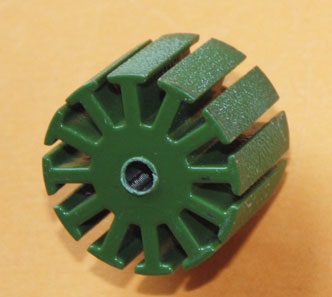
In the new motor, instead of the motor shaft, the entire housing rotated—an outrunner, in other words. Its static core consisted of a 12-part laminated core, as is
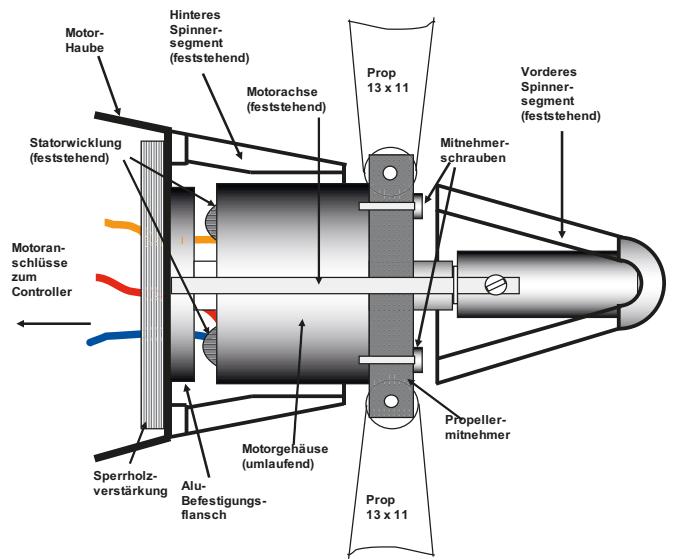
which was the rotor found in many of the electric motors used up to that point. We had salvaged a Bühler motor for this purpose, the kind that was used in cordless power tools back then.
The best part was that now only every other tooth had to be wound, which immediately prompted me to volunteer for the task. I didn’t regret it immediately, but I did end up with deep gouges in my fingers. Every beginning is hard. Nevertheless, I somehow managed to distribute the enameled copper wire more or less evenly across the six winding slots. Emil had turned the circumferential terminal ring and the bearing shells, and the Köhler brothers—who were already experimenting with external-rotor motors (Newtor)—contributed 14 neodymium magnet strips as well as a matching controller. To make a long story short: The LRK motor—which I had since named after the first letter of my own name as a symbolic link—proved right from the first test bench runs that I hadn’t been overpromised. It delivered “huge torque” with good efficiency, which is why we called it “Torquemax LRK” and compared it to the “TDi” among car engines—a designation that was still considered quite honorable back then. A model named
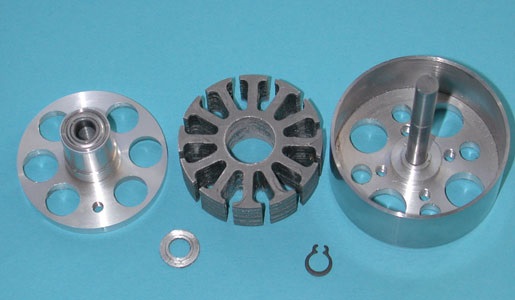
“Tristar” (distributed by Höllein) had the honor of becoming the first test model. It flew spectacularly. Further tests confirmed this impression. We quickly dismissed the idea of applying for utility model protection and going into production ourselves, and I decided to pick up my pen—or rather, my keyboard—and release the “source code.” When the “Build Your Own Brushless Motor” project was announced (huh?), even over the phone it was clear how the brow of the editor in charge—who was otherwise very open to innovation—furrowed deeply. But things turned out differently.
In the weeks that followed, my mail carrier had his hands full, because by no means all of the DIY questions had been answered in the eight pages that *Elektromodell* had—somewhat generously—allotted to me for that purpose. Nevertheless, a veritable DIY motor-building craze seemed to be breaking out. Of course, at first there was a shortage of sources for the construction materials. Together with Klaus “Battmann” Budion (who has since passed away, unfortunately), a battery dealer who was very resourceful at the time, I organized a service for stator laminations and magnets, forwarded inquiries to manufacturers of turned parts, and came to the conclusion that you by no means had to have paid attention in physics class
to be able to attempt building an electric motor. I vividly recall, for example, an order from a fellow enthusiast who wanted exactly 14 magnets: seven north poles and seven south poles! The joy must have been all the greater when it worked out after all. Another customer sent a photo showing a motor in which the intended dynamo laminations in the armature core had been replaced by M-10 cylindrical iron screws. The builder wrote that the motor ran right away, but got quite hot even when idling...? Once, I received a phone call—this was back when numbers weren’t yet displayed on the screen—during which all I heard through the receiver was a deep breath and a hoarse “It’s running, it’s running.” No, this wasn’t stalking—it was a really nice person who then politely gave his name and simply couldn’t believe that he, too, had managed to get the thing running.
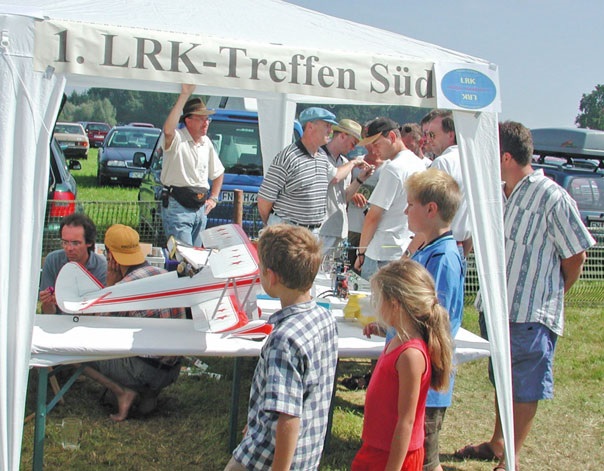
Once the first models were up and running, a DIY community formed, and LRK meetups were organized, often as part of model exhibitions and air shows. Of course, problems were also discussed there—problems that were inevitable given the nascent nature of this new generation of motors. For example, it was initially difficult to find a controller compatible with the LRK—
...because the 3-phase controllers commonly available on the market at the time were designed for 2- to 4-pole, low-inductance squirrel-cage motors and did not yet feature adjustable timing. In addition, the starting behavior could still be described as rather jerky. Conclusion: New controllers are needed.
Around the year 2000—that was also the time when Internet forums were just getting started. From then on, it was through them that news spread like wildfire. Of course, a lot of aggressive nonsense also made the rounds, which, as an author who loved print media, I found took some getting used to, to say the least. After a few months, I decided to step back out of this parallel world and instead write two follow-up articles for *Elektromodell*. Now I also had the opportunity to provide some background information and make the necessary “fine-tuning.” It had become apparent that the motor performed even better if all 12 slots of the stator were actually wound, that it was possible to operate with as few as 10 poles, and that the principle of the multipole rotary motor could be extended to other sheet metal cuts. Soon, old CD and streamer
drives were salvaged, rewound as needed, and often retrofitted with new types of magnets to give park and indoor flyers a new lease on life. Peter Rother, who has sadly since passed away, dedicated a separate website to this field of experimentation <https://www.aerodesign.de/peter/2001/LRK350/index.html> (still accessible at the time this manuscript was written), where, in a “Road Map” for LRK newcomers, he provided further building tips, clarified physical principles, and fostered a better understanding through the new tools of visual animation. Born in Poland, he later discovered that a publication on a comparable topic had already appeared in 1991 as part of a dissertation at the University of Wrocław. On newly created sites such as “Powercroco,” there was a great deal of experimentation, and everything with more than two “teeth” was wound up. Through the publication of an endless array of measurement data resulting from testing numerous winding variations, a vast amount of insightful information reached a growing fan base. At times, one might even have gotten the impression that the construction of aircraft engines had, in some quarters, become an end in itself.
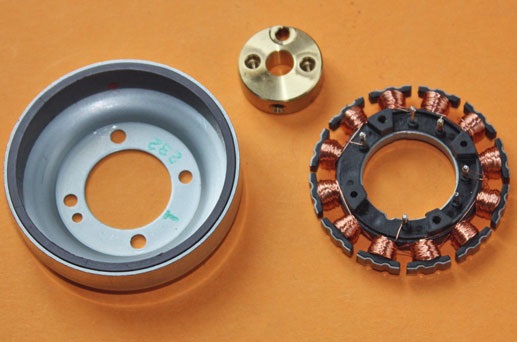
Having already ventured into the external rotor concept, the company gradually increased the number of poles in its motors until it finally arrived at the LRK principle. Rolf Strecker soon began producing handcrafted small batches for customers with special requests. Scorpion, now the undisputed market leader from China, built its entire business model on the LRK principle. In the U.S., however, where I visited the renowned company Neu Motors in San Diego, the outrunner was still considered a “stupid German idea” as late as 2005. Not so in China! At that time, the Middle Kingdom, still operating under a presumption of innocence and aided by a systematically undervalued yuan renminbi, was setting out to mature into the workshop of the Western world. The quasi-monopoly for the production of—
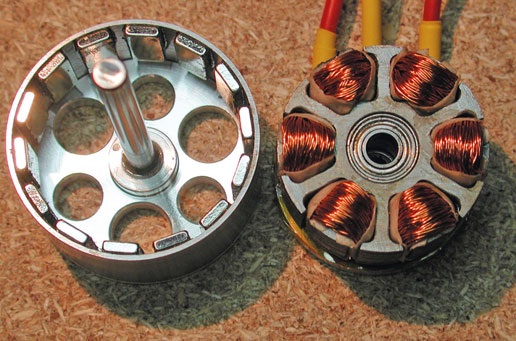
They already had a source for the large number of SE magnets they needed. So it was a logical step that finished motors from the Far East soon began arriving here—at a price that wouldn’t even have covered the cost of the individual parts here. Now even the (at that time still) major German model-making companies had no choice but to follow suit. Hacker, Graupner, Jamara, Multiplex, Robbe, and several major retailers added the outrunner to their product lines, each in their own preferred anodized color and with a custom spoke design. The manufacturer in Shenzhen, southern China, fulfilled every design request, provided the order quantity was reasonably high. The latter was given another major boost years later when multicopters became all the rage; after all,
You needed at least four of them per unit. Specialized companies such as Kontro-nik, Lehner, Plettenberg, and others soon followed suit, with some of them proving that even good products are worth further improvement. The boom in aerobatic helicopters in the early 2010s had to do not only with the V-stabilizer but also with high-performance yet affordable outrunner motors, because, actually, and this needs to be said, there’s really nothing complicated about an LRK motor at all.
By a conservative estimate, the descendants of the LRK engines have captured a market share of 80 to 90 percent in the model aircraft engine market to date. They weigh just a few grams in the polystyrene noses of indoor models and several kilograms under the cowlings of aerobatic aircraft, where they drive propellers with diameters of up to nearly 30" directly with brute force. Multicopters—from amateur photography drones to man-carrying taxis—owe their lift to whole hordes of multipole propulsion motors. I’ve seen LRK motors in recreational boats, underwater tugs, e-bikes, power fans in race cars, and even as drive elements in fabric-cutting machines. In the course of their further development, many useful “mutations” have been incorporated. The high degree of prevalence—
The engines owe their performance not only to their user-friendly, low-rpm power delivery, but also to the fact that gear changes are conventional—
...that the motors could be reused, that they are easy to wind, and that the rest can be built inexpensively. But isn't that... a given for a hobbyist motor?


News from HEBU

TEAM MANAGER "THIS" BOSSHARD
 Rodito Nussbaumer

YOU KNOW WHAT I MEAN? 125 YEARS OF THE SWISS AERO CLUB
 Emil Giezendanner

F3A EUROPEAN CHAMPIONSHIPS IN ST-MACAIRE, FRANCE
 Matthias Bosshard

52. 2026 ALPS CUP
Emil Giezendanner
PRIDE AND GOOD IDEAS
 Markus Nussbaumer

ATOM, THE NEW DOUBLE-DECKER FROM CPLR
Matthias Bosshard
CORSAIR F4U – A WARBIRD WITH A MEMORABLE LOOK
Jürgen Rosenberger, Jürgen Prinz
SUMMER FUN 2026 AT MG USTER
Martin Wunderli
TRY-OUT DAY AT MFV WETTINGEN
Urs Keller
TWIN TOWN PARTNERSHIP
Wolfgang Voeller
BY YOUTH, FOR YOUTH
Lorena Betschen
SMALL, MODEL-LIKE SAILBOATS
Res Dauwalder
What's New at Leomotion.com

HORIZON HOBBY/LEMACO NEWS: MICRO OV-10 BRONCO 645 MM BY E-FLITE

COUPE DES ALPES – OBSERVE AND LEARN
Rodito Nussbaumer
EURO CONTEST GLIDER ACRO TOUR AUSTRIA 2026

INSIGHTS INTO THE HISTORY OF SEAPLANES

34th HAHNENMOOS ALPINE MODEL AIRPLANE CAMP
Res Dauwalder
WELCOME, NEW MEMBER!
Andrea Bolliger
FREE FLIGHT IN THE MIDDLE OF SUMMER
Urs Muntwyler
THE PC-21 STORY
Emil Giezendanner
NEWS FROM HEBU
 Julia Bucher

FROM 0 TO 100
Markus Nussbaumer
MEMORIES
Wolfgang Völler
NOS REGION – A HUB FOR ELECTRIC AVIATION
Emil Giezendanner
Have you almost forgotten about aircraft that take off and land vertically?
Emil Giezendanner
DO YOU KNOW WHAT I MEAN IN THE LAND OF SMILES?
Emil Giezendanner