
Gas or electric?
It has now been demonstrated that electric propulsion systems are well suited for powering even fairly large gliders. What about airplanes?
The concept of an electric airplane was often synonymous with a heavy, underpowered model, due to the considerable extra weight of Ni-CD or Ni-MH batteries and the low efficiency of carbon-brush motors.
Today, these challenges have been overcome thanks to the introduction of brushless motors with rotating cages and the first high-capacity LiPo cells (3700 mAh). It is therefore advisable to test these new components on a mid-sized aircraft.
A quick look at the airfields and catalogs shows that the most common models are equipped with internal combustion engines in classes 40 through 46 (6.5 to 7.5 cm³). The goal, therefore, will be to convert an aircraft of this type to electric power.
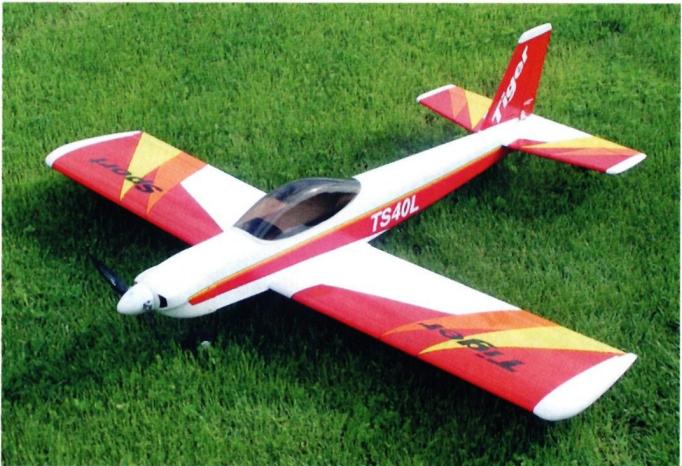
I chose the ThunderTiger Tiger Sport 40L because it was available right away and reasonably priced (about 200 francs). It is a low-wing, symmetrical-profile aerobatic trainer with a 141 cm wingspan, equipped with a tricycle landing gear and featuring a geometry that inspires confidence. The design of this model is based on a balsa wood frame complemented by a molded ABS upper section. Its advanced construction will save time, allowing you to focus on the adjustments that need to be made.
The main challenge is mounting the motor on a properly aligned frame. Furthermore, since the electric motor is significantly lighter than its internal combustion counterpart, all components must be positioned as far forward as possible for centering purposes. Similarly, the tail surfaces will be installed last to allow for the possibility of lightening them if necessary. First, the motor mount consists of a CTP front bracket supported by four M4 threaded rods that have been shaped to fit the holes originally provided in the firewall. This system allows the motor’s position to be adjusted until satisfactory and provides sufficient rigidity. The firewall is then cut out to allow ventilation for the controller mounted on a bracket behind it; the battery then takes the place of the fuel tank, secured by a toothed clamp and accessible through an access panel on the underside. The rest of the assembly is carried out according to the instructions without any further modifications.
All that remains is to seal the opening in the engine cowling with rolled balsa wood—since no cylinder protrudes—and to test the aircraft’s center of gravity with the tail surfaces in place. As expected, the center of gravity is too far aft. The vertical stabilizer and its flap are therefore extensively cut out, re-covered with fabric, and then permanently installed. Center of gravity balance is finally achieved by adding 40 g of lead glued inside the cowling.
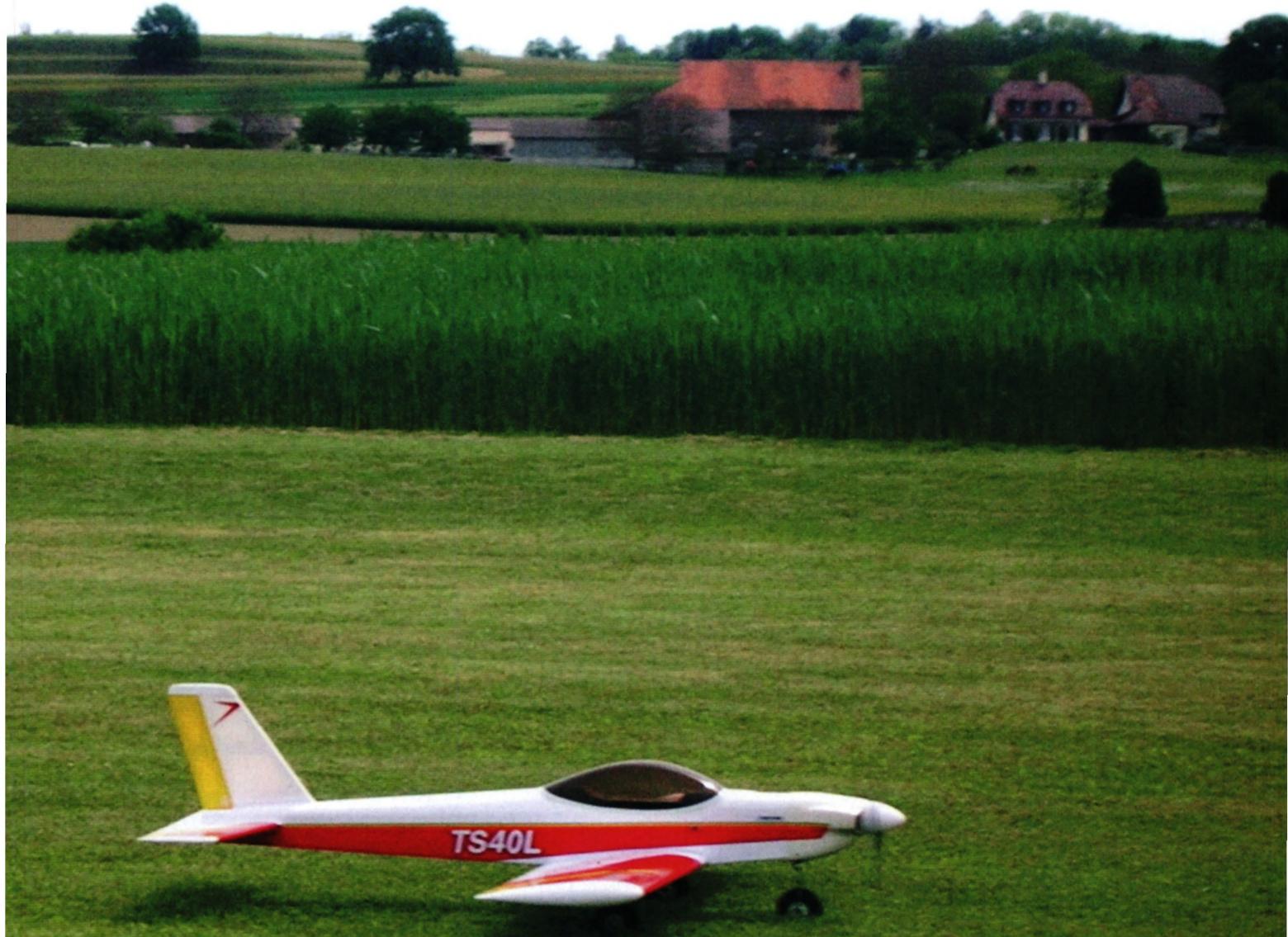
The aircraft, ready for takeoff, has a weight of 2,230 g—compared to the 2,400 to 2,600 g advertised for a 6.5 cm³ engine! This really highlights the benefits of the new equipment, with a battery that simply replaces the full fuel tank. The flight performance is top-notch, and the plane is every bit as powerful as a thermal-powered model. Taking off from a grass runway is no problem at all, and flight time ranges from 15 to 20 minutes depending on the pilot’s flying style.
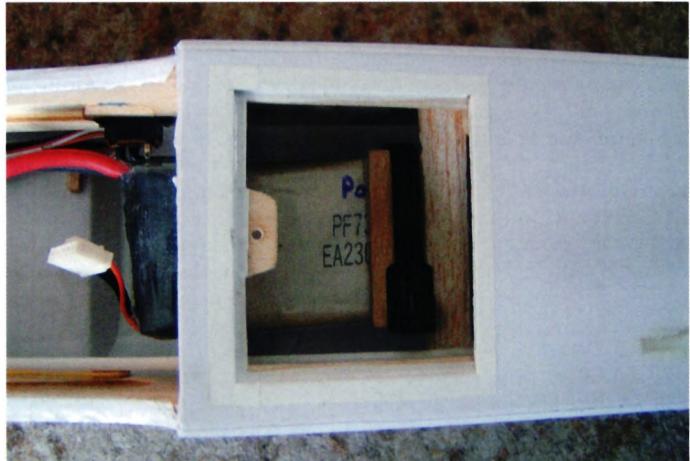
The selected propulsion system consists of the following components:
- Axi 2826/10 motor (180 g)
- Hacker Master 40 B Flight controller (35 g)
- Poly-Quest 3S/3700 mAh battery (290 g)
- a folding propeller with 12"×8" blades, a 55 mm hub, and a 50 mm spinner. The receiver is powered by a BEC system because the model is equipped with only 3 standard servos. It is recommended to place a ferrite bead between the ESC and the receiver, as interference may occur during long flight phases with reduced throttle.
The equipment listed above costs less than 500 francs, which is no small amount, but you have to factor in the savings on fuel, starting the engine, and off-road performance—not to mention how clean and easy it is to use.
It seems prudent to prioritize efficiency when selecting propulsion systems and to avoid operating components at their limits, particularly by choosing appropriate propellers. At the end of a flight, the power pack is no warmer than room temperature, and you can safely rest your fingers on the motor’s rotor. No signs of wear have been observed to date after two seasons of use.
It is not enough to turn off the receiver using the switch at the end of the flight; you must always disconnect the battery’s main connector. In fact, if you forget to do so, the controller continues to draw power, resulting in a slow but complete discharge of the battery—and thus irreversible damage (speaking from experience!) ...
Experience shows that it is now possible to easily convert any gasoline-powered model to electric. I therefore suggest you take the plunge and develop your projects... Because at a time when noise has become a means of exerting pressure on our activities, electric models will be a compelling argument for retaining our airfields.
François Croset

EURO CONTEST GLIDER ACRO TOUR AUSTRIA 2026

THE PC-21 STORY
 Emil Giezendanner

TWIN TOWN PARTNERSHIP
 Wolfgang Voeller

SUMMER FUN 2026 AT MG USTER
Martin Wunderli
CORSAIR F4U – A WARBIRD WITH A MEMORABLE LOOK
Jürgen Rosenberger, Jürgen Prinz
52. 2026 ALPS CUP
Emil Giezendanner
YOU KNOW WHAT I MEAN? 125 YEARS OF THE SWISS AERO CLUB
Emil Giezendanner
News from HEBU

TEAM MANAGER "THIS" BOSSHARD
Rodito Nussbaumer
ATOM, THE NEW DOUBLE-DECKER FROM CPLR
 Matthias Bosshard

F3A EUROPEAN CHAMPIONSHIPS IN ST-MACAIRE, FRANCE
Matthias Bosshard
INSIGHTS INTO THE HISTORY OF SEAPLANES

WELCOME, NEW MEMBER!
Andrea Bolliger
What's New at Leomotion.com

PRIDE AND GOOD IDEAS
 Markus Nussbaumer

SMALL, MODEL-LIKE SAILBOATS
Res Dauwalder
FREE FLIGHT IN THE MIDDLE OF SUMMER
Urs Muntwyler
BY YOUTH, FOR YOUTH
Lorena Betschen
HORIZON HOBBY/LEMACO NEWS: MICRO OV-10 BRONCO 645 MM BY E-FLITE

34th HAHNENMOOS ALPINE MODEL AIRPLANE CAMP
Res Dauwalder
COUPE DES ALPES – OBSERVE AND LEARN
Rodito Nussbaumer
TRY-OUT DAY AT MFV WETTINGEN
 Urs Keller

NEWS FROM HEBU
 Julia Bucher

NOS REGION – A HUB FOR ELECTRIC AVIATION
Emil Giezendanner
MEMORIES
 Wolfgang Völler

70 YEARS OF THE NIDWALDEN MODEL AIRPLANE CLUB
Martin Barmettler
A SPECTACULAR F3A WORLD CUP IN THE PRINCIPALITY OF LIECHTENSTEIN
Emil Giezendanner
FROM 0 TO 100
Markus Nussbaumer