
Gigantic Piper L4 on a scale of 1:2.04
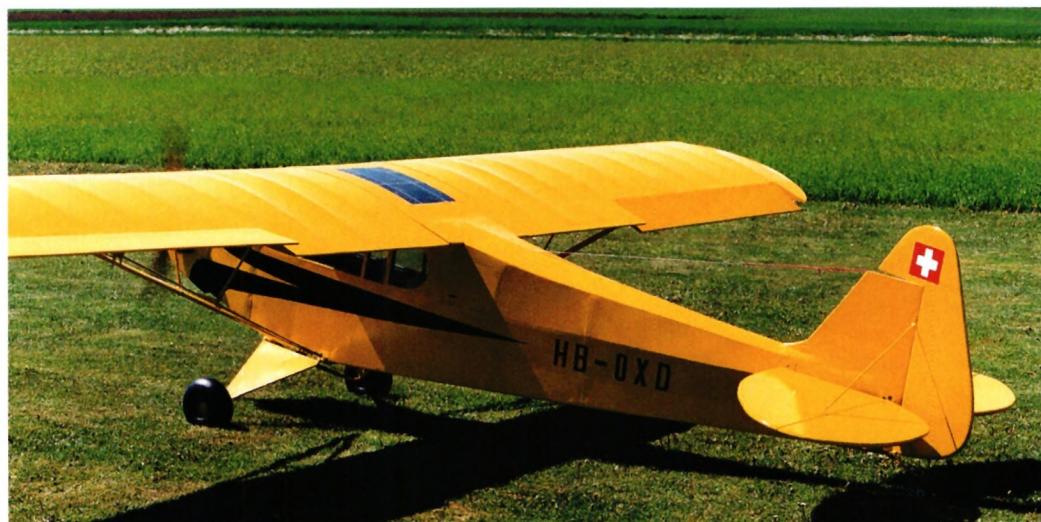
Can a Piper of this size even be built? That’s the question some members of the IG Swiss Piper team have asked. “It’ll be too heavy,” “it’s not possible,” and so on. All of this only spurred my father on to take on the project even more determinedly. The Piper was scaled up and built according to plans from Balsa-USA.
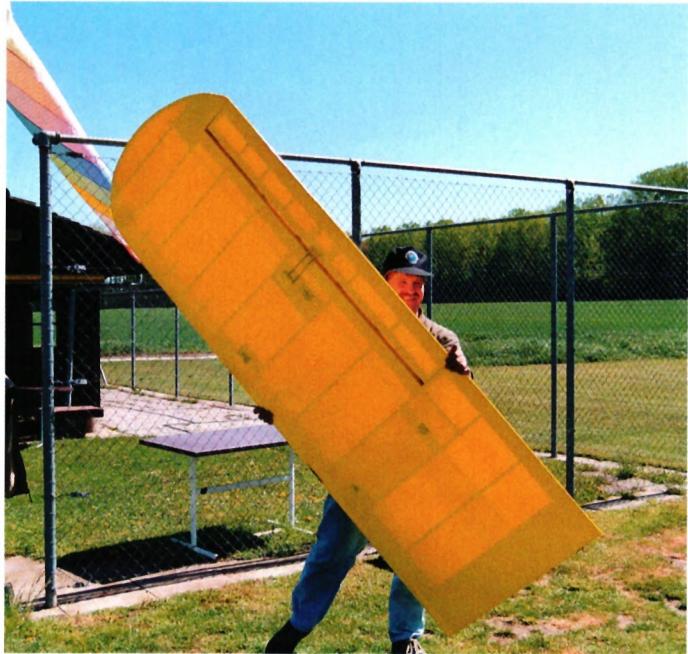
After about a year, the Piper was finished; only the engine was still missing. But the ZDZ 160-cm³ boxer engine was quickly installed and broken in, so the Piper was ready for its first test flight. The big moment of truth was surely the weight? Of course it was. Would the L4 even fly? Without the dummy pilot and fuel, the Piper weighed about 29 kg. Actually, that’s very little. We therefore decided to replace the fuel tank with one of greater capacity and to install additional weight (trim weights, dummy pilot, etc.). So the “Gigant,” weighing 35 kg, was inspected by the FOCA and deemed airworthy.
On Saturday, May 3, 2003, we transported the Piper to the model airfield and assembled it. After we had finished assembling the gigantic aircraft and carried out the final checks, we started the engine.
I taxied the “Gigant” for the first few meters. That was when I truly realized just how big the Piper was. The grass runway—about 20 m wide—suddenly felt quite narrow. One more turn, and off to the takeoff area.
I gently applied throttle and began the takeoff roll: At about 20% power, the Piper lifted its tail after just 5 m; after about 15 m, I saw light shining from beneath the large balloon tires. It was flying. Still with the
| Type | Piper L4 HB-OXD |
| Wing span | 5.24 m |
| Length | 3.47 m |
| Weight | 34 kg |
| Engine | 160 cm³ ZDZ boxer |
| Builder | Peter Stucki |
| 3617 Linden | |
| Rider | Heinz Stucki |
| 3123 Belp | |
| piper.stucki@tele2.ch |
With the same power, the Piper kept climbing higher and higher into the air. Then came the first turn—and so many thoughts were racing through my mind!
Is the angle of attack right? The center of gravity? But everything was completely normal; none of my fears came true.
The Piper L 4 flew simply fantastically. Its flight characteristics and speed are very close to the original. The deep-rumbling boxer engine propels the Piper through the air at just 25% throttle. It could really get addictive! The flight and appearance are superb. But we still have the landing, approach, and throttle reduction to go. The Piper comes in for landing at a walking pace. A brief throttle reduction, and it’s back on the ground. A picture-perfect landing, and all after a run of about 20 meters.
After the successful flight, a big round of applause from my fellow pilots.
You could see the relief on my face from a distance, and my father received his first congratulations. Great! Conclusion: A very successful aircraft, and in terms of flight characteristics, it’s hard to beat the original.
Heinz and Peter Stucki

EURO CONTEST GLIDER ACRO TOUR AUSTRIA 2026

THE PC-21 STORY
 Emil Giezendanner

TWIN TOWN PARTNERSHIP
 Wolfgang Voeller

SUMMER FUN 2026 AT MG USTER
Martin Wunderli
CORSAIR F4U – A WARBIRD WITH A MEMORABLE LOOK
Jürgen Rosenberger, Jürgen Prinz
52. 2026 ALPS CUP
Emil Giezendanner
YOU KNOW WHAT I MEAN? 125 YEARS OF THE SWISS AERO CLUB
Emil Giezendanner
News from HEBU

TEAM MANAGER "THIS" BOSSHARD
Rodito Nussbaumer
ATOM, THE NEW DOUBLE-DECKER FROM CPLR
 Matthias Bosshard

F3A EUROPEAN CHAMPIONSHIPS IN ST-MACAIRE, FRANCE
Matthias Bosshard
INSIGHTS INTO THE HISTORY OF SEAPLANES

WELCOME, NEW MEMBER!
Andrea Bolliger
What's New at Leomotion.com

PRIDE AND GOOD IDEAS
 Markus Nussbaumer

SMALL, MODEL-LIKE SAILBOATS
Res Dauwalder
FREE FLIGHT IN THE MIDDLE OF SUMMER
Urs Muntwyler
BY YOUTH, FOR YOUTH
Lorena Betschen
HORIZON HOBBY/LEMACO NEWS: MICRO OV-10 BRONCO 645 MM BY E-FLITE

34th HAHNENMOOS ALPINE MODEL AIRPLANE CAMP
Res Dauwalder
COUPE DES ALPES – OBSERVE AND LEARN
Rodito Nussbaumer
TRY-OUT DAY AT MFV WETTINGEN
 Urs Keller

NEWS FROM HEBU
 Julia Bucher

NOS REGION – A HUB FOR ELECTRIC AVIATION
Emil Giezendanner
MEMORIES
 Wolfgang Völler

70 YEARS OF THE NIDWALDEN MODEL AIRPLANE CLUB
Martin Barmettler
A SPECTACULAR F3A WORLD CUP IN THE PRINCIPALITY OF LIECHTENSTEIN
Emil Giezendanner
FROM 0 TO 100
Markus Nussbaumer