
Club 20 or Mini-Pylon Racing
Pylon racing involves flying an airplane around a marked triangular course. The origins of this sport date back to the early 1930s and, like so many wonderful things, it originated in the United States.
Back then, former World War I fighter pilots were so bored by the peaceful times that they decided to demonstrate their aerial combat experience in races flown just above the ground. They flew the fighter planes they’d used in the war, and soon people began referring to these as the “modern knightly battles” of the 20th century. But the pilots soon realized that they could fly around the three towers much faster if they used smaller aircraft with relatively low wing loading. This meant that ultra-light construction had to be employed. Many aircraft shattered in mid-air back then, and there were numerous fatalities. World War II brought the development of these racing aircraft to a halt for some time, and after the war, the competition continued with super-powerful military aircraft. Aircraft with supercharged engines producing up to 3,000 PS were the legendary winners of these fastest races of all time, for shortly thereafter these powerhouses—such as the Mustangs, the Warhawks, and so on—were banned from the racecourses. Then came the era of famous designs like General James Doolittle’s bulky “GEE BEE” by General James Doolittle and the many Brown Racers; later came the Shoestrings and the Rivets, and today, aircraft like the Miss DARA and the Miss COSMIC WIND—equipped with slender Lycoming engines producing around 100 PS—are the preferred choices in FORMULA ONE. Thanks to their sophisticated aerodynamic shapes and low power-to-weight ratio, these aircraft still achieve top speeds of up to 600 km/h.
That covers the history and development of pylon racing. The real deciding factor that prompted me to write this article on model pylon racing was the fact that in Switzerland, there is simply no alternative for the model aircraft enthusiast who wants to compete against other pilots except to plunge into the aerobatics scene at great financial expense. This is particularly evident in the rapidly increasing number of participants, year after year, at the regional championships where the “small” national program is flown.
I would like to be careful here not to say anything against model aerobatics in any way, for it certainly represents the crowning achievement of our shared hobby. However, even those who, for financial reasons, cannot afford to participate in this discipline should have the opportunity to compete. That is why I would like to announce a new racing class for the Pylon in Switzerland—a kind of budget race—which I expect will be well received.
This new sport is called CLUB 20 and comes from England—not least because, as is well known, the English are currently having to implement cost-cutting measures left and right. In my opinion, this in no way detracts from the appeal of this class; on the contrary, pylon racing in its current form—with the FAI and Formula 1 classes featuring 6.5 cc engines and the Quarter Midget class with tuned 2.5 cc gems—has until now been accessible only to true specialists.
Purpose: To make pylon racing—which has so far been reserved for “professionals”—a sport accessible to the general public.
General: The models must, at least to some extent, resemble a full-scale prototype that was propeller-driven. The organizer reserves the right to disqualify models before the races if, in their opinion, they do not resemble any real-world prototype in any way. There is no rule specifying how many channels the model must be controlled via. However, a minimum of 2-axis control plus a motor shut-off device is required. Any dangerous flying will result in immediate disqualification.
1. Fuselage
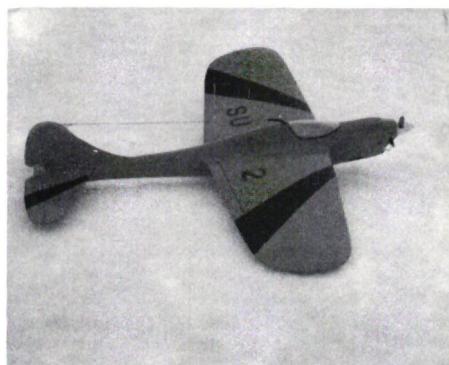
The fuselage itself (excluding additions such as landing gear, etc.) must be at least 70 mm wide, measured excluding the wing-fuselage junctions, and 127 mm high. These dimensions must be present in the area of the wing root but do not have to fall within a single cross-section.
2. Wings
The net wing area must be at least 1,935 cm² (excluding HLW). The minimum thickness is 22.5 mm at the wing root and 16 mm at the tips. The wing planform is limited only by the requirement to resemble the prototype; otherwise, it is up to the designer.
Biplanes are not permitted.
3. Chassis
A chassis is not required.
4. Engine
: The displacement of the single engine must not exceed 3.28 ccm or .20 cubic inches. The engine must be one of the following: OS .20, Enya .19 or .19 BB, HB .20, Veco .20, Webra .20 Glo, or FOX .20, equipped with the muffler supplied by the manufacturer (resonance tubes are not permitted).
No modifications may be made to the engine or its auxiliary components. The fuel tank may be pressure-vented. If an engine other than those listed above is permitted, this will be published in “Modellflugsport.”
If a competitor doubts the originality of another competitor’s engine during a competition, they may demand, in exchange for a deposit of 20 Swiss francs, that the suspect open their engine for inspection. If the engine has not been modified, the falsely accused competitor will receive the CHF 20. If, however, it has been “tinkered with,” the competitor found guilty will be disqualified, and the other competitor may recover their deposit.
5. Propellers
Only soft plastic propellers (Top Flite) and fiberglass-reinforced plastic propellers are permitted. Modifications are allowed but not recommended.
6. Spinner
Requirement: A round, i.e., blunt spinner with a minimum diameter of 38 mm.
7. Fuel
: Sold exclusively by the organizer. Contains 25% castor oil and 5% nitro. The cost of fuel is included in the entry fee.
8. Weight
: Must be between 950 and 1,400 grams, ready to fly and fully fueled.
9. Race Course and Procedure
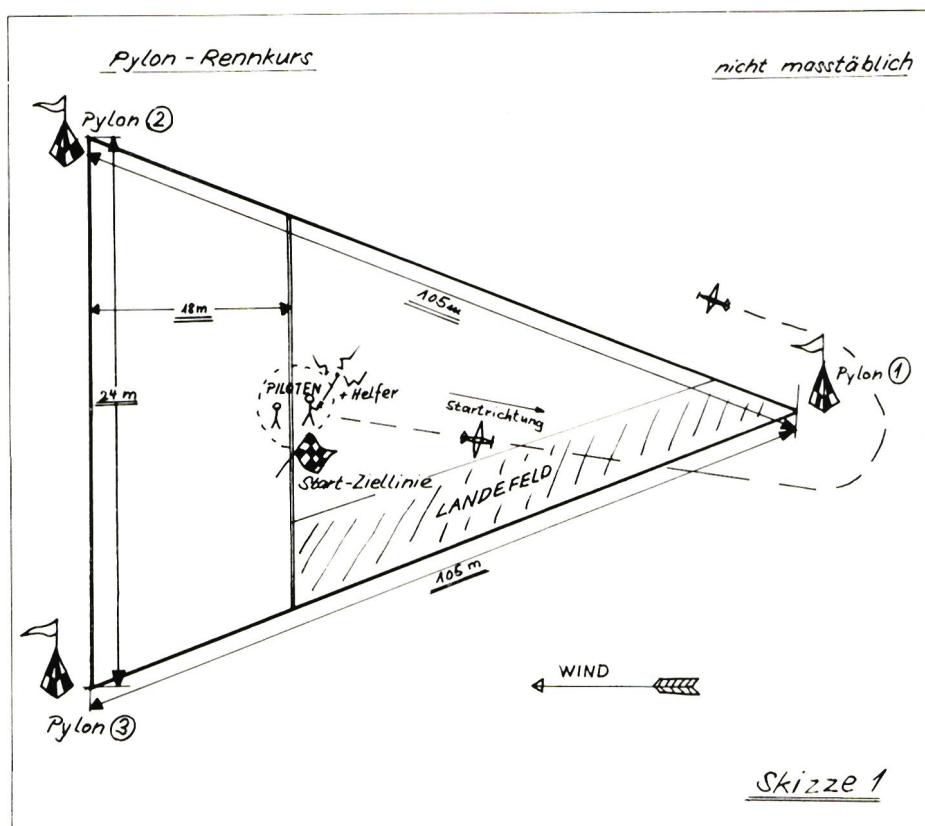
: A maximum of 4 aircraft fly one lap together. The models are hand-launched from behind the start/finish line, where the pilots remain standing even during the flight. The takeoff direction is toward Pylon No. 1 (see Diagram 1). The course is flown 10 (ten) times in a counterclockwise direction. If not all engines are running after one minute, only those with running engines may continue. The start takes place simultaneously upon a signal. If a pilot takes longer than six minutes—counting from the signal to the start of the engine—to complete 10 laps of the course, he is disqualified. Flights should not exceed a height of approximately 20 m if possible.
10. Scoring
Points are awarded per round as follows:
8 points for first place
, 6 points for second
place, 4 points for third
place, and 2 points for fourth place
If a pilot* has a “cut”—that is, if they made one of the thirty turns in front of a pylon rather than behind it—they receive no points for that round.
They must therefore compete in a later round against three other pilots who also had a “cut.” Third- and fourth-place finishers can only compete against each other. Second-place finishers must have a rematch against the winner
.* New rule: 2 cuts = 0 points, 1 cut = 1 point.
The requirements for the organizer of a Club 20 race are quite minimal. Above all, they don’t need to invite judges from all over Switzerland, as is the case with aerobatics, because many of these judges—rightly so—expect to be reimbursed for their expenses. They simply need to provide three pylons (see Sketch 2), which the hosting model aircraft club can build as a team.
You’ll also need a refueling station, a few liters of fuel, a kitchen scale, and a caliper. That completes the set of equipment. The brave men in the club are then outfitted with a plastic construction helmet and given the title “flag marshal.” Each flag marshal must be given a green and a red flag. The green one means “good,” while the red one means “cut,” i.e., 0 points. If the pilot receives a “cut,” he may not simply repeat the turn correctly, but must fly the ten laps to the end and calmly accept his meager result. If he aborts the flight, he is eliminated from the competition. (6-minute limit!) We don’t necessarily need a marshal at pylons 2 and 3, but it would be helpful. We also need someone to signal the end of the race—a black-and-white checkered flag would, of course, be ideal—and four people to serve on the judging panel. Each jury member keeps an eye on “their” pilot, counts the laps, and notes any cuts, dangerous flying, etc. Timekeeping isn’t necessary, but it can, under certain circumstances, add to the excitement of a competition. The spectator area should be located as far away as possible, ideally behind pylons 2 and 3. Under no circumstances behind pylon No. 1!! I’m certainly no safety fanatic, but a serious accident resulting in physical injury would be pretty much the worst thing for the public appeal of a new sport.
Those of you who have found this short report interesting (and I hope there are at least 3 or 4 of you!!) should send a simple postcard to:
Roger Riedener, Burgstrasse 105
, 8408 Winterthur
Please write “CLUB 20” on it!
Depending on the size of the group of interested parties, I’ll then keep everyone informed—either personally or through “Modellflugsport”—about model plans, kits, dates, and perhaps even the founding of an association.
I’d think it would be “just the thing” if this really got off the ground!


News from HEBU

PRIDE AND GOOD IDEAS
 Markus Nussbaumer

TEAM MANAGER "THIS" BOSSHARD
 Rodito Nussbaumer

YOU KNOW WHAT I MEAN? 125 YEARS OF THE SWISS AERO CLUB
 Emil Giezendanner

F3A EUROPEAN CHAMPIONSHIPS IN ST-MACAIRE, FRANCE
 Matthias Bosshard

HORIZON HOBBY/LEMACO NEWS: MICRO OV-10 BRONCO 645 MM BY E-FLITE

ATOM, THE NEW DOUBLE-DECKER FROM CPLR
Matthias Bosshard
SUMMER FUN 2026 AT MG USTER
Martin Wunderli
52. 2026 ALPS CUP
Emil Giezendanner
TWIN TOWN PARTNERSHIP
Wolfgang Voeller
CORSAIR F4U – A WARBIRD WITH A MEMORABLE LOOK
Jürgen Rosenberger, Jürgen Prinz
SMALL, MODEL-LIKE SAILBOATS
Res Dauwalder
TRY-OUT DAY AT MFV WETTINGEN
Urs Keller
WELCOME, NEW MEMBER!
Andrea Bolliger
What's New at Leomotion.com

COUPE DES ALPES – OBSERVE AND LEARN
Rodito Nussbaumer
EURO CONTEST GLIDER ACRO TOUR AUSTRIA 2026

BY YOUTH, FOR YOUTH
Lorena Betschen
INSIGHTS INTO THE HISTORY OF SEAPLANES

34th HAHNENMOOS ALPINE MODEL AIRPLANE CAMP
Res Dauwalder
THE PC-21 STORY
Emil Giezendanner
FREE FLIGHT IN THE MIDDLE OF SUMMER
Urs Muntwyler
NEWS FROM HEBU
 Julia Bucher

FROM 0 TO 100
Markus Nussbaumer
MEMORIES
Wolfgang Völler
NOS REGION – A HUB FOR ELECTRIC AVIATION
Emil Giezendanner
DO YOU KNOW WHAT I MEAN IN THE LAND OF SMILES?
Emil Giezendanner
Have you almost forgotten about aircraft that take off and land vertically?
Emil Giezendanner