
Once you smell kerosene...
WREN was founded in 1999 by Mike Murphy, John Wright, Terry Lee, and Roger Parish. The catalyst was the successful demonstration of the turbine helicopter at the Jet World Masters in Zeltweg (see report in MFS 5/99).
At first, only blueprints and individual parts for turbines were offered. Due to demand, the product line was expanded to include kits and ready-to-fly powerplants based on the MW 54 turbine. It is now available as a jet powerplant with 54N, 64N, or 80N thrust, either as a kit or ready-to-fly. For enthusiasts, a twin-shaft turboprop engine based on the MW 54 has been available for some time, also as a kit or ready-to-fly model. Its power output is comparable to that of 120-cc gasoline engines.
The innovative team at WREN is committed to quality and the continuous development of their products, which is why they do not engage in mass production themselves. Many turbine manufacturers, such as PST, RAM, Simjet, and others, produce these engines under license. In the helicopter sector as well, several manufacturers are in the process of adapting WREN’s twin-shaft technology to their own mechanical systems.
Currently, the smallest production turbine, the MW44 with 35N of thrust, is available exclusively from WREN. According to Mike Murphy, building such a turbine to be fully functional was a relatively small step. However, the journey to a reliable production product cost him a great deal of time and patience. For this reason, it is not offered as a kit and is sold exclusively by WREN directly. Martin Sannwald and I had ordered two MW 44s from WREN. To make small talk and get a glimpse into the company, we decided to pick up the turbines ourselves. In Rotherham, England, we were welcomed in true English style with tea and cake. Rotherham is located in a former coal-mining region. To boost the local economy, the city set up an industrial center made of container-like modules. WREN has leased three of them. These spaces are used for storage, offices, and assembly. WREN outsources the actual manufacturing of the individual parts to subcontractors. Only the production of the wax blanks for the investment-cast parts is not outsourced. WREN uses its own molds for this purpose, which even we were not allowed to see when open (mold making is a trade secret).
After the tour, we were introduced to the MW 44. Since this turbine does not have an automatic start system, a brief training session is helpful. In larger turbines, the gas and kerosene supply, as well as the ignition and starter, are controlled automatically. After a brief explanation and demonstration by Mike, we were able to try it ourselves. Activate the ECU, open the kerosene valve, turn on the ignition, engage the starter, and open the gas supply. As soon as the gas ignites, maintain a speed of 15,000–25,000 RPM in short intervals. The pump engages automatically once the exhaust gas temperature is detected. As soon as the kerosene reaches the turbine, the sound changes, and you can now let the starter run continuously until the RPM reaches approximately 35,000. From this RPM, the turbine accelerates on its own to the idle speed of 50,000, at which point you can remove the starter, ignition, and throttle. The entire process takes no longer than it takes to read this description. It takes the turbine about 2–3 seconds to go from idle to approximately 120,000. Above this RPM, the engine is just as dynamic as a 2-stroke engine. For die-hard Jet-Cat users, the starting procedure may seem complicated. However, after 2–3 starts, we felt that starting a glow plug engine isn’t any easier.
Now that we’d caught a whiff of kerosene, we were eager to see the turboprop engine in action. This 2,200-gram engine is equipped with an autostart system. Once the transmitter gives the go-ahead, the turbine starts on its own, and the propeller begins to turn (just like on the big planes). Martin had to hold the test stand against more than 20 kg of static thrust in the kerosene-scented propeller wind. In addition, the noise level was significantly lower than that of comparable gasoline engines. After this demonstration, we wanted to pack two more of them into our suitcases right away. However, since WREN only wanted to put us on the waiting list, we decided to reconsider the whole thing.
When we said goodbye to the WREN team, we were convinced by the products we’d seen. However, we also realized that WREN cannot—and does not want to—produce these engines in large quantities. I’m certain, though, that the technology will find its way onto the global market in collaboration with other companies. On the flight back to Switzerland, we found ourselves dreaming of the PC-9 and PC-21 in all sorts of configurations. Who knows what’s next on the drawing board?
| Manufacturer: | Savex GFK Models www.savex.cz |
| Scale: | Approx. 1:10 |
| Wingspan: | 1270 mm |
| Length: | 1,420 mm |
| Weight: | Approx. 3,950 g + 1 liter of kerosene |
| Construction: | Fully GRP/CFRP; wings in GRP sandwich construction, fully painted according to specifications. |
| Price approx. | €460 |
| Outstanding work: | Bonding the horizontal stabilizer, installing the frames for the turbine and RC system, installing the servos and linkages. Installing the landing gear. Estimated time: approx. 25 hours. |
| Landing gear: | Spring Air Series 600 |
| Functions: | Elevator, ailerons, rudder, landing flaps, turbine, retractable landing gear |
| RC equipment: | 7 MPX Micro Digi servos, 1 MPX Micro servo (nose wheel steering), MPX RX 12 Synth receiver |
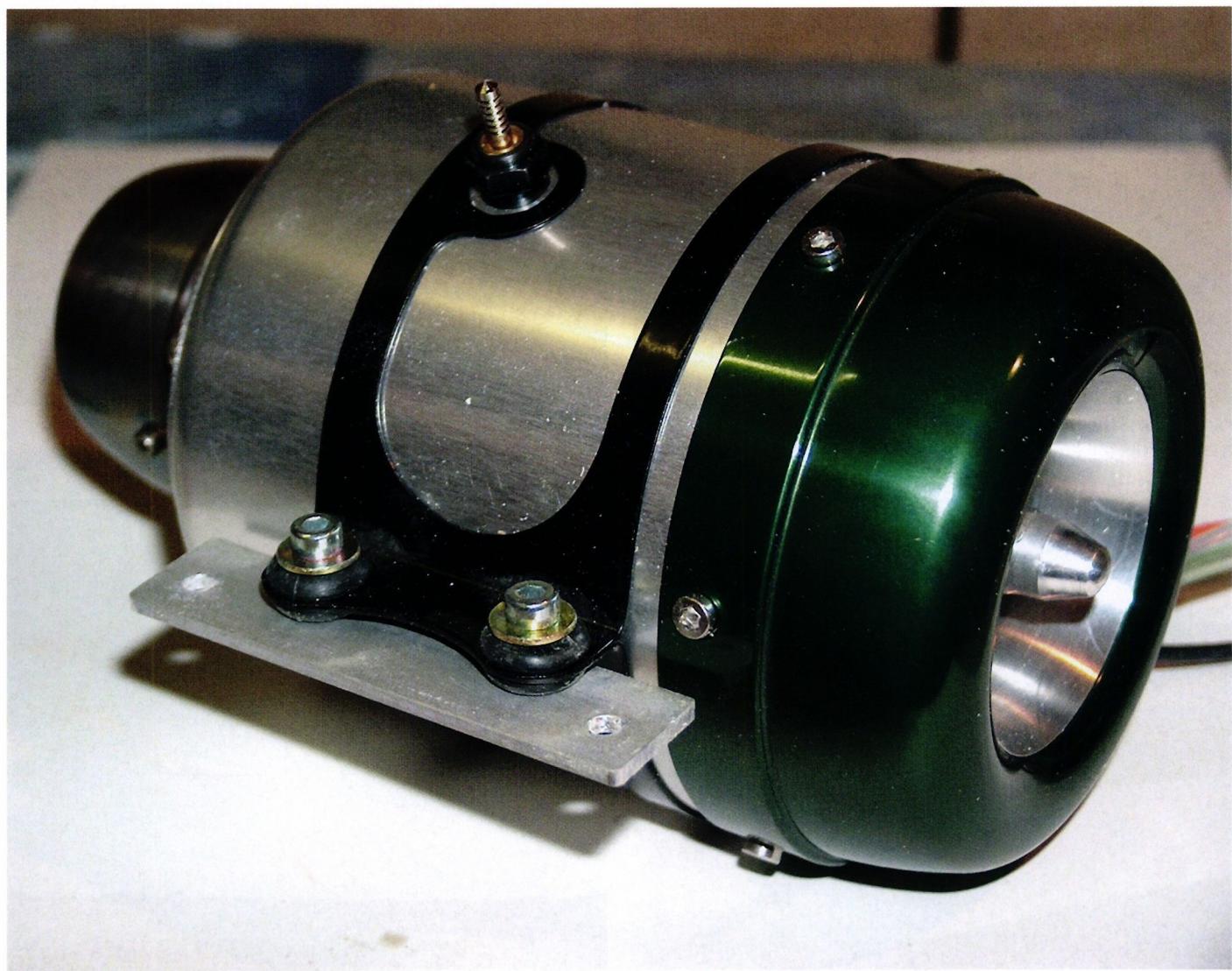
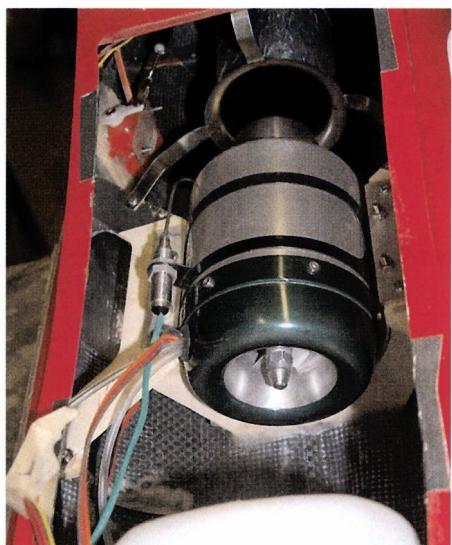
| Powerplant: | WREN MW 44 |
| Thrust tube: | WREN |
| Thrust: | approx. 35 N at 190,000 ; approx. 1.5 N at 50,000 |
| Rotational speed: | 50,000–190,000 |
| Length: | 135 mm |
| Diameter: | 75 mm |
| Flow rate: | 122 ml/min at 190,000 |
| Exhaust gas temp. | 520–600 °C |
| Weight: | 435 g |
| Model: | Manual start |
| Price approx. | £1,450, including all peripheral components such as electronics, starter motor, batteries, and fuel tank |
price of the model, depending on the version, approx. SFr. 4,500–5,000
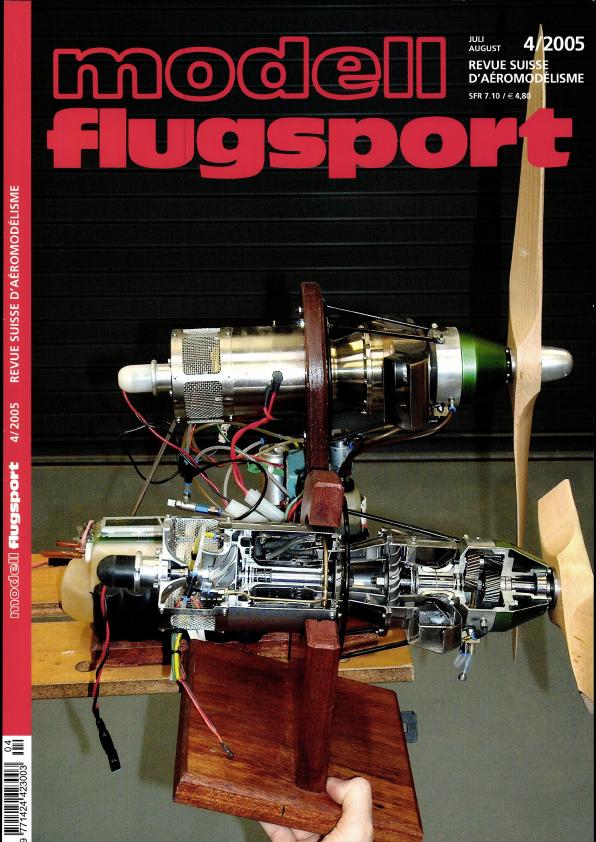
Weighing 2,200 grams, it features an auto-start function. After the start command is sent by the transmitter, the turbine starts on its own, driving the propeller just like the “big ones.” Amid the kerosene-scented propeller wind, Martin had to hold the test stand against more than 20 kg of static thrust. In addition, the noise level was significantly lower than that of comparable gasoline engines. After this demonstration, we wanted to pack two more units into our suitcases right away. However, since WREN only wanted to put us on the waiting list, we decided to reconsider the whole thing.
When we said goodbye to the WREN team, we were convinced by the products we’d seen. However, we also realized that WREN cannot—and does not want to—produce these engines in large quantities. I’m certain, though, that the technology will find its way onto the global market in collaboration with other companies. On the flight back to Switzerland, we found ourselves dreaming of the PC-9 and PC-21 in all sorts of configurations. Who knows what’s next on the workbench?

EURO CONTEST GLIDER ACRO TOUR AUSTRIA 2026

THE PC-21 STORY
 Emil Giezendanner

TWIN TOWN PARTNERSHIP
 Wolfgang Voeller

SUMMER FUN 2026 AT MG USTER
Martin Wunderli
CORSAIR F4U – A WARBIRD WITH A MEMORABLE LOOK
Jürgen Rosenberger, Jürgen Prinz
52. 2026 ALPS CUP
Emil Giezendanner
YOU KNOW WHAT I MEAN? 125 YEARS OF THE SWISS AERO CLUB
Emil Giezendanner
News from HEBU

TEAM MANAGER "THIS" BOSSHARD
Rodito Nussbaumer
ATOM, THE NEW DOUBLE-DECKER FROM CPLR
 Matthias Bosshard

F3A EUROPEAN CHAMPIONSHIPS IN ST-MACAIRE, FRANCE
Matthias Bosshard
INSIGHTS INTO THE HISTORY OF SEAPLANES

WELCOME, NEW MEMBER!
Andrea Bolliger
What's New at Leomotion.com

PRIDE AND GOOD IDEAS
 Markus Nussbaumer

SMALL, MODEL-LIKE SAILBOATS
Res Dauwalder
FREE FLIGHT IN THE MIDDLE OF SUMMER
Urs Muntwyler
BY YOUTH, FOR YOUTH
Lorena Betschen
HORIZON HOBBY/LEMACO NEWS: MICRO OV-10 BRONCO 645 MM BY E-FLITE

34th HAHNENMOOS ALPINE MODEL AIRPLANE CAMP
Res Dauwalder
COUPE DES ALPES – OBSERVE AND LEARN
Rodito Nussbaumer
TRY-OUT DAY AT MFV WETTINGEN
 Urs Keller

NEWS FROM HEBU
 Julia Bucher

NOS REGION – A HUB FOR ELECTRIC AVIATION
Emil Giezendanner
MEMORIES
 Wolfgang Völler

70 YEARS OF THE NIDWALDEN MODEL AIRPLANE CLUB
Martin Barmettler
A SPECTACULAR F3A WORLD CUP IN THE PRINCIPALITY OF LIECHTENSTEIN
Emil Giezendanner
FROM 0 TO 100
Markus Nussbaumer