
Europe's RC Aerobatics Elite in Central Switzerland
In just a few weeks—at the end of August, to be exact—Europe’s best RC aerobatic pilots will gather in Buochs for their biennial FAI European Championship. From the perspective of the International Aeronautical Federation (FAI), these are known as “continental championships.” However, so far only the Asian countries have seized this opportunity, while the American continent does not host such competitions. RC aerobatics, or F3A as it is known today, is the oldest RC category of all. The first World Championships took place as early as 1960 in Dübendorf. Gliding, helicopters, pylon racing, and scale modeling followed decades later. The first five world championship titles all went to the United States. Bruno Giezendanner was the first to snatch the title from the “land of limited impossibilities.” Since then, the titles have gone to four
four different countries: Austria, Liechtenstein, France, and Japan. Aerobatics as a top-level sport is time-consuming and equipment-intensive, and—like all sports that can’t be measured—it’s a matter of character. It’s a matter of character because I have to accept the scores I receive, no matter what. I see this as a healthy mix of self-criticism and self-confidence. The difference from politics is easily explained: Every maneuver must be flown!
Electric propulsion has now been making inroads into F3A for about two years. Thirty years of development and progress in the international electric aviation community have borne fruit. Electric propulsion will also take hold in large aerobatic models starting at 2.5 meters, as well as in the very small models flown indoors. Further progress is on the horizon. The shift to electric propulsion will force various motor and accessory manufacturers to rethink their approaches, and it remains to be seen whether time will continue to be wasted on noise measurements at official championships. Every now and then, I get the feeling that even die-hard F3A pilots sense something of the very special philosophy behind electric flying. Electric propulsion is much more than just a means of propulsion. I’d almost dare to use the word “sustainable” if it weren’t so overused and worn out. For me, aerobatics and electric propulsion have always gone hand in hand: the former offering a highly refined sense of flight and control, and the latter providing a smooth, clean, low-vibration powerhouse that’s easy and precise to control. I wish all pilots great flights and good luck.
Sincerely,
Emil Ch. Giezendanner
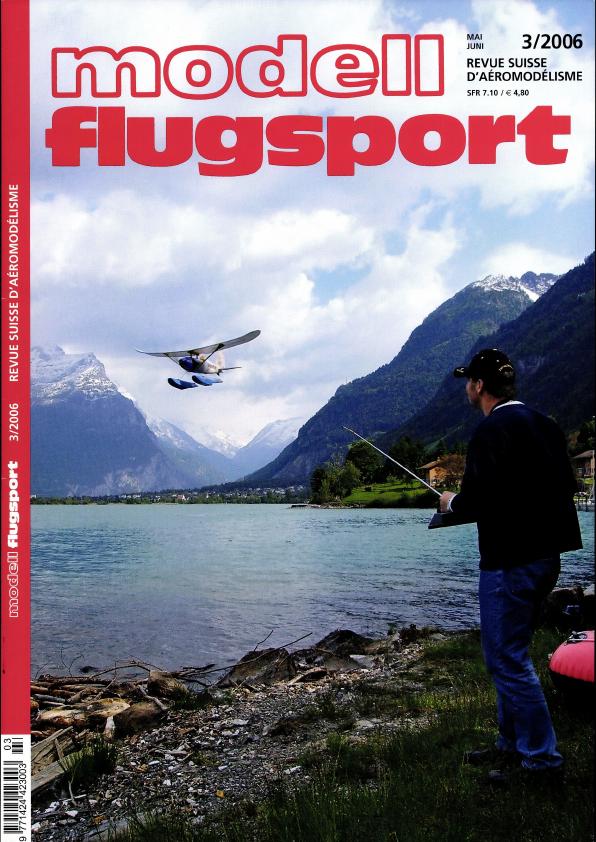

EURO CONTEST GLIDER ACRO TOUR AUSTRIA 2026

THE PC-21 STORY
 Emil Giezendanner

TWIN TOWN PARTNERSHIP
 Wolfgang Voeller

SUMMER FUN 2026 AT MG USTER
Martin Wunderli
CORSAIR F4U – A WARBIRD WITH A MEMORABLE LOOK
Jürgen Rosenberger, Jürgen Prinz
52. 2026 ALPS CUP
Emil Giezendanner
YOU KNOW WHAT I MEAN? 125 YEARS OF THE SWISS AERO CLUB
Emil Giezendanner
News from HEBU

TEAM MANAGER "THIS" BOSSHARD
Rodito Nussbaumer
ATOM, THE NEW DOUBLE-DECKER FROM CPLR
 Matthias Bosshard

F3A EUROPEAN CHAMPIONSHIPS IN ST-MACAIRE, FRANCE
Matthias Bosshard
INSIGHTS INTO THE HISTORY OF SEAPLANES

WELCOME, NEW MEMBER!
Andrea Bolliger
What's New at Leomotion.com

PRIDE AND GOOD IDEAS
 Markus Nussbaumer

SMALL, MODEL-LIKE SAILBOATS
Res Dauwalder
FREE FLIGHT IN THE MIDDLE OF SUMMER
Urs Muntwyler
BY YOUTH, FOR YOUTH
Lorena Betschen
34th HAHNENMOOS ALPINE MODEL AIRPLANE CAMP
Res Dauwalder
HORIZON HOBBY/LEMACO NEWS: MICRO OV-10 BRONCO 645 MM BY E-FLITE

COUPE DES ALPES – OBSERVE AND LEARN
Rodito Nussbaumer
TRY-OUT DAY AT MFV WETTINGEN
 Urs Keller

NEWS FROM HEBU
 Julia Bucher

NOS REGION – A HUB FOR ELECTRIC AVIATION
Emil Giezendanner
MEMORIES
 Wolfgang Völler

70 YEARS OF THE NIDWALDEN MODEL AIRPLANE CLUB
Martin Barmettler
A SPECTACULAR F3A WORLD CUP IN THE PRINCIPALITY OF LIECHTENSTEIN
Emil Giezendanner
FROM 0 TO 100
Markus Nussbaumer