
Take out the engine and head up the mountain
IG PSSAS – A Different Kind of Model Aircraft Flying
Admittedly, the PSS members are model airplane enthusiasts just like everyone else. They aren’t any better-looking, and they aren’t any better at math or writing, but many of them are absolute masters of lightweight construction. The PSS team’s motto, “the lighter, the better it flies,” may not always be true, but it comes very close to the truth.
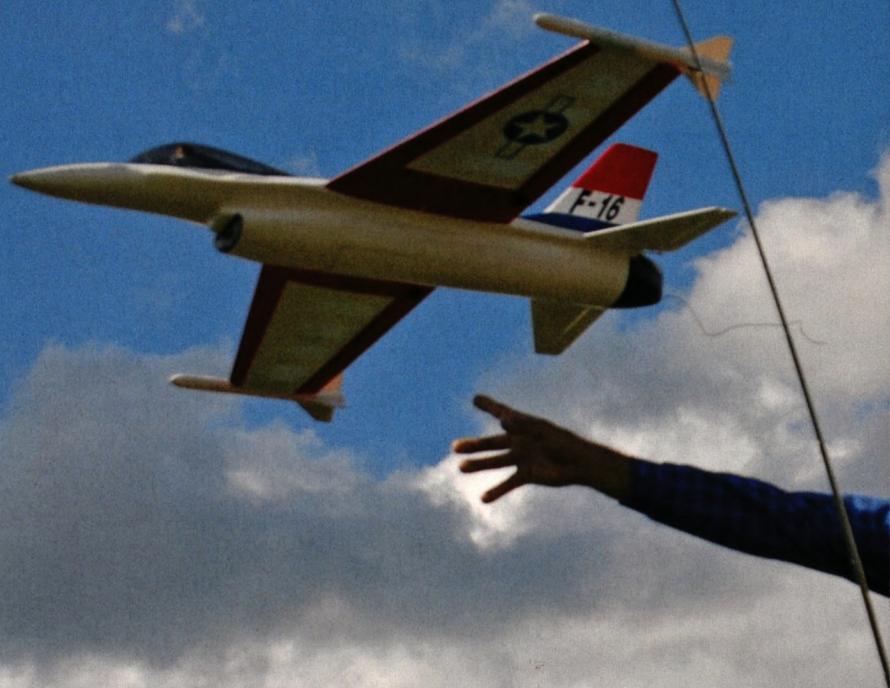
It was many years ago—in fact, as recently as the last millennium—when a few members of the “Homo Model Aviator” species set out to consistently do without engines, exhaust pipes, landing gear, fuel tanks, or even infinitely heavy battery cells. This endeavor was not always successful. Many of the so-called projects ended up straight in the trash, gathering dust somewhere in a hobby basement or on an attic floor. Others, however, actually dared to launch their unpowered creations—with the result that the aircraft flew exactly as far as the thrower could toss them (gritting his teeth, the author must admit that he, too, belonged to this group).
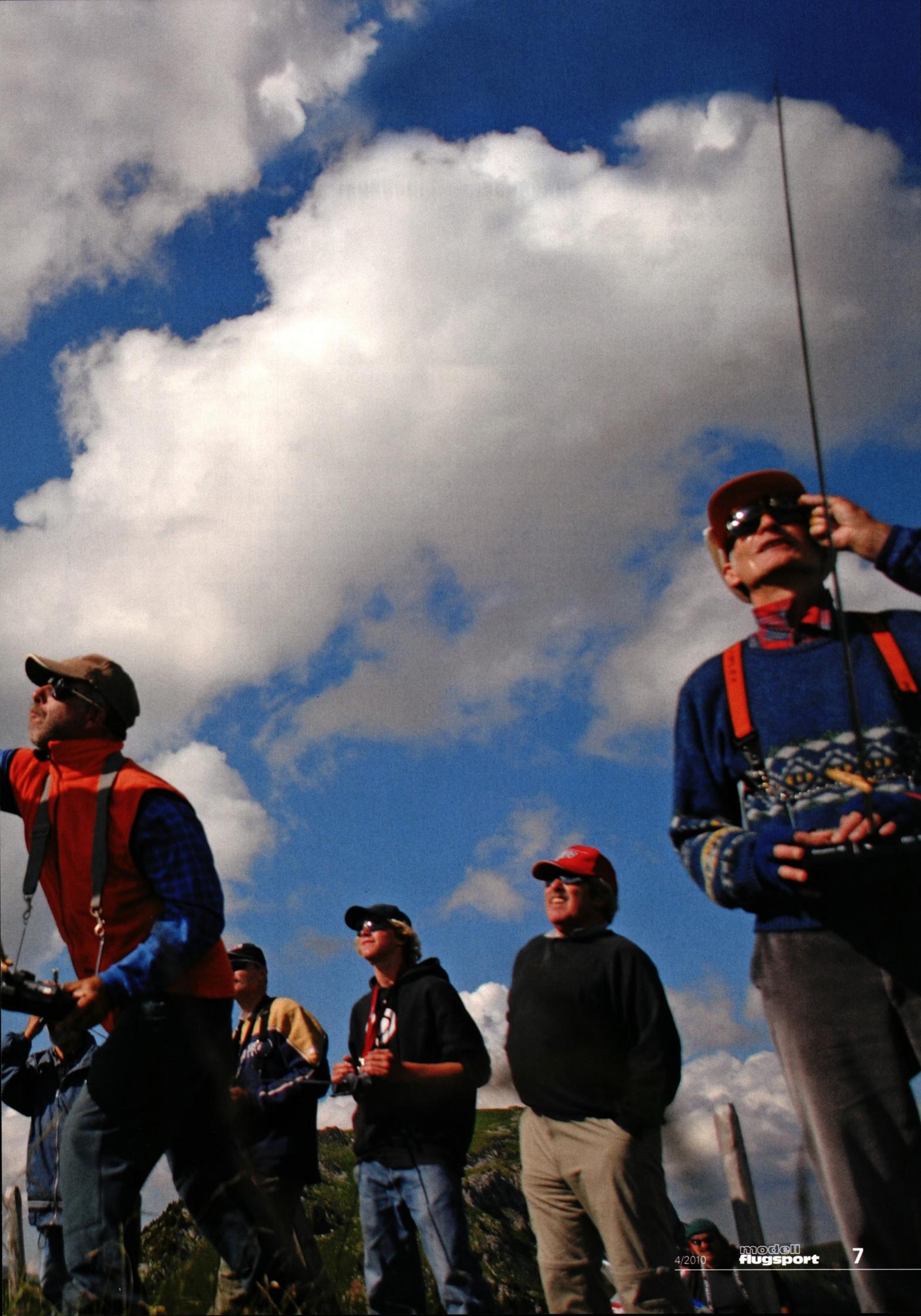
Some, however, did manage to make their first few circles on the slope. Others even managed to stay aloft in the updraft for several minutes. Most of this happened in places where the participants felt they weren’t being watched. After all, none of them wanted to come across as weirdos. The scenes in England and America, however, had already been known for several years at that point. Word quickly spread in insider circles that there had been a few successes in Switzerland as well.
It was Peter Hofer from Altdorf who invited everyone to the first PSS meeting in Switzerland. Above Altdorf, on the Biel Kinzig, there was a full-blown Föhn on September 24, 1994. Ideal conditions for actually flying the models we’d brought along. The group that gathered back then wasn’t very large. Peter Hofer, Walter Wolf, Paul Schilliger, Alfred Genther, Urs Brechbühl, Alex Arnold, and the author himself were present on the Biel Kinzig. Some of those mentioned above just wanted to see what the fuss was about and whether the whole thing actually worked. Others, however, were determined to actually prove it. Urs Brechbühl from Thun soon had his Fokker 27 sweeping along the slope in a way that left everyone in awe. His Super Sabre and his Harrier—both with wings that were still a bit too large—also made a strong impression. Alfred Genther, for his part—who is widely regarded as one of the pioneers of this model aircraft category in Switzerland—brought along his Bell X-1, a model that, even by today’s PSS standards, remains highly unusual but flies well. His Martin B-57 Canberra also made a strong impression. He startled the men present with his first landing. With a bang, a hatch suddenly opened, and his Canberra floated gently toward the ground, dangling from a parachute. Peter Hofer, who flew a few laps with his Rödel Tornado, also had reason to celebrate a success. The author, whose Rödel Alpha Jet also made its maiden flight, must admit at this point, however, that at the time he clearly belonged to the group of people who, while they did get airplanes into the air, were doing things that had little to do with actual flying. Regardless, the PSS bug had bitten. Late in the evening of September 24, the seven men in the parking lot of the Biel-Kinzig Railway decided to found the Power Scale Soaring Association Switzerland.
The years went by
What began as a small seed in 1994 has grown and flourished over the past years. Of the seven founding members, five are still more or less actively involved today. Membership has now stabilized at just over 30. Some of them belong to the core group, which consists of about 15 to 20 model airplane enthusiasts. Whenever possible, they attend every scheduled event. Years ago, at a general meeting of the IG PSSAS, it was decided to meet at least four times a year to fly together. At that time, several flying sites were evaluated for their suitability for PSS. The meetings in Ticino, the Bernese Oberland, and the Uri region have become established traditions. The general meeting at the “Kreuz” in Winikon also remains a fixture. What has changed fundamentally, however, are the models that are towed up the slope these days.
PSS gliders are adaptive. This is a significant advantage when trying to balance aerodynamics, weight, and various adjustment parameters. Admittedly, this is also true for model aircraft enthusiasts who have equipped their models with combustion engines or electric motors. For most of them, however, the angle of glide and weight play a far less significant role. If you’re flying too low, a small movement of the control stick is all it takes to climb back up. As long as the center of gravity and the EWD are even somewhat in the right range, you can glide down from a certain altitude even with the biggest “crutch.” But PSS models aren’t just meant to glide—they’re meant to gain altitude. Anyone who has ever thrown a model—one they spent hundreds of hours building in their workshop—over the edge of a slope, only to watch it go nothing but downhill from that moment on, knows exactly what I’m talking about. In the Swiss Plateau, on a small west wind or Bisen slope, this might not be quite so dramatic. A short hike, and you’ve recovered the model a few meters further down. In the Alps or even in the mountains, such recoveries can quickly turn into climbing expeditions. This is what’s known as “extreme model flying.” It’s not only extremely exhausting but also extremely dangerous. It’s probably better to find the right airfoil profiles and the ideal settings.
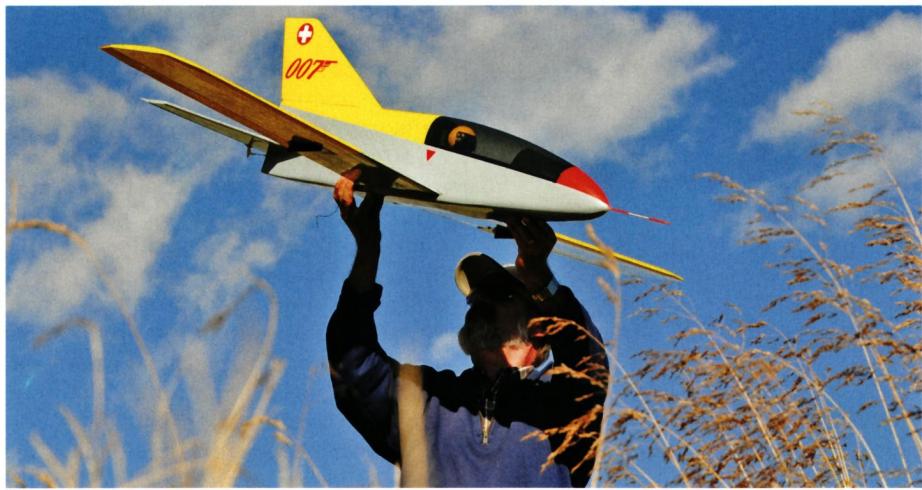
PSS gliders are adaptive. This is a significant advantage when trying to balance aerodynamics, weight, and various adjustment parameters. Admittedly, this is also true for model aircraft enthusiasts who have equipped their models with combustion engines or electric motors. For most of them, however, the angle of glide and weight play a far less significant role. If you’re flying too low, a small movement of the control stick is all it takes to climb back up. As long as the center of gravity and the EWD are reasonably well-adjusted, you can glide down from a certain altitude even with the biggest of flaws. But PSS models aren’t meant to just glide—they’re meant to gain altitude. Anyone who has ever thrown a model—one they spent hundreds of hours building in their workshop—over the edge of a slope, only to watch it go nothing but downhill from that moment on, knows exactly what I’m talking about. In the Swiss Plateau, on a small west wind or Bisen slope, this might not be quite so dramatic. A short hike, and you’ve recovered the model a few meters further down. In the Alps or even in the mountains, such recoveries can quickly turn into climbing expeditions. This is what’s known as “extreme model flying.” It’s not only extremely exhausting but also extremely dangerous. It’s probably better to find the right airfoils and the ideal settings.
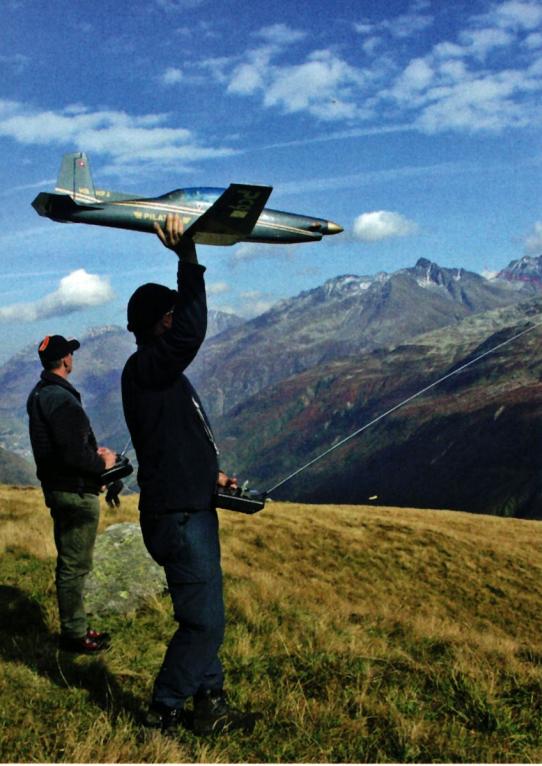
Which model aviator hasn’t been looking for them, too? All of us at IG PSSAS are still searching as well. We’ll probably never find them. But we’ve made some progress. Today, the PSS members are doing quite well at getting a new model airborne. It’s an improvement over the early days. But even the PSS can’t do it without thermals and updrafts: The electric models—the A-10 Thunderbolt, Venom, Vampire, and a few others—have played no small part in the PSS’s successes. After all, they were all among the models that learned to fly a few years ago with wooden propellers and Speed 400 motors. All were built very lightly, back then still from balsa and plywood. Styrofoam, Depron, and, in some cases, EPP were added as lightweight and easy-to-work-with construction materials. Meanwhile, even the first self-built all-FRP model—an Aérospatiale N 262 Frégate—is now flying in the Swiss mountains. Kilian Henzi’s project took just under five months. During this time, alongside his hobby—which is also his “job”—he briefly designed, drew, and built a prototype, equipping it with the finest details such as door hinges, flaps, covers, and thousands of rivets. He then used this to produce seven different fiberglass molds, and as early as May, the first N262 took flight: 150 cm wingspan. In its lightest version—weighing just under 850 grams—it has already given many a light-wind glider a run for its money and set new standards within the IG PSSAS.
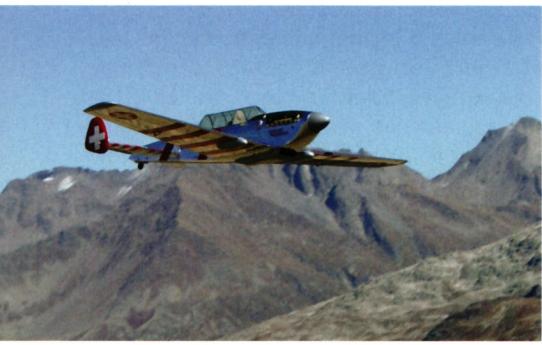
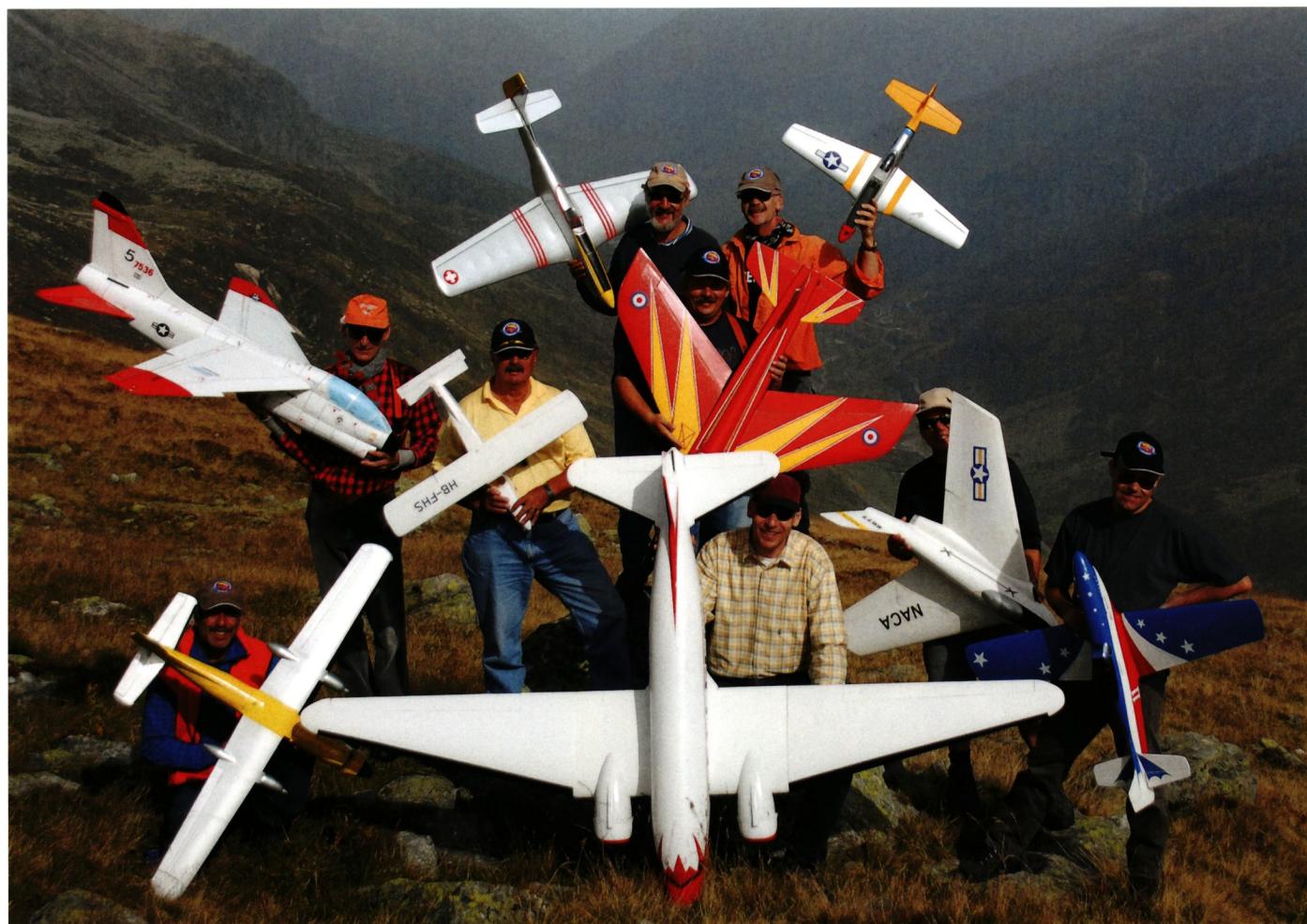
Quite simply because of their uniqueness. I have nothing against the snow-white “super orchids” with their red-trimmed wings, which undoubtedly perform much better than a PSS model. It’s just that they all look almost exactly the same. At our gatherings, a massive DC-3 with a wingspan of three meters flies alongside an 80-centimeter P-51 Mustang, a Danair N 262, and a Swiss Army Hawk. Similarly, a C-36 could meet up on the hillside with a Hunter, a Venom, a Partenavia P-68, and many others. All of them are built and painted to resemble a real-life model, at least to some extent. This alone creates a diversity that’s hard to find anywhere else.
Those interested can find information and plenty of pictures online at www.pssas.ch.
Anyone who wants to dive into the adventure of Power Scale Soaring is warmly invited to attend a meetup. Dates and times can be found on the website. If you’d like to watch a short introductory video, search for “Fiat G 55 Centauro” on YouTube to find a video by an Italian colleague from the 2005 Furka flying event. The direct link is: www.youtube.com/watch?v=SUvo3G6-4as.
So rip out the engine, remove the exhaust, stow the landing gear in a drawer, pack your backpack, and come along!


News from HEBU

TEAM MANAGER "THIS" BOSSHARD
 Rodito Nussbaumer

YOU KNOW WHAT I MEAN? 125 YEARS OF THE SWISS AERO CLUB
 Emil Giezendanner

HORIZON HOBBY/LEMACO NEWS: MICRO OV-10 BRONCO 645 MM BY E-FLITE

PRIDE AND GOOD IDEAS
 Markus Nussbaumer

34th HAHNENMOOS ALPINE MODEL AIRPLANE CAMP
Res Dauwalder
TRY-OUT DAY AT MFV WETTINGEN
Urs Keller
F3A EUROPEAN CHAMPIONSHIPS IN ST-MACAIRE, FRANCE
 Matthias Bosshard

52. 2026 ALPS CUP
Emil Giezendanner
ATOM, THE NEW DOUBLE-DECKER FROM CPLR
Matthias Bosshard
SUMMER FUN 2026 AT MG USTER
Martin Wunderli
What's New at Leomotion.com

THE PC-21 STORY
Emil Giezendanner
COUPE DES ALPES – OBSERVE AND LEARN
Rodito Nussbaumer
TWIN TOWN PARTNERSHIP
Wolfgang Voeller
EURO CONTEST GLIDER ACRO TOUR AUSTRIA 2026

BY YOUTH, FOR YOUTH
Lorena Betschen
CORSAIR F4U – A WARBIRD WITH A MEMORABLE LOOK
Jürgen Rosenberger, Jürgen Prinz
SMALL, MODEL-LIKE SAILBOATS
Res Dauwalder
WELCOME, NEW MEMBER!
Andrea Bolliger
FREE FLIGHT IN THE MIDDLE OF SUMMER
Urs Muntwyler
INSIGHTS INTO THE HISTORY OF SEAPLANES

NEWS FROM HEBU
 Julia Bucher

FROM 0 TO 100
Markus Nussbaumer
MEMORIES
Wolfgang Völler
NOS REGION – A HUB FOR ELECTRIC AVIATION
Emil Giezendanner
DO YOU KNOW WHAT I MEAN IN THE LAND OF SMILES?
Emil Giezendanner
A SPECTACULAR F3A WORLD CUP IN THE PRINCIPALITY OF LIECHTENSTEIN
Emil Giezendanner