
Nothing works without “lift”
High school students take their first steps toward becoming pilots. During the project week, aerodynamics was one of several courses offered to students at Rheinfelden High School. Here, the course instructor shares his impressions from the four-day event. On Friday, May 14, 2004, an exhibition of the students’ work and courses took place at the school. Interested parents and others were able to view some of the work during a presentation.
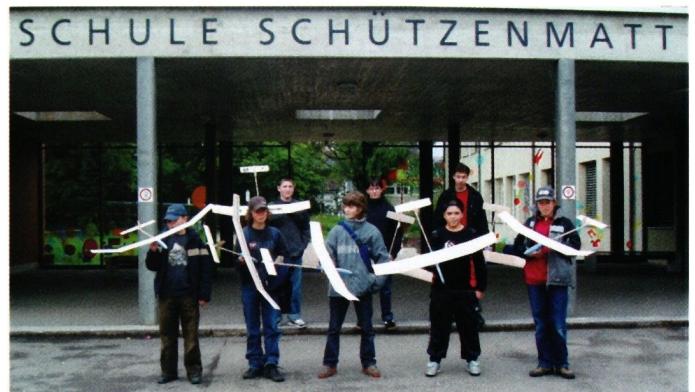
Who is Daniel Bernoulli? What is lift? What is the EWD of a wing? And finally: Why does an airplane fly? These are questions that eight middle school students from the Schützenmatt School in Rheinfelden asked themselves—and found answers to. During the project week from May 3–7, 2004, the students were offered a variety of projects to choose from. In the aerodynamics course, the “aspiring pilots” first learned why an airplane flies and how to control it in the air. They then set out to build their own model glider. Step by step, the main components of the aircraft took shape. Finally, on the third day, all the parts came together to form a whole. You could feel the motivation growing as the model neared completion. The airplanes were weighted with lead balls at the nose of the fuselage to set the center of gravity correctly. The wings were painted to protect the wood from any thunderstorm downpours during the maiden flight in the lovely month of May. The boys familiarized themselves with flying an airplane using a flight simulator, and each participant tried to virtually launch, fly, and land a model. Then came Friday, the big day of truth, when it would become clear whether the work had been done precisely and according to plan. On the way to the airfield below the Feldschlösschen Brewery, we were surprised by a Friday thunderstorm, which forced us to turn back to the school building. Just an hour later, the weather gods showed mercy, and we were finally able to test-fly the gliders on the soccer field after all. Everyone was thrilled that all the gliders actually took flight. A competition consisting of four flights ultimately crowned Daniel Delgado the winner, as his glider flew the farthest on average. We demonstrated how important the development of fine motor skills and hands-on experience are for young people in training. Focused, attentive work following a plan and the sense of accomplishment that comes from completing a task are milestones that must be nurtured and encouraged. The current political trend and the debate surrounding the reduction of hands-on, practical work in schools are diametrically opposed to the needs and interests of young people. Based on this consideration, Robert Gaechter from Magden volunteered to serve as a course instructor. Over the course of a week, he was able to gain firsthand experience working with the children right at the heart of the action. Schützenmatt School takes a proactive approach and encourages parents to contribute their knowledge and skills to support the school and the students. I highly recommend this—it enriches the children’s learning environment and also deepens parents’ understanding. We would like to take this opportunity to extend our heartfelt thanks to PS Modellbau in Liestal for providing the school’s model airplanes at a discounted price, and to Mr. Moser of the Feldschlösschen Brewery for allowing us to use the grounds as a training slope. Robert E. Gaechter lives in Magden and is a consulting mechanical engineer. He is married and the father of two children. An avid model builder for many years and an active member of the Fricktal Model Flying Club, he led the weekly aerodynamics course during the project week.

EURO CONTEST GLIDER ACRO TOUR AUSTRIA 2026

THE PC-21 STORY
 Emil Giezendanner

TWIN TOWN PARTNERSHIP
 Wolfgang Voeller

SUMMER FUN 2026 AT MG USTER
Martin Wunderli
CORSAIR F4U – A WARBIRD WITH A MEMORABLE LOOK
Jürgen Rosenberger, Jürgen Prinz
52. 2026 ALPS CUP
Emil Giezendanner
YOU KNOW WHAT I MEAN? 125 YEARS OF THE SWISS AERO CLUB
Emil Giezendanner
News from HEBU

TEAM MANAGER "THIS" BOSSHARD
Rodito Nussbaumer
ATOM, THE NEW DOUBLE-DECKER FROM CPLR
 Matthias Bosshard

F3A EUROPEAN CHAMPIONSHIPS IN ST-MACAIRE, FRANCE
Matthias Bosshard
INSIGHTS INTO THE HISTORY OF SEAPLANES

WELCOME, NEW MEMBER!
Andrea Bolliger
What's New at Leomotion.com

PRIDE AND GOOD IDEAS
 Markus Nussbaumer

SMALL, MODEL-LIKE SAILBOATS
Res Dauwalder
FREE FLIGHT IN THE MIDDLE OF SUMMER
Urs Muntwyler
BY YOUTH, FOR YOUTH
Lorena Betschen
HORIZON HOBBY/LEMACO NEWS: MICRO OV-10 BRONCO 645 MM BY E-FLITE

34th HAHNENMOOS ALPINE MODEL AIRPLANE CAMP
Res Dauwalder
COUPE DES ALPES – OBSERVE AND LEARN
Rodito Nussbaumer
TRY-OUT DAY AT MFV WETTINGEN
 Urs Keller

NEWS FROM HEBU
 Julia Bucher

NOS REGION – A HUB FOR ELECTRIC AVIATION
Emil Giezendanner
MEMORIES
 Wolfgang Völler

70 YEARS OF THE NIDWALDEN MODEL AIRPLANE CLUB
Martin Barmettler
A SPECTACULAR F3A WORLD CUP IN THE PRINCIPALITY OF LIECHTENSTEIN
Emil Giezendanner
FROM 0 TO 100
Markus Nussbaumer