
Corsair GWS: Small but mighty!
GWS, a Taiwan-based company, manufactures a wide range of polystyrene park flyers and accessories for small models, which are generally known for their affordable prices. The recent arrival of a distributor in Switzerland gave me the opportunity to take a closer look at this manufacturer’s line of warbirds—and more specifically at the Corsair, a truly one-of-a-kind aircraft with such a distinctive shape.
Available for less than 100 francs, the kit is very comprehensive and includes:
- Two fuselage halves, a one-piece wing, the stabilizer, and the vertical stabilizer, all molded from white expanded polystyrene with a fairly fine grain
- A transparent canopy
- A one-piece ABS engine cowling
- A complete landing gear set with indoor-type wheels
- Control cables and rods
- Two sprues of small plastic parts
- A 280-type motor screwed onto its mount with a 5.33:1 gearbox on bearings and a 3 mm shaft
- A spinner and two propellers
- Two sheets of decals
- Step-by-step assembly instructions illustrated with numerous photos
- A CD-ROM for PC
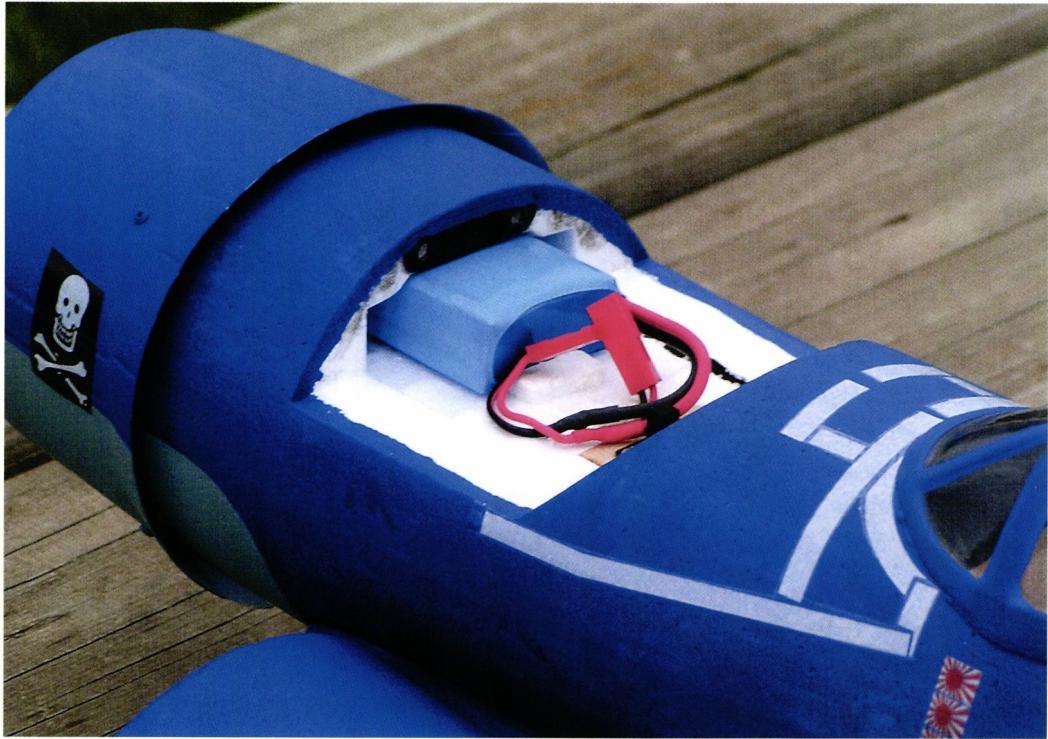
A glance at the manual suggests that assembly will be fairly quick, with most of the work devoted to finishing (painting). Note that the wing has a distinctive profile with a recessed underside at the rear, as the aircraft can also be used for slope soaring (PSS glider). Some design choices are innovative, such as the magnetic closure for the battery access hatch. Before starting work, be sure to protect your work surface with foam or honeycomb plastic to avoid marking the polystyrene parts, use a scalpel for all cutting or trimming of the material, and use epoxy or cyanoacrylate adhesive specifically designed for polystyrene, along with an activator, for bonding.
Assembly is done by following the instructions, with a few minor differences:
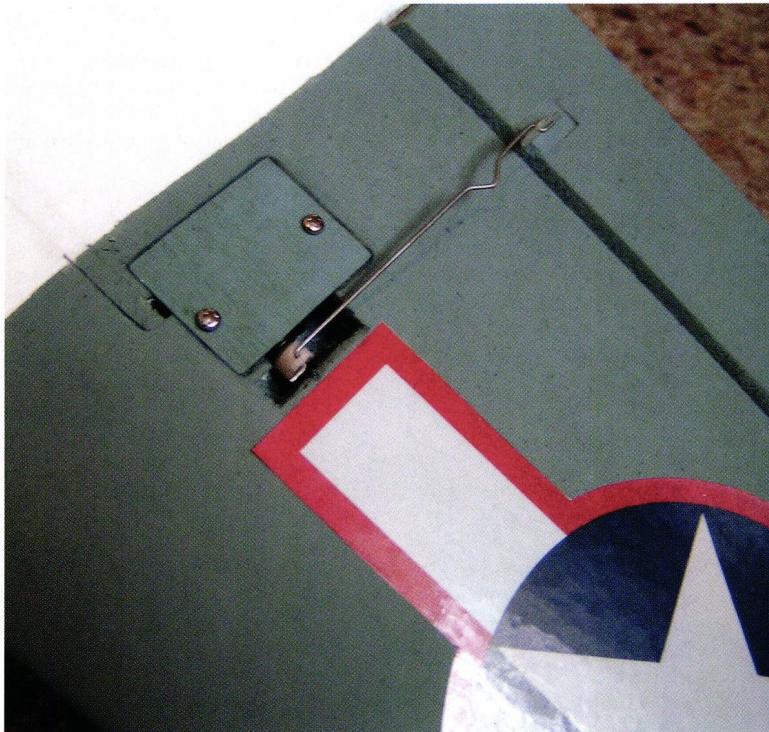
- Given the shape of the wings, the ailerons are controlled by two 9-gram servos mounted flat and secured with a 0.8 mm CTP cover
- The control lines are replaced with 0.8 mm caps and white tubing with no slack
- The wheels and indoor tail wheel are models with foam tires available as an option
| Technical Specifications | |
| Length: | 727 mm |
| Wingspan: | 901 mm |
| Wing area: | 15 dm² |
| Weight: | 455 g |
| Wing loading: | 30.3 g/dm² |
| Powerplant: | GW/EPS 350C |
| Propeller: | 8″×6″ |
| Batteries: | 11.1 V/1250 mAh LiPo |
- Bomb-shaped skids are made to replace the landing gear when flying on a grass runway
Finally, the entire aircraft is sanded with fine-grit sandpaper and hand-painted with acrylic paints, accented with a few details and weathering effects (exhausts). The chosen subject is an F4U-1A in a three-tone scheme with red-edged cockades dating from the winter of 1943–1944 on the island of Bougain-
View of the model in grass-landing configuration.
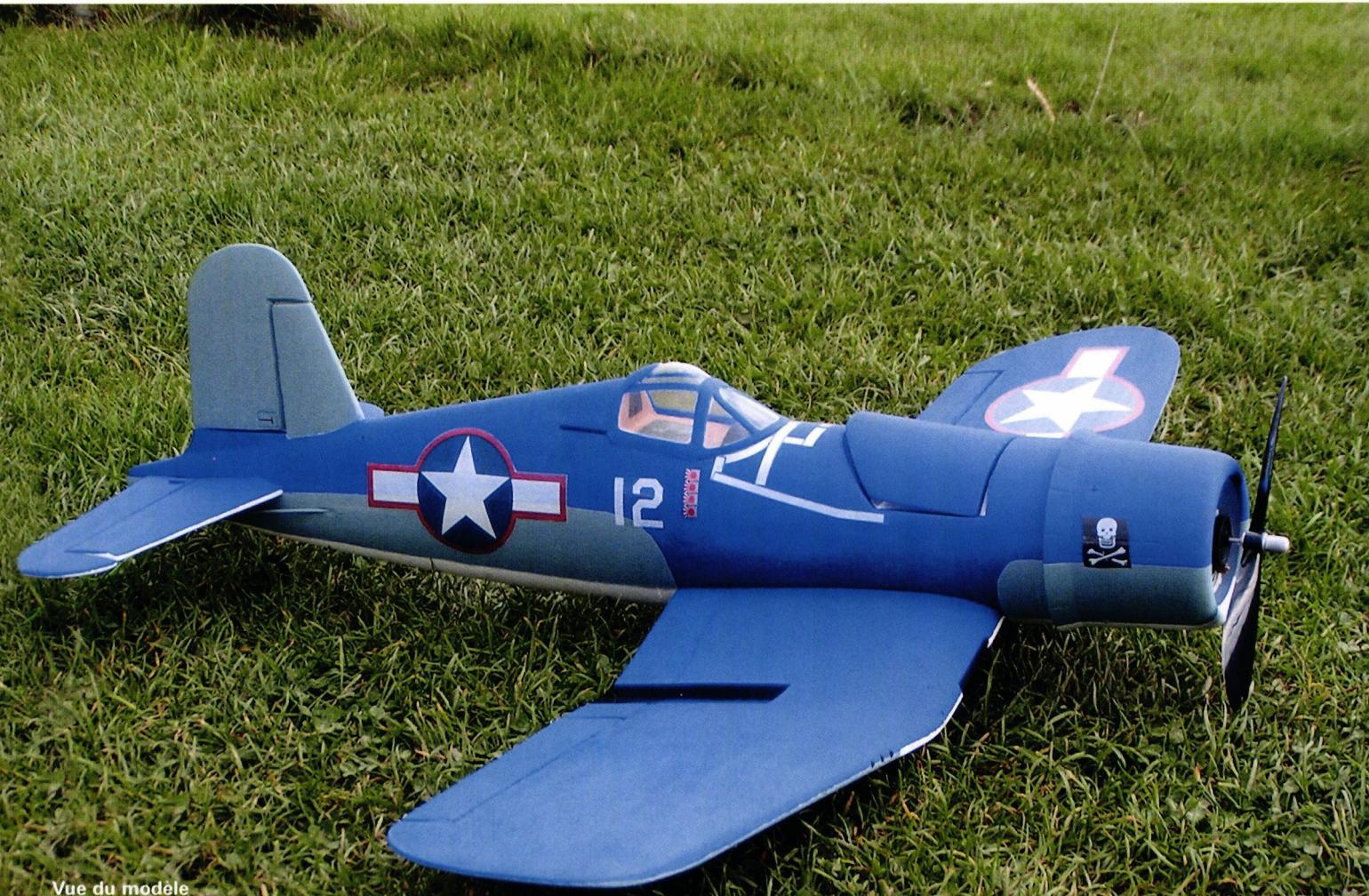
city (VF-17 “Jolly Rogers” squadron).
For the initial tests, a 3S/1250 mAh LiPo battery was selected, which required choosing the smallest propeller (8"×6") to avoid overloading the motor and resulted in a total weight of 455 g. The center of gravity was set—without lead—at 60 mm from the leading edge, in accordance with the instructions (note: the illustration shows a value that is too far forward, at 50 to 55 mm!). The control travel was set to the manufacturer’s maximum values.
Ground handling is very easy thanks to the steerable tail wheel, and takeoff from a paved runway requires only about ten meters.
On grass, you can launch the model by holding it by the fuselage below the trailing edge, but the maneuver
is tricky. A piece glued under the wing would make this easier—for example, a dummy fuel tank.
The power delivered by the engine is more than sufficient, and all phases of flight—including aerobatics—can be performed at half throttle.
The model proves to be stable and well-damped, though a bit responsive to the elevator, and performs very respectably in strong winds.
Landing requires a bit more attention to avoid nose-diving, but you can fold the landing gear legs forward to counteract this tendency.
Subsequently, the elevator and aileron travel were reduced to achieve a smoother flight.
Maximum current draw is limited to 7 to 8 amps, and typical flight time is about 20 minutes, provided you don’t overuse the throttle.
Power from a 2S LiPo battery would also be possible in combination with the included 9″×7″ propeller or, even better, with an optional 9″×7″ three-blade propeller.
The main strength of this Corsair is that it flies like a larger model, with the added benefit of being able to maintain very low speeds without stalling, although flying it requires some experience and may not be suitable for a beginner.
The in-flight feel is quite realistic, and the model’s aesthetics are undeniable.
This model also demonstrates that remarkable performance can be achieved with low-cost equipment. And since everyone agrees it’s cute… So if you’re interested in small models that actually look like something, check out www.gws-rc-models.ch to see if you find what you’re looking for!
François Croset

EURO CONTEST GLIDER ACRO TOUR AUSTRIA 2026

THE PC-21 STORY
 Emil Giezendanner

TWIN TOWN PARTNERSHIP
 Wolfgang Voeller

SUMMER FUN 2026 AT MG USTER
Martin Wunderli
CORSAIR F4U – A WARBIRD WITH A MEMORABLE LOOK
Jürgen Rosenberger, Jürgen Prinz
52. 2026 ALPS CUP
Emil Giezendanner
YOU KNOW WHAT I MEAN? 125 YEARS OF THE SWISS AERO CLUB
Emil Giezendanner
News from HEBU

TEAM MANAGER "THIS" BOSSHARD
Rodito Nussbaumer
ATOM, THE NEW DOUBLE-DECKER FROM CPLR
 Matthias Bosshard

F3A EUROPEAN CHAMPIONSHIPS IN ST-MACAIRE, FRANCE
Matthias Bosshard
INSIGHTS INTO THE HISTORY OF SEAPLANES

WELCOME, NEW MEMBER!
Andrea Bolliger
What's New at Leomotion.com

PRIDE AND GOOD IDEAS
 Markus Nussbaumer

SMALL, MODEL-LIKE SAILBOATS
Res Dauwalder
FREE FLIGHT IN THE MIDDLE OF SUMMER
Urs Muntwyler
BY YOUTH, FOR YOUTH
Lorena Betschen
34th HAHNENMOOS ALPINE MODEL AIRPLANE CAMP
Res Dauwalder
HORIZON HOBBY/LEMACO NEWS: MICRO OV-10 BRONCO 645 MM BY E-FLITE

COUPE DES ALPES – OBSERVE AND LEARN
Rodito Nussbaumer
TRY-OUT DAY AT MFV WETTINGEN
 Urs Keller

NEWS FROM HEBU
 Julia Bucher

NOS REGION – A HUB FOR ELECTRIC AVIATION
Emil Giezendanner
MEMORIES
 Wolfgang Völler

70 YEARS OF THE NIDWALDEN MODEL AIRPLANE CLUB
Martin Barmettler
A SPECTACULAR F3A WORLD CUP IN THE PRINCIPALITY OF LIECHTENSTEIN
Emil Giezendanner
FROM 0 TO 100
Markus Nussbaumer