
Testimonial
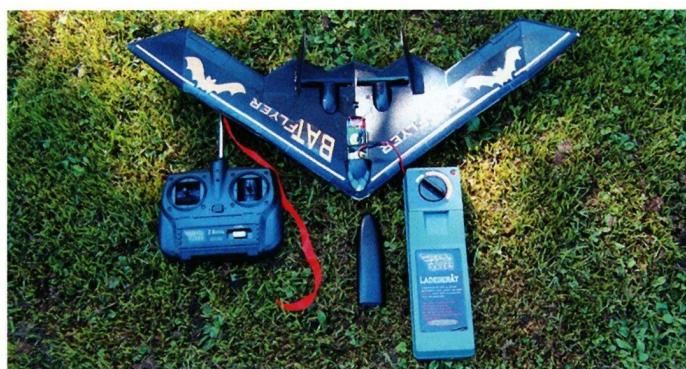
A twin-engine electric model airplane with a remote control and battery charger, all packed neatly into a handy box? I couldn’t believe my eyes when I was handed this box containing the airplane. Inside are the model, the transmitter, and a charger; and I really didn’t have to take anything more than this one box to the airfield to enjoy flying.
A glance inside the box and the size of the airplane—with a wingspan of 680 mm—elicited an “ooh” from everyone present, but it really does have everything you need. The batteries can be removed from the airplane in a minute and charged with the charger in 20 minutes. Then pick up the remote control and be sure to check the wind—ideally, there shouldn’t be any at all. Push the throttle forward, and off you go. With a turbine-like roar, the plane gently climbs and
flies away at a remarkable speed. The first turns take a little getting used to, because the plane has no ailerons, and the direction is determined exclusively by the thrust of the two tail propellers. For tighter turns, you simply have to figure out the trick of always releasing the throttle during the turn; otherwise, the thrust from the tail propellers isn’t different enough. Once you get used to it, flying in circles is really fun, and even light thermals are enough for longer gliding flights without constant propulsion.
Of course, flying the Bat Flyer isn’t comparable to flying a “full-size” gasoline-powered or electric airplane. But in my opinion, it’s the easiest way—even for non-model aviators—to experience the thrill of flying a model airplane. For experienced pilots, the model certainly isn’t a real challenge, but the Bat Flyer definitely offers a great deal of fun...
R. Stoppa

EURO CONTEST GLIDER ACRO TOUR AUSTRIA 2026

THE PC-21 STORY
 Emil Giezendanner

TWIN TOWN PARTNERSHIP
 Wolfgang Voeller

SUMMER FUN 2026 AT MG USTER
Martin Wunderli
CORSAIR F4U – A WARBIRD WITH A MEMORABLE LOOK
Jürgen Rosenberger, Jürgen Prinz
52. 2026 ALPS CUP
Emil Giezendanner
YOU KNOW WHAT I MEAN? 125 YEARS OF THE SWISS AERO CLUB
Emil Giezendanner
News from HEBU

TEAM MANAGER "THIS" BOSSHARD
Rodito Nussbaumer
ATOM, THE NEW DOUBLE-DECKER FROM CPLR
 Matthias Bosshard

F3A EUROPEAN CHAMPIONSHIPS IN ST-MACAIRE, FRANCE
Matthias Bosshard
INSIGHTS INTO THE HISTORY OF SEAPLANES

WELCOME, NEW MEMBER!
Andrea Bolliger
What's New at Leomotion.com

PRIDE AND GOOD IDEAS
 Markus Nussbaumer

SMALL, MODEL-LIKE SAILBOATS
Res Dauwalder
FREE FLIGHT IN THE MIDDLE OF SUMMER
Urs Muntwyler
BY YOUTH, FOR YOUTH
Lorena Betschen
HORIZON HOBBY/LEMACO NEWS: MICRO OV-10 BRONCO 645 MM BY E-FLITE

34th HAHNENMOOS ALPINE MODEL AIRPLANE CAMP
Res Dauwalder
COUPE DES ALPES – OBSERVE AND LEARN
Rodito Nussbaumer
TRY-OUT DAY AT MFV WETTINGEN
 Urs Keller

NEWS FROM HEBU
 Julia Bucher

NOS REGION – A HUB FOR ELECTRIC AVIATION
Emil Giezendanner
MEMORIES
 Wolfgang Völler

70 YEARS OF THE NIDWALDEN MODEL AIRPLANE CLUB
Martin Barmettler
A SPECTACULAR F3A WORLD CUP IN THE PRINCIPALITY OF LIECHTENSTEIN
Emil Giezendanner
FROM 0 TO 100
Markus Nussbaumer