
Warbirds on a 1:1 scale
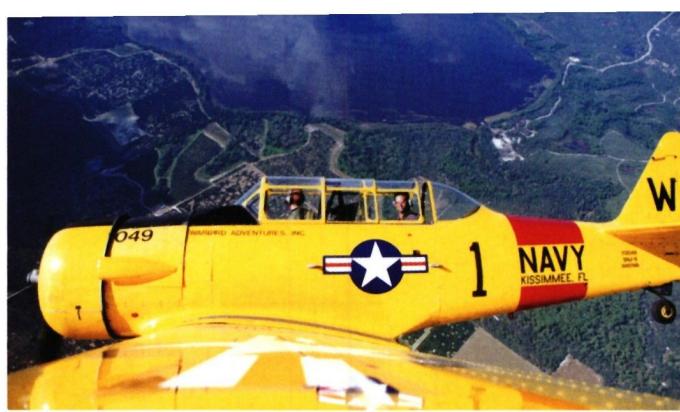
The T-6 Harvard was the standard training aircraft for the Allies during World War II and perhaps even the most important design in the history of aviation. It is still flown and maintained as a warbird all over the world today.
Although the T-6 was originally designed solely as a basic trainer, it was later used for a wide variety of purposes, such as a fighter aircraft, interceptor, light bomber, and for air patrol. Almost every country in the world flew this aircraft or trained its pilots on it, including Switzerland.
As part of my type rating training on the P-51 Mustang in Kissimmee, Florida, I was allowed—and required—to log about 10 hours on this trainer. The reason is simply that the T-6 has a cockpit layout very similar to that of the P-51. In addition, flying the Mustang requires experience with high-powered tailwheel aircraft.
The last aircraft I flew before that was an Extra 300L with 300 PS, but at around 800 kg, it was nearly two metric tons lighter than the T-6.
An essential part of the T-6’s preflight check is spinning the propeller several times to ensure that accumulated oil in the lower cylinders doesn’t seize the engine during startup.
My first impression upon boarding the T-6 immediately made me feel like I was sitting in a real warbird. Above all, the smell of old leather, oil, and gasoline is what makes these aircraft feel like they’ve been transported back 50 years. To the left of the seat, you’ll notice a lever that controls the hydraulic pump. When you press this lever, you have hydraulic pressure for about 30 seconds to extend the flaps and landing gear. The checklist then says “Power-push Gear” or “Power-push Flaps.” But more on that later.
Set the mixture to “rich” and move the throttle lever forward 2–3 cm. Then, fuel is injected 5 to 6 times using a metal pin. Next, press the starter button and let the propeller turn two revolutions, then switch on the two magnetos. The engine starts running with a loud pop and a sound typical of a radial engine. The white plumes coming from the exhaust indicate residual oil from the last flight.
When taxiing to the runway, you have to taxi in a zigzag pattern because the T-6’s long, high nose blocks your forward view. Through the open cockpit, you get a full sense of the engine’s sound and heat. It’s the real warbird experience. Since the tail wheel, when locked in place, can only pivot 6° in either direction, you need to unlock it for tighter turns. This is done by pushing the control stick all the way forward. This pulls a pin on the tail wheel, allowing it to rotate 360°.
During the run-up check, at 1,600 RPM, the propeller is switched three times from fine pitch to coarse pitch so that the oil, which moves the piston for the RPM adjustment, becomes warm and thin.
The engine is also run on each individual magnet to ensure that both are functioning properly.
For a normal takeoff, the flaps are retracted. The rudder is trimmed approximately 6° to the right; this helps the pilot counteract the torque that occurs.
Then the boost pressure is slowly increased to about 34 inches, and the T-6 comes to life. To me, it felt like sitting on a tall horse that was trotting off slowly but very powerfully. At around 40–50 knots, you raise the tail by gently pushing the elevator. Up to that point, you’re extremely careful to keep the T-6 flying dead straight using the rudder. Because if it breaks out even once and you overcorrect, you’ll quickly end up in the grass. It’s the same as with a warbird model or even an overpowered Piper. We’ve all been there—the model can quickly veer off 90° to the left.
At around 100–110 knots, you pull the T-6 off the runway with a slight elevator input. We then climb to 7,000 feet at about 140 knots. Only now does an incredible sense of satisfaction spread through the cockpit, and you feel as if you’ve been transported back 60 years. This is a good altitude to start practicing some stalls and spins. Depending on the load, the T-6 stalls at around 100 knots. The stall comes on quite abruptly, and the T-6 rotates about 60° to the right around its longitudinal axis. This is quite surprising for a trainer. After all, the Mustang, at a similar
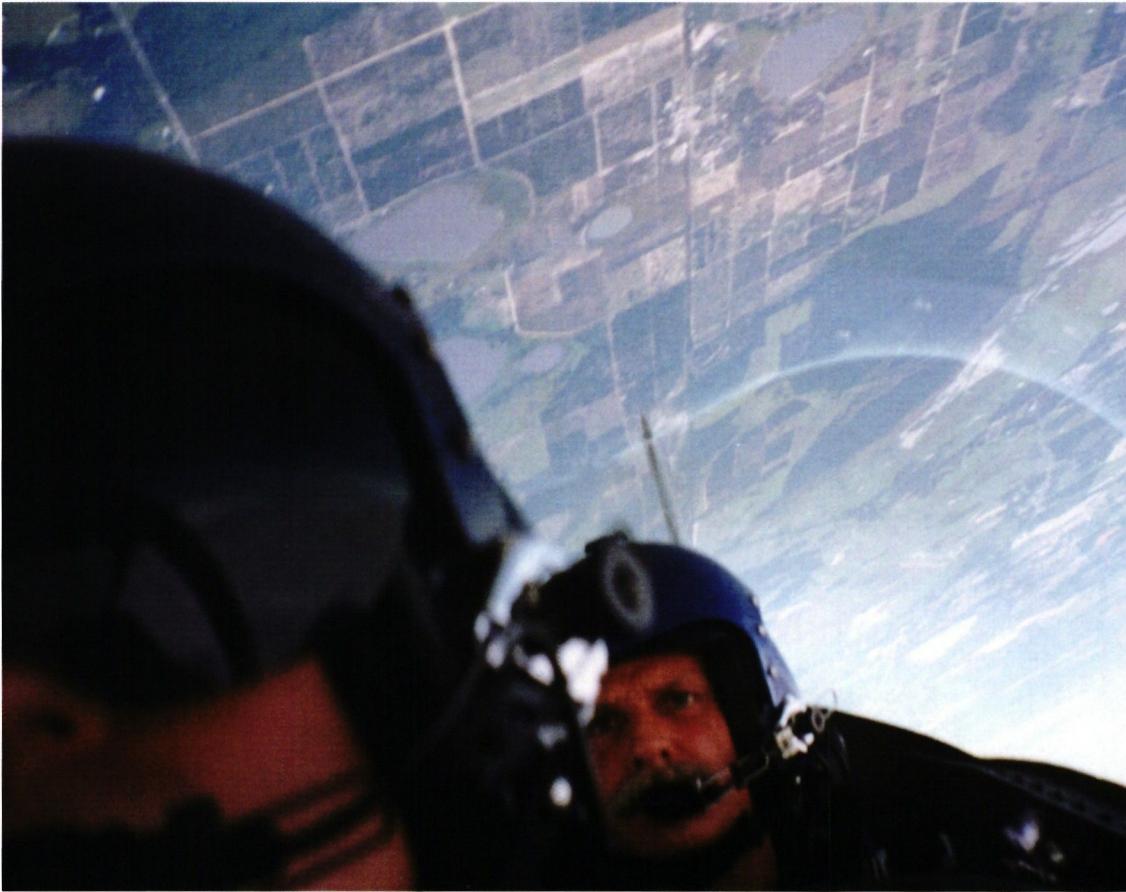
It’s actually quite docile and very easy to control. During a spin, the T-6 turns quite quickly in both directions. Thanks to the large rudder, the spin can be stopped fairly quickly even without using the elevator. But with elevator and opposite rudder, it stops even faster—and that’s exactly what the manual says.
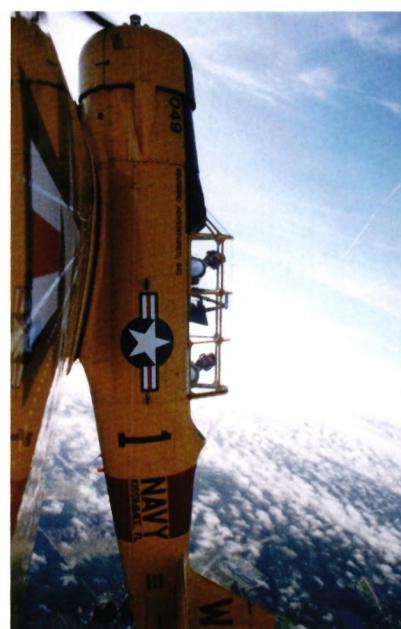
The control forces on the T-6 are surprisingly light for its weight and roughly comparable to those of a PC-7. Our T-6 took about 2–3 seconds to complete a roll, which isn’t bad for a warbird. It was also quite responsive to fly during aerobatics. Naturally, the loop and barrel rolls are much larger—and seem more cumbersome—due to the weight and speed.
Perhaps you’re already familiar with our website: www.flugvideo.ch? We offer videos of model aircraft airshows and major airshows in Switzerland. These include the Payerne Air Show, the Lodrino Jet Meeting, and Warbirds over Glarnerland...
than with a CAP or Pitts. But it’s still amazing how agile an almost 60-year-old aircraft with a takeoff weight of 2.5 metric tons can be when flying through all the standard aerobatic maneuvers. When performing a stall turn with a warbird like this one, you must ensure that you fly the maneuver to the left, in accordance with the propeller’s direction of rotation. You must also significantly reduce power when entering the maneuver; otherwise, the precision, slipstream, and torque will exceed the available aerodynamic forces on the elevator and rudder.
The balanced counterweights in the control surfaces ensure a comfortable control feel on all three axes.
Flying low over Florida’s Everglades really gave me that authentic warbird feeling. Thundering at 160 knots over swamps and mangrove forests is a sensation that always made me let out a loud “WAHUUUOOOO.” Simply fantastic.
The cockpit can be opened, giving you a wonderful view of the aircraft
and the landscape. Depending on the outside temperature, the heat in the cockpit can rise to extremely high levels, so it’s no surprise to be drenched in sweat after just a short flight. After all, you’re sitting just one meter behind the Pratt & Whitney—
ney Wasp R-1340 engine. With a normal flying style, it consumes approximately 130–150 liters of avgas per hour.
During the descent toward the airfield, care must be taken to keep the radial engine’s temperature at a minimum to prevent what is known as “shock cooling.” This is achieved by maintaining 20–25 inches of power and beginning the descent as early as possible.
On the downwind leg, it’s time for “Power-Push Gear”: firmly push the lever to the left of the seat, check the hydraulic pressure gauge (min. 1,000 psi), and lower the landing gear lever. Through two Plexiglas windows on the wings, you can see the landing gear locking pins engage. If they do not engage on one or both sides, you can manually unlock the landing gear and rock the aircraft using the rudder to engage it.
Next, engage the Power-Push flaps, check the hydraulic pressure, and extend the flaps in stages.
In this so-called “dirty configuration,” the T-6 descends extremely quickly. During the final approach, the propeller is set to fine pitch and the mixture to full rich.
Due to the T-6’s high drag in the landing configuration, it’s important to fly a clean and steep final approach at approximately 100 knots. This is because if you miss the correct altitude and speed before touchdown, the T-6 will simply touch down on the runway with its main landing gear and then begin to bounce.
Strong crosswinds exceeding 20 kts during landing should be avoided. Otherwise, let one wing hang into the wind, use the rudder to maintain alignment, and touch down on just one wheel first.
As soon as one or both main landing gear wheels touch the runway, you push the control stick forward quickly but gently and taxi on the main landing gear until the speed is reduced enough that the tail comes down on its own. Due to its relatively short tail, the T-6 is quite lively during takeoff and landing. By comparison, the P-51 is a breeze. Taxing back to the hangar is routine, and it’s only then that you realize just how drenched in sweat you are.
Making the switch to the Mustang was another huge leap forward for me in terms of flying, but the T-6 remains a great—and above all, affordable—way for me to fly a warbird. Warbird Adventures in Kissimmee offers these flights at very affordable prices. It’s practically a must for any warbird fan. Happy landings.
Michael Weber
| 4419 Lupsingen |
| Age: 26. |
| Commercial and airline pilot |
| Total flight hours: 1,700 h |
| Flying experience on various warbirds such as the P-51 Mustang, AT-6 Harvard, T-28 Trojan, and Pilatus P-2 |
| Aerobatic aircraft: Extra 300L, CAP, and Pits Spezial |
| Airliners: Saab 2000 |

EURO CONTEST GLIDER ACRO TOUR AUSTRIA 2026

THE PC-21 STORY
 Emil Giezendanner

TWIN TOWN PARTNERSHIP
 Wolfgang Voeller

SUMMER FUN 2026 AT MG USTER
Martin Wunderli
CORSAIR F4U – A WARBIRD WITH A MEMORABLE LOOK
Jürgen Rosenberger, Jürgen Prinz
52. 2026 ALPS CUP
Emil Giezendanner
YOU KNOW WHAT I MEAN? 125 YEARS OF THE SWISS AERO CLUB
Emil Giezendanner
News from HEBU

TEAM MANAGER "THIS" BOSSHARD
Rodito Nussbaumer
ATOM, THE NEW DOUBLE-DECKER FROM CPLR
 Matthias Bosshard

F3A EUROPEAN CHAMPIONSHIPS IN ST-MACAIRE, FRANCE
Matthias Bosshard
INSIGHTS INTO THE HISTORY OF SEAPLANES

WELCOME, NEW MEMBER!
Andrea Bolliger
What's New at Leomotion.com

PRIDE AND GOOD IDEAS
 Markus Nussbaumer

SMALL, MODEL-LIKE SAILBOATS
Res Dauwalder
FREE FLIGHT IN THE MIDDLE OF SUMMER
Urs Muntwyler
BY YOUTH, FOR YOUTH
Lorena Betschen
HORIZON HOBBY/LEMACO NEWS: MICRO OV-10 BRONCO 645 MM BY E-FLITE

34th HAHNENMOOS ALPINE MODEL AIRPLANE CAMP
Res Dauwalder
COUPE DES ALPES – OBSERVE AND LEARN
Rodito Nussbaumer
TRY-OUT DAY AT MFV WETTINGEN
 Urs Keller

NEWS FROM HEBU
 Julia Bucher

NOS REGION – A HUB FOR ELECTRIC AVIATION
Emil Giezendanner
MEMORIES
 Wolfgang Völler

70 YEARS OF THE NIDWALDEN MODEL AIRPLANE CLUB
Martin Barmettler
A SPECTACULAR F3A WORLD CUP IN THE PRINCIPALITY OF LIECHTENSTEIN
Emil Giezendanner
FROM 0 TO 100
Markus Nussbaumer