
Chronicle of the ALRS
For quite some time, the European rocket community looked enviously toward the distant United States, where a gathering of many American and international rocket enthusiasts takes place every year. For many of us, all we had were the accounts of those who had already been there, or a glance at rocket magazines that often took months to arrive. More recently, coverage on the Internet and Usenet forums has at least provided a timely glimpse of the flight days across the pond. However, much of what was flown there remained, for the time being, nothing more than a pipe dream in terms of size, perfection, and propulsion.
In 2000, the time had finally come. Organized by the Swiss ARGOS (Advanced Rocketry Group of Switzerland), the first large-rocket flight day on the European mainland finally took place after months of preparation. Following the American model LDRS (Large and Dangerous Rocket Ships), this flight event was named ALRS (ARGOS Large Rocket Ships). The adjective “dangerous” was deliberately omitted, as it does not apply to flight-capable rocket models.
This chronicle is intended to provide a brief overview of five years of “higher, faster, further” in Val de Ruz.
In 1999, an announcement on the Internet caused a sensation. There was going to be an air show in Switzerland, and there would be almost no limits on engine power! Many of us had been waiting for this for a long time, and had repeatedly imagined what it would be like to see large rockets in person. In March 2000, the time had finally come: sixty rocket enthusiasts from all over the world set off for Switzerland to pursue their passion.
The trip to Val de Ruz near Neuchâtel was long for some, but never boring—after all, there were so many fantasies to live out, so many launches to run through in their minds...
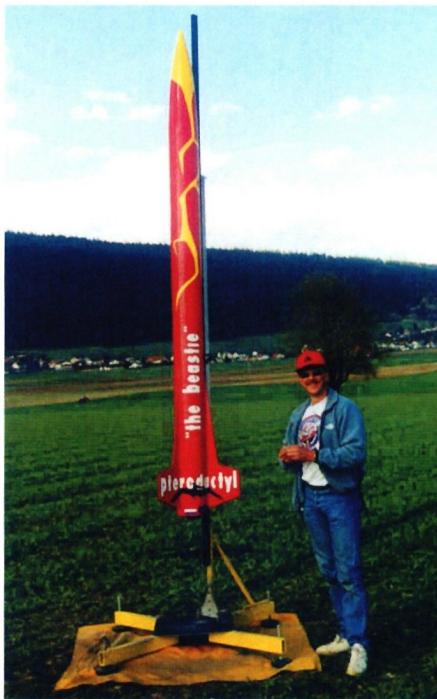
Upon arriving at the scene, everyone immediately took a look at the rockets brought by the other participants. In no time at all, an almost family-like atmosphere took hold. Many knew each other only through the Internet or phone calls and could now put a face and a rocket to each voice. Many rockets were launched, ranging in size from a flying pencil to Frank deBrouwer’s “The Beastie” from the Netherlands, which was 350 cm long and weighed 18 kg. For the first time on the European mainland, the rocket-flying community got to experience an “M”-class engine, and the applause after burnout—as well as for the successful landing and passing of the Level 3 test—was immense.
In the evening, old friendships were strengthened, new ones formed, and enthusiasts talked shop late into the night (or early in the morning, depending on your perspective).
Exhausted but still excited, many stumbled onto the airfield the next morning, only to be bitterly disappointed by the weather. Overnight, a rain front had crept into the Val de Ruz, bringing the event to an early end.
That’s when the saying “After ALRS is before ALRS” was born, and so, full of hope for better weather and even more beautiful flights, we set off on the long journey home with a final “See you at ALRS 2!”
ALRS 2 not only brought the rocket community back together in harmony
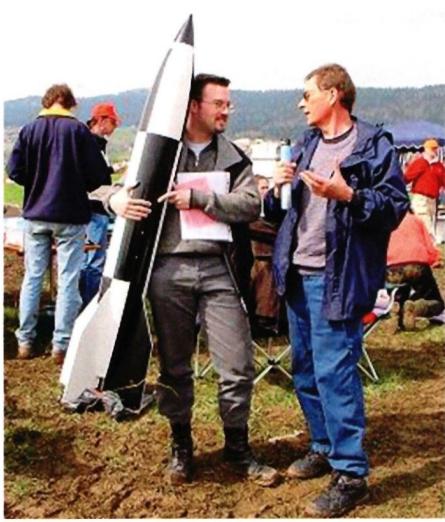
to Neuchâtel, but also brought along two TV crews from Germany, one from Austria, and various reporters from local newspapers to the field.
While last year’s event had been very crowded due to heavy foot traffic from the public, this was not the case in 2001. Due to concerns that, with attendance figures like those in 2000 (just under 700 spectators), it would no longer be possible to guarantee compliance with safety regulations, explicit advertising outside the aviation community had been avoided this year.
Nevertheless, nearly sixty pilots from all over the world—including the U.S.—gathered once again to enjoy their hobby in harmony.
Flying events like this are ideal for testing one’s personal limits and, as part of the required certifications, advancing to the next higher engine class. Accordingly, there was a high number of high-powered flights. Stefan Wimmers’ and Tom Engelhardt’s respective Level 2 flights were also recorded for television and later broadcast on Spiegel TV. A feast for the eyes—and for many, reason enough to attend—were, of course, the large rockets built by our Dutch colleagues. Up to 5 meters long, weighing 20 kg, made of carbon fiber and fiberglass-reinforced plastic (FRP), and equipped with electronics and 2–3 parachutes on board, these rockets promised entertainment at its finest. Unfortunately, not all flights went flawlessly. More than once, when the parachute failed to open, the helpless pilot had no choice but to face the inevitable disaster: yet another victim of the rocket gods... It should be noted, however, that thanks to the strictly enforced safety regulations, there were no injuries to report—and this holds true worldwide, by the way. This weekend, too, the evening wrapped up with a raffle and plenty of liquid fuel. The day’s unluckiest participants found luck at the raffle and were able to take home a large number of new kits and spare parts.
2001 had not been a good year. After the successful ALRS in March, in September the world witnessed burning skyscrapers and a nation on the brink of war.
In the wake of the devastating terrorist attacks in the U.S., rocket enthusiasts were once again the subject of much discussion, and for a long time there were plans to cancel the 2002 ALRS. In October 2001, another blow struck: in Las Vegas, the production facility of the main supplier, Aerotech, burned to the ground. After this accident, which seriously injured three workers and killed one, it looked for a long time as though our hobby would soon exist only in virtual reality. Only through bold intervention and generous donations of supplies and funds was the community able to stay afloat.
Ultimately, however, in October 2002, a group of the “usual suspects” gathered at the well-known location and found a swamp par excellence. Days of rain and stormy winds had turned the meadow into a quagmire. After just a short walk, every pilot already had about a kilo of mud on their boots—and they were size 49.
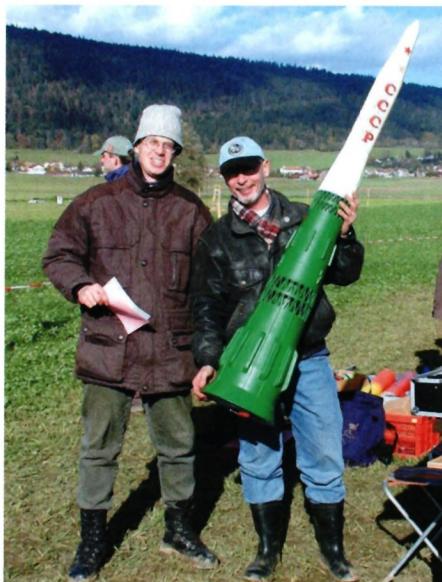
Undeterred by strong winds, rockets were still launched—albeit in smaller numbers and with limited engine power. Under those dark clouds (sic!), a few beautiful flights still took place at ALRS 3, which made up for the bad weather for the few people who were there. It was perhaps at this gathering in particular that it became most clear why the ALRS has become such an important institution for me and many other rocket enthusiasts: we had made friends, and even though rockets are an important part of our lives, they are not the most important thing.
At ALRS 4, the rocket gods were kind to us. Although a relatively strong wind was blowing through the Val de Ruz, the September sun was still shining brightly, treating us to a weekend with nearly 100 flights across all engine classes, a fantastic atmosphere, and, once again, a truly international crowd. Model rocket enthusiasts from Germany, Great Britain, France, Italy, Sweden, and the Netherlands brought the fruits of their labor from long winter months, carefully packed, all the way to Neuchâtel. Gregory Pribush made a special trip all the way from Israel with a disassembled rocket in his suitcase (seeing the look on the customs officers’ faces must have been priceless).
Above all, it became clear here that the “rocket bug” had found fertile ground, especially in the countries surrounding Switzerland. Many rocket enthusiasts brought their families along, and many children had already brought their own rockets with them.
Some were even ready to assemble their first motor under the watchful eye of an adult pilot and then have an experienced colleague launch it in the rocket. Of course, the ALRS is primarily intended to be a gathering for flying, seeing and being seen, and for test flights. At such gatherings, there is a wealth of experience on hand from which everyone—especially the younger generation—can benefit.
Once again, practically the entire spectrum of our hobby was represented: From homemade rockets made from a roll of wrapping paper, some balsa wood, and a plastic parachute, to the scale model Saturn V moon rocket, remote-controlled rocket gliders, and high-performance carbon-fiber-reinforced plastic (CFRP) rockets. And once again, we were able to enjoy a flight day with almost no losses—if only… well, if only the “rocket-eating tree” hadn’t swallowed one of the last rockets of the day.
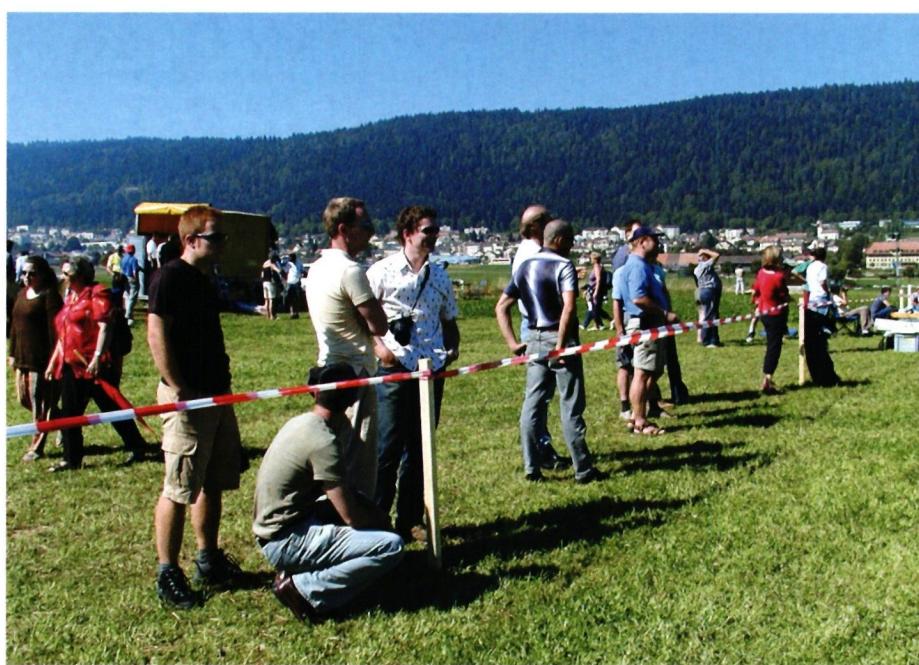
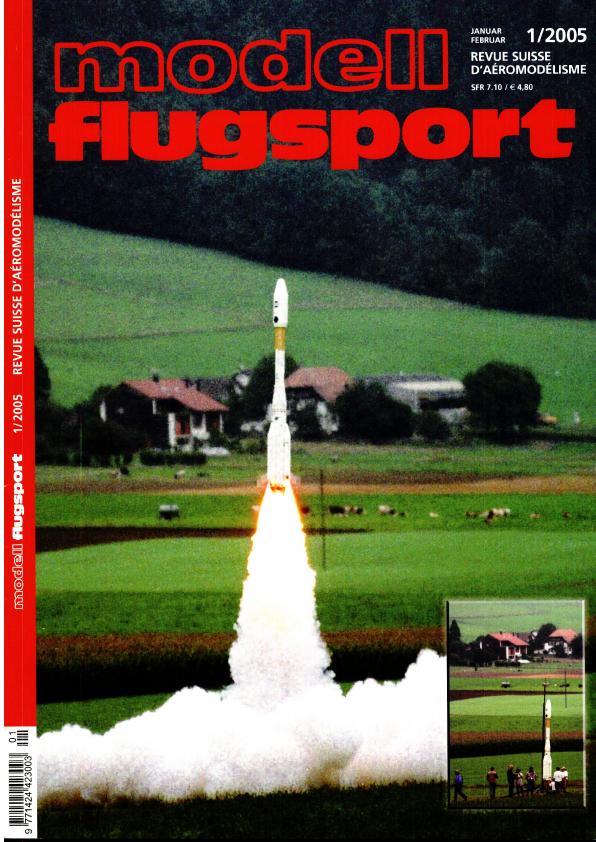
ALRS 5 was the largest gathering on the mainland to date. A large number of pilots were able to take their exams. The largest and most complex scale rocket in Europe, the Ariane 4, was also successfully launched. It was built by a team of five ARGOS members. The wind and weather were very kind to the rocket community this time. Not a single cloud marred the first day, and so, after some initial loading delays, rocket after rocket was soon launched from all the launch pads—always under the watchful eye of the RSO (Range Safety Officer).
The highlight—the Ariane flight—was successfully completed on Sunday as bad weather was rolling in (the rain front was still half an hour away); I’ll just let the pictures speak for themselves here. As the final flight—and as a bonus, so to speak—we were able to celebrate a rather rare occurrence: the successful Level 1 flight by Eveline Isenschmid, who had caught the “rocket bug” from her boyfriend (a co-initiator of the Ariane project).
The highlight—the Ariane flight—was successfully completed on Sunday as bad weather was rolling in (the rain front was still half an hour away); I’ll just let the pictures speak for themselves here. As the final flight—and as a bonus, so to speak—we were able to celebrate a rather rare occurrence: the successful Level 1 flight by Eveline Isenschmid, who had caught the “rocket bug” from her boyfriend (a co-initiator of the Ariane project).
The ALRS will certainly continue to grow as an institution in the rocket community. We’ll see even more beautiful, more perfect models, and no doubt a few newcomers will find their way to us through this airshow. So if you’re out for a walk in Val de Ruz next September and suddenly see a countdown, followed by a loud hiss and a bright flame rising on the horizon, don’t be alarmed! Keep an eye out for a parachute above you. Soon, a breathless person will come running toward you. If you then encounter him on his way back with a rocket slung over his shoulder, don’t be shy! If you watch long enough, maybe you’ll suddenly catch a whiff of space fever, too?
Photos by Dany Flury,
Olivier Timper, Thomas Peters,
Otto Walthert, and Jürg Thüring

EURO CONTEST GLIDER ACRO TOUR AUSTRIA 2026

THE PC-21 STORY
 Emil Giezendanner

TWIN TOWN PARTNERSHIP
 Wolfgang Voeller

SUMMER FUN 2026 AT MG USTER
Martin Wunderli
CORSAIR F4U – A WARBIRD WITH A MEMORABLE LOOK
Jürgen Rosenberger, Jürgen Prinz
52. 2026 ALPS CUP
Emil Giezendanner
YOU KNOW WHAT I MEAN? 125 YEARS OF THE SWISS AERO CLUB
Emil Giezendanner
News from HEBU

TEAM MANAGER "THIS" BOSSHARD
Rodito Nussbaumer
ATOM, THE NEW DOUBLE-DECKER FROM CPLR
 Matthias Bosshard

F3A EUROPEAN CHAMPIONSHIPS IN ST-MACAIRE, FRANCE
Matthias Bosshard
INSIGHTS INTO THE HISTORY OF SEAPLANES

WELCOME, NEW MEMBER!
Andrea Bolliger
What's New at Leomotion.com

PRIDE AND GOOD IDEAS
 Markus Nussbaumer

SMALL, MODEL-LIKE SAILBOATS
Res Dauwalder
FREE FLIGHT IN THE MIDDLE OF SUMMER
Urs Muntwyler
BY YOUTH, FOR YOUTH
Lorena Betschen
34th HAHNENMOOS ALPINE MODEL AIRPLANE CAMP
Res Dauwalder
HORIZON HOBBY/LEMACO NEWS: MICRO OV-10 BRONCO 645 MM BY E-FLITE

COUPE DES ALPES – OBSERVE AND LEARN
Rodito Nussbaumer
TRY-OUT DAY AT MFV WETTINGEN
 Urs Keller

NEWS FROM HEBU
 Julia Bucher

NOS REGION – A HUB FOR ELECTRIC AVIATION
Emil Giezendanner
MEMORIES
 Wolfgang Völler

70 YEARS OF THE NIDWALDEN MODEL AIRPLANE CLUB
Martin Barmettler
A SPECTACULAR F3A WORLD CUP IN THE PRINCIPALITY OF LIECHTENSTEIN
Emil Giezendanner
FROM 0 TO 100
Markus Nussbaumer