
The Direct Path to the Top
Fifty years ago, the Dornier Do 31 experimental aircraft, piloted by test pilot Drury Wood—who is now 94 years old and lives in the United States—successfully completed the first VTOL circuit with a full takeoff and landing transition.
With little attention from the trade press, the internationally advertised VTOL Meeting took place at the AEMC Friedrichshafen model airfield. The challenge for the model pilots was to achieve this feat with a model aircraft. Ultimately, nine model pilots from Germany, Italy, the Netherlands, Austria, and Switzerland participated. Flights were conducted and scored for the awards in two categories: propeller and jet engines—the latter in the form of impellers—because, although the call for entries left the propulsion type open, all models were electrically powered. In addition to the construction quality, two out of three flight demonstrations were evaluated.
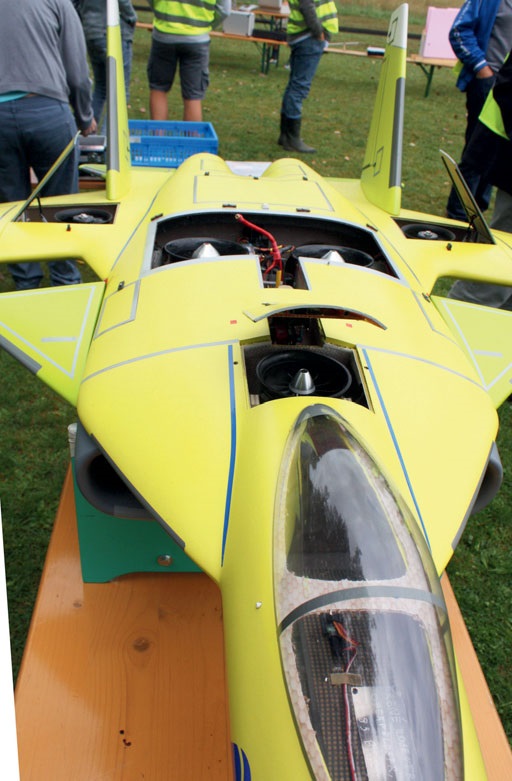
The clear winner in the impeller category was René Rosenträger (Germany) with his SU-X, an SU-47 Berkut modified to transition from short takeoff to vertical takeoff capability. The forward-swept experimental aircraft with a duck configuration is based, in its model version, on two 90-mmpropellers with thrust-vectoring nozzles, as well as three auxiliary engines for the longitudinal and pitch axes, which are enclosed by fuselage cowlings during level flight. The model is constructed using an extremely weight-optimized honeycomb design, and it was deeply regrettable that during the final scoring flight, while transitioning back, it briefly spun out of control and sustained damage to the nose (fortunately, repairable).
Joel Valshof (NL) also learned the hard way that success sometimes comes at the cost of setbacks when he damaged his Harrier just a few days before the meet. Without hesitation, Joel mounted the components on a support frame and used it to demonstrate impressive vertical takeoffs and landings—though, of course, he was unable to transition to level flight due to the lack of aerodynamic lifting surfaces. Beat Sigrist (CH) is also a fan of the Harrier. He replaced the Pegasus engine with swiveling exhausts with four swiveling impellers and performed impressive maneuvers.
Alois Wesseler (D) has, by his own account, made the Harrier his life’s work. For the time being, the model—built in a rather conventional manner, very close to the original—could still be admired on the ground due to a malfunction in the motor controller. Alois works with a self-laminated two-blade carbon impeller and is pushing the limits of what is currently possible with electric propulsion (preheated 14-second LiPo batteries, current > 200 A, Lehner motor). Johannes Huser, with his replica of the EWR VJ 101—originally a jet-powered, vertical-takeoff, supersonic German experimental aircraft built by Ernst Heinkel Flugzeugbau GmbH, Messerschmitt AG, and Bölkow GmbH—participated in the meeting, by his own account, solely for fun and to gather information, and despite an ambitious construction evaluation, he opted not to perform any of the two required evaluation flights. Even last-place finishers can shine brilliantly.
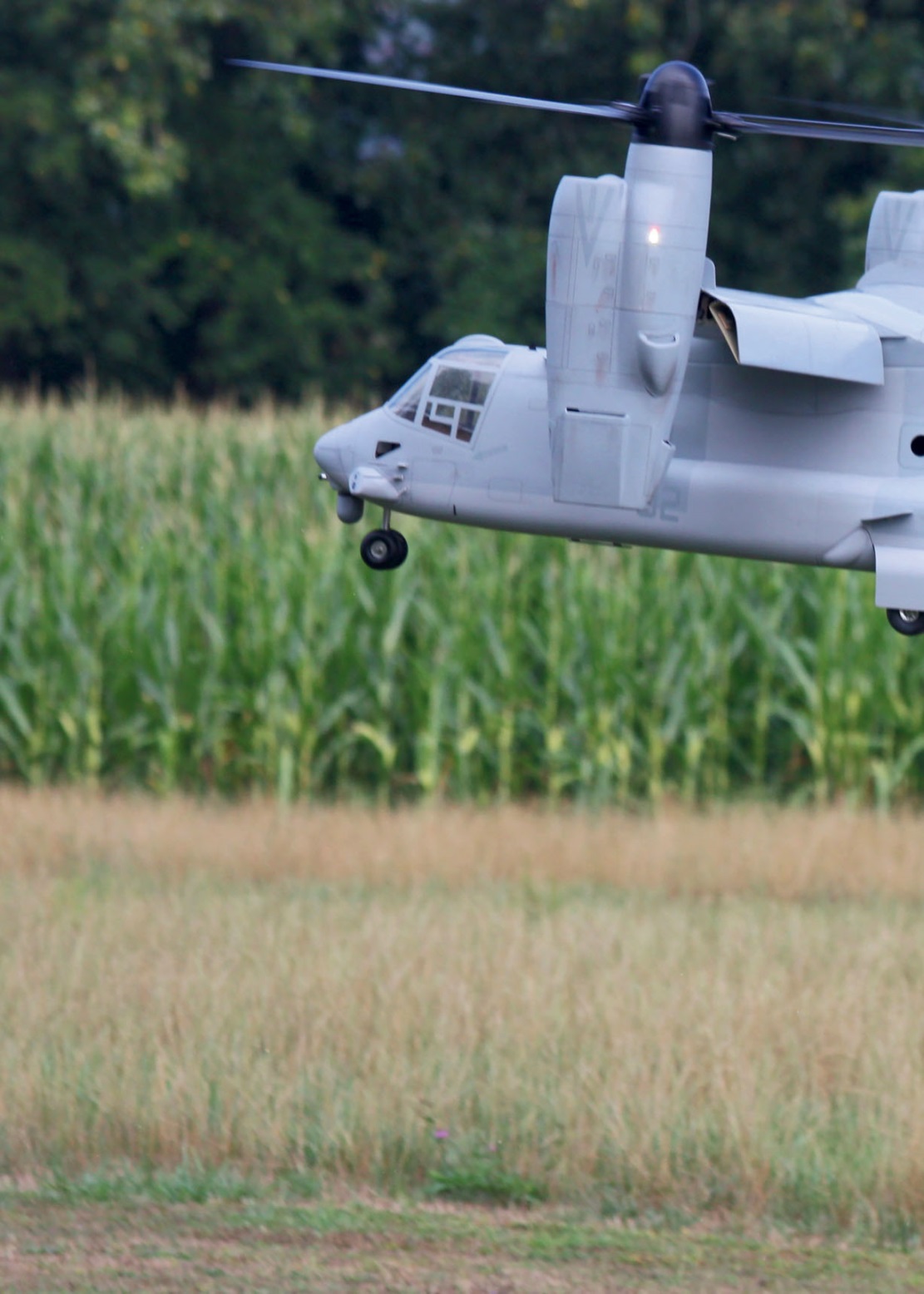
In the propeller-driven aircraft category, Norbert Schürz (A) secured pole position with his faithful replica of the legendary—and infamous—U.S. tiltrotor aircraft, the Bell Boeing V-22 Osprey. A Kontronik Pyro 850-400 motor—mounted in the center of the wing and powered by a 12s LiPo battery—drives both outer rotors centrally via a common drive shaft and bevel gears. The rotors at the wing tips are tilted by a worm gear and controlled via swashplates. The “Schürz-Osprey”—a rather controversial figure in its original form—is a collection of ingenious design solutions and proves once again that models can be several steps ahead of their real-life counterparts.
The same can likely be said of the Convair XFY-1 Pogo, developed as early as 1947—more than 70 years ago—which René Kunipatz (D) and Ettore Quaglia (I) set out to build. The original version of this tail-launch project never made it past the testing phase. The two models differed in size and fidelity to the real aircraft. Based on the flight evaluation, René Kunipatz’s smaller and simpler model ultimately won by a narrow margin. He had focused intensively on the by no means trivial problem of counter-rotating propellers and demonstrated rapid winged flight with smooth transitions to the tail-launch and landing phases.
Anton Thoma earned excellent construction points with his AgustaWestland AW609—a (vertical takeoff) VTOL tiltrotor convertible aircraft featuring an attitude control system he developed himself—but was only able to complete one scoring flight.
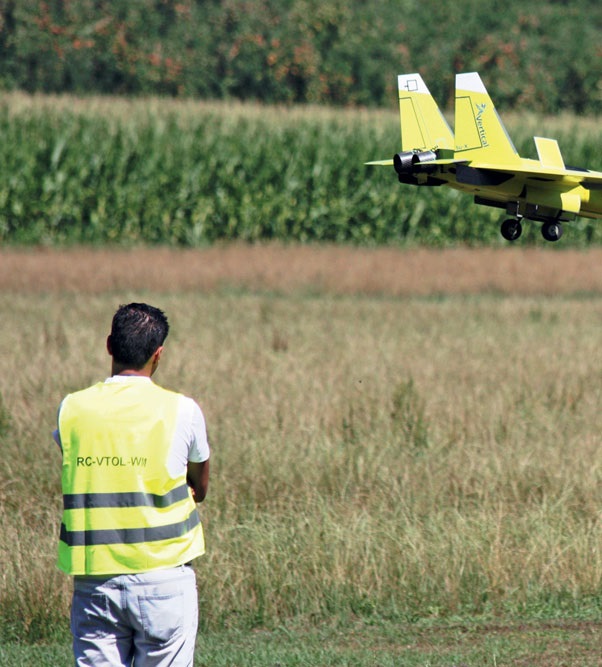
All in all, it was a highly exciting model aircraft meet that was somewhat reminiscent of events from the pioneering days of electric flight, such as the early years in Pfäffikon or Aspach (Germany). The pilots had virtually no ready-made solutions to fall back on here and therefore used the competition primarily as an opportunity for an intensive exchange of experiences. Finally, some good news: The Dornier Museum is currently considering repeating the event in two years, though with the hope of including replicas of the Do 31 by then. As we learned, such projects have already been launched several times by the highly motivated participants. This museum initiative is all the more commendable given that almost every private museum is constrained by tight financial constraints.
*Ludwig Retzbach*
The maiden flight took place on March 19, 1989, in Arlington, Texas. The first “transition” (the transition from hover to horizontal flight or vice versa) was performed on September 14, 1989. The first production aircraft was completed on February 5, 1997. After numerous setbacks, including accidents, the V-22 officially entered series production in 2005.
In September 2007, a Marine Corps squadron equipped with ten Ospreys was deployed to Iraq. The squadron thus became the first unit to operate the aircraft in combat conditions. In November 2008, the U.S. Air Force deployed four Ospreys nonstop (using in-flight refueling) to Mali for an exercise. Beginning in November 2009, it was also deployed in Afghanistan.[4] In March 2011, Ospreys from the USS Kearsarge rescued a crew member from an F-15 that had crashed over Libya. Deployment to Japan began in 2012.
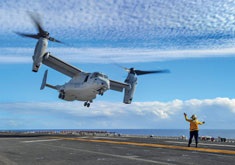
| Length | 17.48 m | Top speed | 565 km/h |
| Wingspan | 13.97 | Range | up to 1,760 km |
| Rotor diameter | 11.58 | Number of units (as of 2017) | 350 |
| VTOL takeoff weight | 21,546 kg |


News from HEBU

HORIZON HOBBY/LEMACO NEWS: MICRO OV-10 BRONCO 645 MM BY E-FLITE

PRIDE AND GOOD IDEAS
 Markus Nussbaumer

TEAM MANAGER "THIS" BOSSHARD
 Rodito Nussbaumer

YOU KNOW WHAT I MEAN? 125 YEARS OF THE SWISS AERO CLUB
 Emil Giezendanner

F3A EUROPEAN CHAMPIONSHIPS IN ST-MACAIRE, FRANCE
 Matthias Bosshard

ATOM, THE NEW DOUBLE-DECKER FROM CPLR
Matthias Bosshard
SUMMER FUN 2026 AT MG USTER
Martin Wunderli
What's New at Leomotion.com

52. 2026 ALPS CUP
Emil Giezendanner
TWIN TOWN PARTNERSHIP
Wolfgang Voeller
34th HAHNENMOOS ALPINE MODEL AIRPLANE CAMP
Res Dauwalder
CORSAIR F4U – A WARBIRD WITH A MEMORABLE LOOK
Jürgen Rosenberger, Jürgen Prinz
SMALL, MODEL-LIKE SAILBOATS
Res Dauwalder
TRY-OUT DAY AT MFV WETTINGEN
Urs Keller
WELCOME, NEW MEMBER!
Andrea Bolliger
FREE FLIGHT IN THE MIDDLE OF SUMMER
Urs Muntwyler
COUPE DES ALPES – OBSERVE AND LEARN
Rodito Nussbaumer
EURO CONTEST GLIDER ACRO TOUR AUSTRIA 2026

BY YOUTH, FOR YOUTH
Lorena Betschen
INSIGHTS INTO THE HISTORY OF SEAPLANES

THE PC-21 STORY
Emil Giezendanner
NEWS FROM HEBU
 Julia Bucher

FROM 0 TO 100
Markus Nussbaumer
MEMORIES
Wolfgang Völler
NOS REGION – A HUB FOR ELECTRIC AVIATION
Emil Giezendanner
DO YOU KNOW WHAT I MEAN IN THE LAND OF SMILES?
Emil Giezendanner
Have you almost forgotten about aircraft that take off and land vertically?
Emil Giezendanner