
Tanga – a hot model for F3B and slope flying!
Since the first World Championship a good 30 years ago, F3B models have been continuously refined. Even though the physics have remained the same, slight improvements are constantly being made from one model generation to the next. This is made possible by the use of new materials and by refinements that optimize aerodynamics.
From the perspective of the models’ evolutionary development, it is therefore not surprising that, given the same boundary conditions and design methods, the models are becoming increasingly similar. In fact, the models of the latest generation are nearly identical and are virtually indistinguishable to the untrained eye. The following features are characteristic:
- A V-tail combined with very slender fuselages that barely accommodate the RC system under the nose.
- Ballast in the wings and spars, since there isn’t enough space in the fuselage.
- Two-piece wings and tail units.
- Simple V-shape, slender wings with medium aspect ratio (14–15) and a t/4 line that is as straight as possible (no rearward sweep).
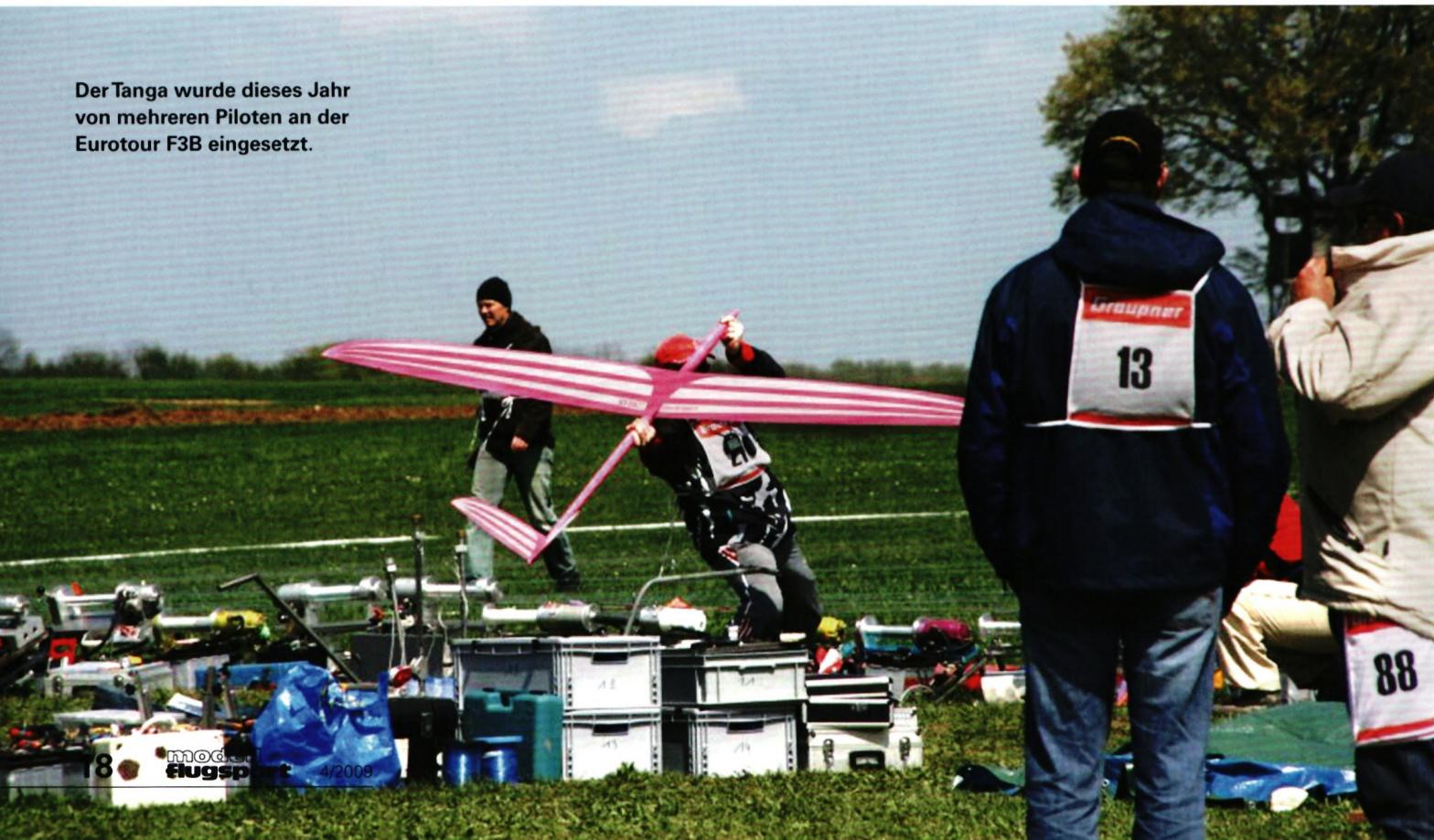
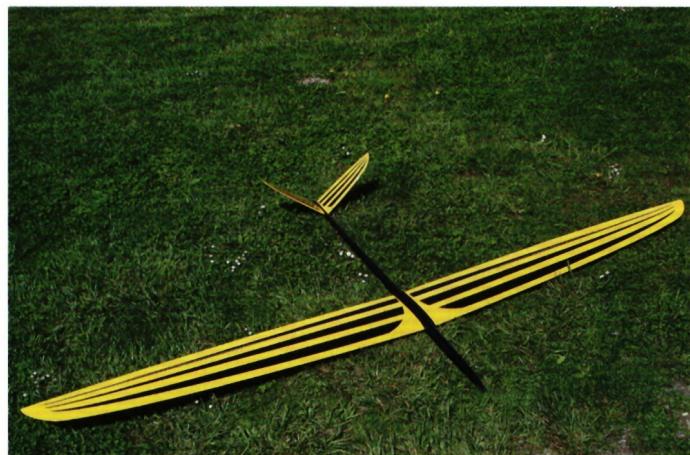
But wait—at the end of 2008, a model suddenly appeared at the Oktoberfest Cup that stood out pleasantly from the sea of sameness: the Tanga! The differences are immediately obvious—the wing features a substantial root depth and has a completely unique leading-edge curvature. The
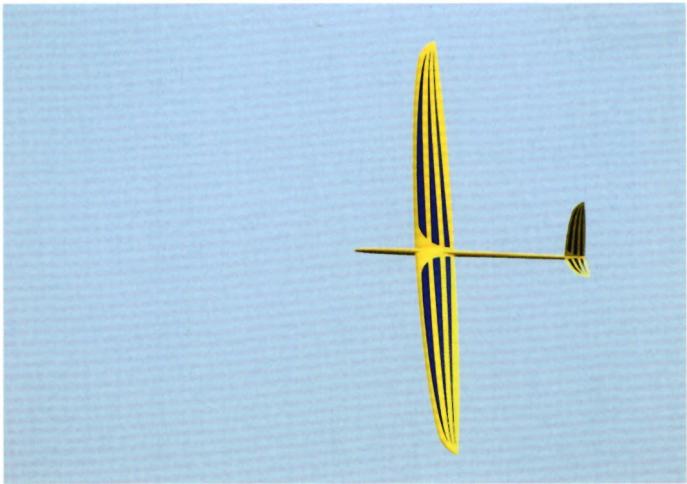
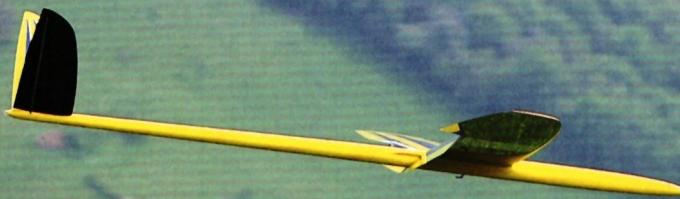
The fuselage has a mostly rounded cross-section and is slightly thicker than today’s standard. Thanks to this design, a large ballast tube just barely fits between the connector and the launch hook. A small cabin lift allows the ballast to be changed in no time at all, eliminating the tedious task of removing the wings. Enhanced by a cheerful color scheme, this glider immediately stood out, and its unconventional lines provided plenty of conversation.
The Tanga was designed and engineered by Norbert Habe, who has already developed several very successful models and airfoil series. However, the F3B professionals Stefan Böhlen, Fidel Frick, and Heinz Bischofberger also had a significant influence on the final design, contributing their wishes and ideas to the project.
All in all, an interesting approach and a promising model—it piqued my interest. After a brief exchange with Stefan Böhlen,
Once I got in touch with the company that also sells the models, it became clear that I could still get a model for the current season. After just a few weeks, I was able to pick up my Tanga in Kirchheim. This isn’t something you can take for granted—normally, you have to plan on a wait of up to a year for the latest F3B models. The short delivery time also gives me hope that, if the worst comes to the worst, I’ll be able to get replacement parts quickly.
The “kit” is delivered (although calling it “building” is a bit of a stretch for a modern F3B model— all that’s left is to install the electronics) in two different versions: either the “economy” version with minimal components, or the “exclusive” version, which includes all necessary small parts and the ballast set—except for the RC system. I opted for the latter version, mainly because the custom-made carbon-fiber ballast tube saves a lot of work.
All components make an excellent impression; the fit of the wings and tailplane to the fuselage is superb, and all seams are cleanly finished. The fuselage surprises with a pleasingly low weight of 284 g. The tail unit halves are also fine weight-wise at 40 g each; only the wings, at about 600 g per half, are slightly heavier than today’s F3B standard. However, it must be noted that the wings
have a fairly large wing area, which puts their weight into perspective. The perceived sturdiness of the individual components ranges from good to very good; only the ailerons can be bent slightly by hand, a trade-off due to their thin profile. Anyone who wants to go full throttle should therefore consider the version with a double-carbon shell.
I started working on the wings right away. The wiring harness is quickly installed using the included twisted-pair cable and MPX connector. When installing the servos, you have to decide whether to use a conventional “cross-link” linkage or the pre-installed RDS. RDS stands for Rotary Drive System; it is a completely internal linkage system in which an angled metal pin moves the aileron via a corresponding guide. This technology is becoming increasingly common in F3B and is already almost the state of the art—
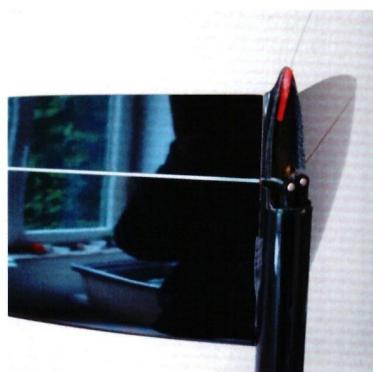
nik. It was clear to me from the start that I would choose RDS, since I’d only had good experiences with this system so far. In addition to aerodynamic advantages (no parts protrude from the airfoil), there are also mechanical considerations that speak in favor of RDS: The torque load on the servos can be designed to be the same as with a typical cross-linkage system, but the radial bearing forces are eliminated. The travel characteristic is largely linear (highly nonlinear with normal linkages) and practically symmetrical at every position. This ensures uniform loading and identical play in all flap positions. The linear travel characteristic also simplifies the trimming of the flaps
during the various phases of flight. In long-term operation, an RDS develops pleasingly little play and can even be designed to be virtually play-free.
On the Tanga, the necessary pockets are already prepared in the ailerons, and the corresponding parts for coupling the shaft and servo pinion are also included. One of the most time-consuming steps is molding the servo pinion. To do this, the servo—and especially the pinion—is coated several times with release wax. Next, Uhu Endfest 300, thickened with short-cut carbon fiber, is applied to the coupling piece and then slipped over the servo pinion. Once fully cured (wait long enough), the coupling piece can be pulled off the servo with a little force. A gear-like structure, similar to that found in a servo lever, should now be visible inside the coupling piece. In a second step, use Endfest again to glue the angled mandrel into the coupling. Once everything has cured, you can install the servo with the RDS into the wings without any parts attached and use a servo tester to verify that the linkage is functioning correctly. If everything is friction-free
Once the glue is set, you can glue the servos (or servo frames) into the wings using Endfest. Lead weights help hold the servos in the correct position while the glue dries. It’s important to emphasize that all these gluing processes must be carried out very carefully, and all bonding surfaces must be roughened and cleaned with acetone before gluing. Once this is done, you can move on to assembling the fuselage. The large ballast tube fits just barely through the canopy opening, which was intentionally kept small. Adhesive can only be applied once the
assembled state, and the work steps must be carefully planned. One quiet evening, I glued the servo board and the ballast tube in a single step using Endfest 300. To take full advantage of the fuselage ballast, the ballast pieces must be able to slide into the ballast tube smoothly and easily, which requires a certain amount of care when installing the individual components. When installing the remaining components, I was quite surprised; everything fit like a glove—but wait, there was no more room for the receiver!
Apparently, the Tanga was designed for small receiver batteries; my Eneloop battery simply took up too much space. A four-cell Intellect battery (1400 mAh capacity) provided the space savings needed to fit in a small Graupner or Futaba receiver. I initially used an SMC-16-Scan receiver, but then switched to the Futaba FASST system during testing. Both receiver systems posed no problems during installation or operation. Since the front section of the Tanga is made of fiberglass upon request, the antennas of a 2.4-GHz receiver can be left inside the fuselage.
After carefully adjusting the specified center of gravity and the control surfaces, I was ready for the maiden flight. This took place right at the winch, and with the elevator trimmed slightly down, the Tanga soared confidently into the sky. Even on the first flight, I was able to circle in some thermals, and I got an initial impression of the handling characteristics. After adjusting the
After adjusting the trims and rudder deflections and carefully fine-tuning the high-launch settings (F3B models are typically flown just before stalling during a high launch), I already felt very confident flying the Tanga. The next flights took place right away during an F3B speed flight training session. Further fine-tuning of the high-launch settings and the aileron deflections during the speed flight phase led to success surprisingly quickly. My times were at least on par with my colleagues’, and the altitudes I was able to reach were also impressive.
Now, I certainly don’t want to give the impression that the Tanga is a miracle glider, because no such model exists. Good flight performance is achieved only through the correct settings and the pilot’s input, and even with the Tanga, a certain amount of time is needed to get used to it. For example, I had to adjust the aileron differentiation during the various flight phases and also adapt the
elevator to my personal style. The Tanga is delightfully agile; it responds exceptionally well to the elevator in particular. This is generally a good sign; conversely, it’s much more difficult to execute good speed turns if the glider is sluggish. Still, you have to get used to the agility first; otherwise, speed flights in particular will take on a very interesting trajectory.
Thanks to its thin airfoil, the Tanga “flies” very well, and even with minimal ballast, very high speeds can be achieved. The model also performed impressively in slope flying. From slow circling in thermals all the way to rapid slope-edge gliding, the Tanga performed admirably.
And one key advantage of the Tanga quickly became clear: With its striking lines and extravagant design, the risk of mistaking one model for another is drastically reduced!

EURO CONTEST GLIDER ACRO TOUR AUSTRIA 2026

THE PC-21 STORY
 Emil Giezendanner

TWIN TOWN PARTNERSHIP
 Wolfgang Voeller

SUMMER FUN 2026 AT MG USTER
Martin Wunderli
CORSAIR F4U – A WARBIRD WITH A MEMORABLE LOOK
Jürgen Rosenberger, Jürgen Prinz
52. 2026 ALPS CUP
Emil Giezendanner
YOU KNOW WHAT I MEAN? 125 YEARS OF THE SWISS AERO CLUB
Emil Giezendanner
News from HEBU

TEAM MANAGER "THIS" BOSSHARD
Rodito Nussbaumer
ATOM, THE NEW DOUBLE-DECKER FROM CPLR
 Matthias Bosshard

F3A EUROPEAN CHAMPIONSHIPS IN ST-MACAIRE, FRANCE
Matthias Bosshard
INSIGHTS INTO THE HISTORY OF SEAPLANES

WELCOME, NEW MEMBER!
Andrea Bolliger
What's New at Leomotion.com

PRIDE AND GOOD IDEAS
 Markus Nussbaumer

SMALL, MODEL-LIKE SAILBOATS
Res Dauwalder
FREE FLIGHT IN THE MIDDLE OF SUMMER
Urs Muntwyler
BY YOUTH, FOR YOUTH
Lorena Betschen
HORIZON HOBBY/LEMACO NEWS: MICRO OV-10 BRONCO 645 MM BY E-FLITE

34th HAHNENMOOS ALPINE MODEL AIRPLANE CAMP
Res Dauwalder
COUPE DES ALPES – OBSERVE AND LEARN
Rodito Nussbaumer
TRY-OUT DAY AT MFV WETTINGEN
 Urs Keller

NEWS FROM HEBU
 Julia Bucher

NOS REGION – A HUB FOR ELECTRIC AVIATION
Emil Giezendanner
MEMORIES
 Wolfgang Völler

70 YEARS OF THE NIDWALDEN MODEL AIRPLANE CLUB
Martin Barmettler
A SPECTACULAR F3A WORLD CUP IN THE PRINCIPALITY OF LIECHTENSTEIN
Emil Giezendanner
FROM 0 TO 100
Markus Nussbaumer