
The Miracles in the Shadow of the Spear
At the IG Warbird Fall Meeting, 36 active pilots and many spectators enjoyed the beautiful late-fall weather and an exciting flight program.
Yves Burkhardt, president of IG Warbird, on his morning walk.
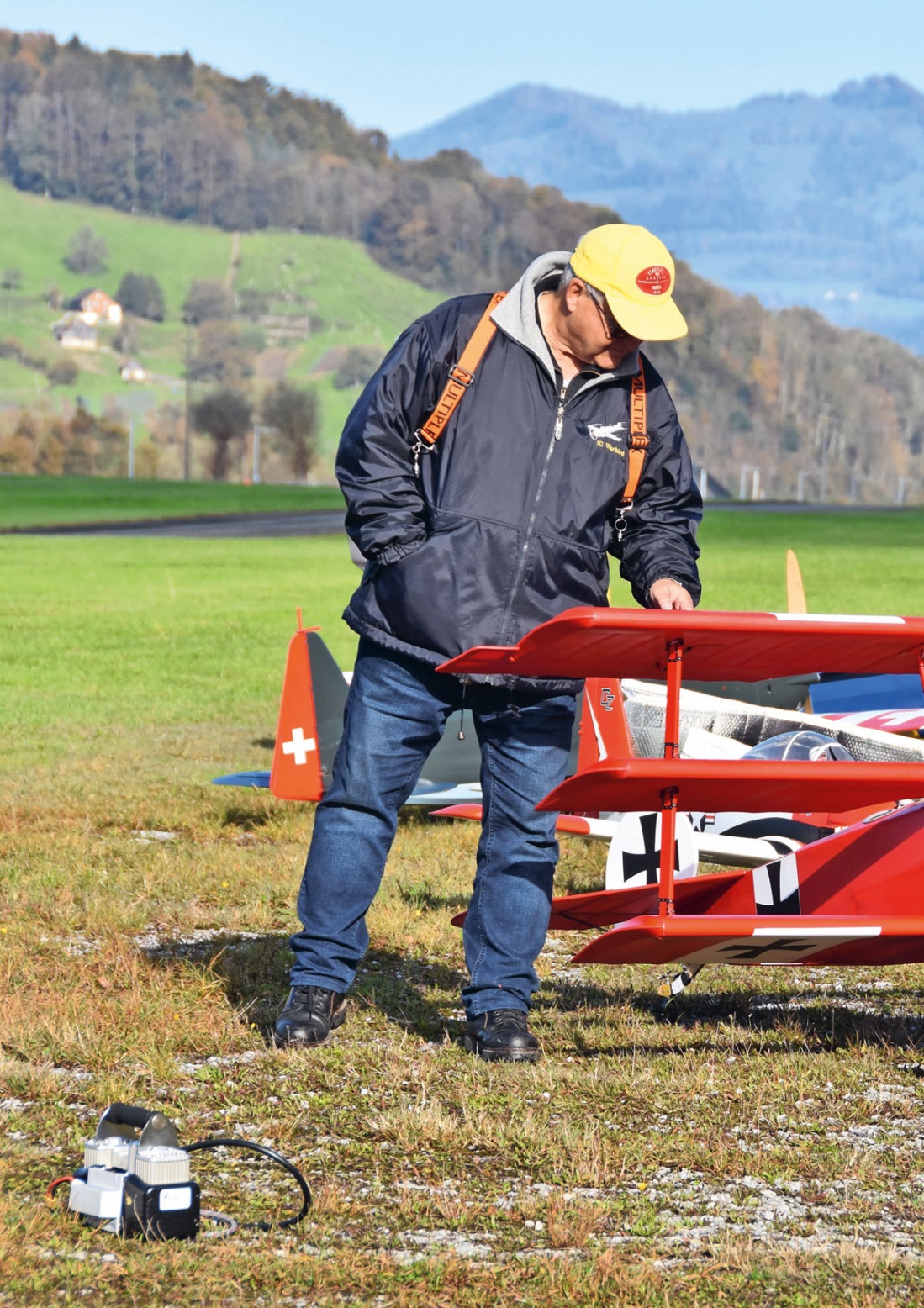
As early as 8:30 a.m., there was already a flurry of activity at the Schänis airfield. Models were unloaded and assembled, and many old colleagues were greeted. Colleagues whom some hadn’t seen in quite a while due to the COVID-19 restrictions. This made everyone all the more eager to see what new creations had emerged in the various workshops in the meantime. But even tried-and-true models like Paul Haller’s large Skyraider or Kurt Wächter’s Morane demonstrated
that even thirty-year-old models still retain their charm and are still in great shape.
Still in the shadow of the Speer, Europe’s tallest Nagelfluh mountain, Yves Burkhardt and Rolf Kessler conducted the mandatory briefing. Two flight directors each ensured that the program could be carried out smoothly and safely.
Attending a Warbird meet for the first time were Fredy Gass and Marco Zaugg, who brought their two beautifully—
| Scale: | 1:3.85 |
| Length / Longueur: | 340 cm |
| Wingspan / Envergure: | 360 cm |
| Weight / Mass: | 29.2 kg |
| Propulsion: | Kingtech-100 turboprop |
| Propeller: | SL propeller |
| ER-50 Electric Retractable Landing Gear | |
| ER-50 Electric Retractable Landing Gear | |
| Lighting: | Unilight / Inoflyer |
| Fuselage Construction: | Hard foam with wooden struts and fiberglass-reinforced plastic coating |
| Fuselage construction: | Foam with wooden stringers, all covered with fiberglass |
| Wing construction: | Wood-planked and fiberglass-coated |
| Wing construction: | Wooden frame with fiberglass reinforcement |
| Power supply: | Powerbox system |
| Power supply: | Powerbox system |
| Paint scheme: | Target Pilot Squadron 12, C-501 Target Towing |
| C-483 Training (dual controls) with orange nose | |
| Decoration: | Target Flight Squadron 12, C-501 Target Tug |
| C-483 Training (dual controls) with orange nose |
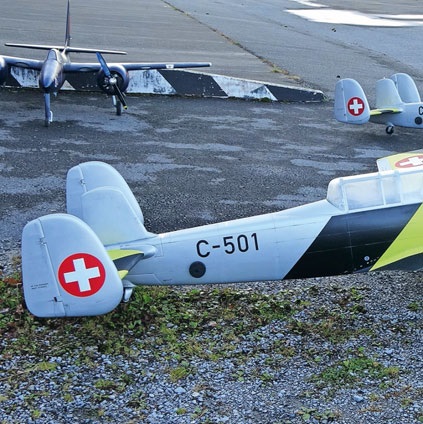
C-3605 by Fredy Gass and Marco Zaugg.
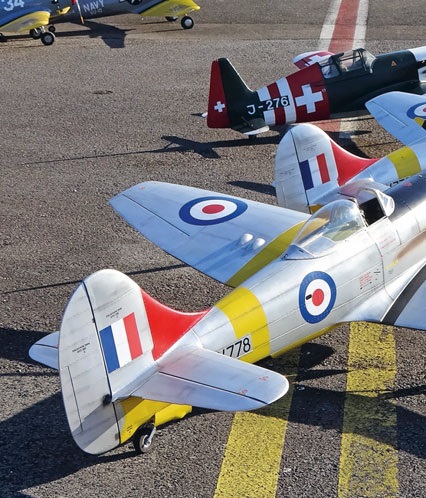
Hawker Tempest by Rolf Schönenberger and Urs Schirmer.
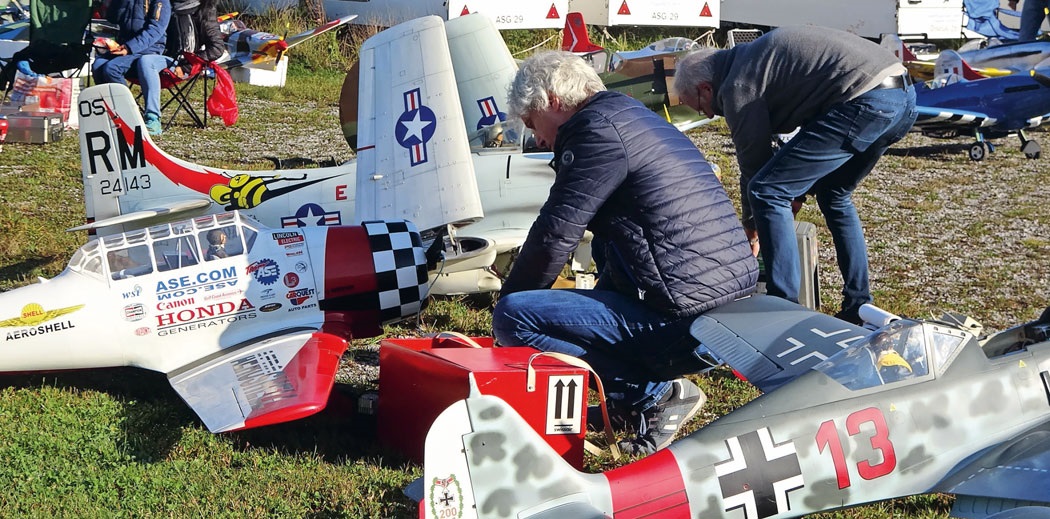
It was a bustling morning.
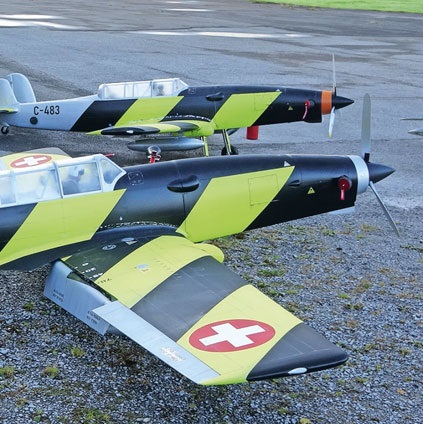
presented the turbine-powered C-3605 both on the ground and in the air. The Luftwaffe’s target-towing aircraft—which at the time were converted from the piston-engine C-3603—also thrilled pilots and spectators in Schänis as large-scale models. With a wingspan of 3.2 m, the brand-new, home-built Morane D3801 by “Kusi” Kindler was also very impressive; Markus flew it with great skill and true to the original design. Also making their debut at the event were two perfectly built Hawker Tempests by our Glarus colleagues Rolf Schönenberger and Urs Schirmer, each powered by DLA two-cylinder engines. Since 36 pilots were in attendance, many flight numbers were assigned—in some cases spontaneously—to
Watch the video:
| Scale: | 1/4.8 |
| Wingspan: | 2.50 m |
| Length: | 2.1 m |
| Weight / Mass: | 20.5 kg dry |
| Engine: | DLA 116 ccm inline / DLA 116 cm³ inline |
| Propeller: | 27/13 Falcon |
| Homemade from an old Olin Vitasek mold / Fuselage and engine cowling made of fiberglass; wings made of wood / Landing gear: Sierra Gigant USA spring fork | |
| Custom-built using an old Olin Vitasek mold / Fuselage and engine cowling made of fiberglass. Wooden wings / Sierra Gigant USA tricycle landing gear | |
| Paint schemes: | After the war, it served as a target aircraft |
| Decoration: | After the war, it served as a target aircraft |
flew together. Among them were two FW-190s from TopRC-Models, piloted by Beat Gohl and Heinz Neuhaus, as well as three large T-28 Trojan foam models, led by the youngest, 11-year-old pilot Rodito Nussbaumer, escorted by Noldi Peyer and Yves Burkhardt, as they explored the steel-blue sky above Schänis. Erich Wächter and Beat Frey demonstrated with their two Saito-powered AT-6s what it looks like when you train together regularly. The biplane contingent was also well represented in Schänis this year. Making their debut were Hugo Christen’s large Fokker triplane and Rolf Fritschi’s Nieuport N-28 C-1 “Bébé,” both painted in the colors of the Swiss Air Force of that era. Two large Spitfires and a Venom by Koni Oetiker, as well as Hanspeter Hofer’s masterfully built Me-109 in the former colors of the Swiss Air Force, proved that electric models don’t always have to be small. But—and this is what makes the event and the IG Warbird so appealing—smaller warbirds also have their place at our Warbird-
On September 11, 1993, the IG Warbird (IGW) was founded in Triengen by our “Corsair-Housi Messmer.” The IG Warbird was launched with a full-fledged television report on SF1, and out of sheer joy, Corsair-Messmer immediately staged a forced landing in tall grass with the landing gear still extended during the TV filming.
In the meantime, the IGW already has over 100 members from Switzerland and abroad. The IG Warbird is a voluntary interest group for anyone involved with warbirds in any way. Most of our members are model airplane enthusiasts, but we also have members interested in history, etc. The IGW strives to maintain its ties to the original Swiss Warbird scene; as a result, people like Max Vogelsang (former P-51 Mustang pilot, former Morane pilot) are also members of the IG Warbird.
IG Warbird strives to hold at least two air shows each year, one in early summer and one in the fall.
The website www.igwarbird.ch keeps members up to date. In addition, the club plans to organize excursions to museums or air shows.
Above all, however, the IG Warbird is about sharing experiences with one another. Especially in the warbird model scene, knowledge of engine installation, landing gear, batteries, surface treatment, decorations, and decals—as well as appropriate flight tactics and proper test flights for the often larger models—is extremely important. Newcomers to the scene are just as welcome as experienced pilots.
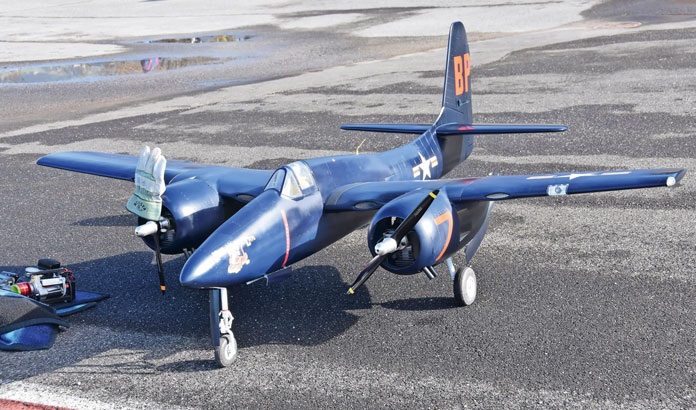
They always have a special place in the event. This was demonstrated, among other things, by Godi Hirschi with his F4U Tigercat and by Erich Züger with his P-38 Lightning, which was created using a 3D printer (!).
We’d like to take this opportunity to extend our heartfelt thanks to everyone involved—including ASSAG, the operator of the glider airfield in Schänis, as well as the Schänis Model Flyers—who
once again provided with a wonderful—and, aside from a bit of “sheet metal damage” on a Tigercat, a formidable—meeting in Schänis. We’re already looking forward to Schänis 2022!
And don’t forget to register now for the winter event on January 22, 2022, at the Swiss Museum of Transport in Lucerne.


News from HEBU

HORIZON HOBBY/LEMACO NEWS: MICRO OV-10 BRONCO 645 MM BY E-FLITE

PRIDE AND GOOD IDEAS
 Markus Nussbaumer

TEAM MANAGER "THIS" BOSSHARD
 Rodito Nussbaumer

YOU KNOW WHAT I MEAN? 125 YEARS OF THE SWISS AERO CLUB
 Emil Giezendanner

F3A EUROPEAN CHAMPIONSHIPS IN ST-MACAIRE, FRANCE
 Matthias Bosshard

ATOM, THE NEW DOUBLE-DECKER FROM CPLR
Matthias Bosshard
SUMMER FUN 2026 AT MG USTER
Martin Wunderli
What's New at Leomotion.com

52. 2026 ALPS CUP
Emil Giezendanner
TWIN TOWN PARTNERSHIP
Wolfgang Voeller
34th HAHNENMOOS ALPINE MODEL AIRPLANE CAMP
Res Dauwalder
CORSAIR F4U – A WARBIRD WITH A MEMORABLE LOOK
Jürgen Rosenberger, Jürgen Prinz
SMALL, MODEL-LIKE SAILBOATS
Res Dauwalder
TRY-OUT DAY AT MFV WETTINGEN
Urs Keller
WELCOME, NEW MEMBER!
Andrea Bolliger
FREE FLIGHT IN THE MIDDLE OF SUMMER
Urs Muntwyler
COUPE DES ALPES – OBSERVE AND LEARN
Rodito Nussbaumer
EURO CONTEST GLIDER ACRO TOUR AUSTRIA 2026

BY YOUTH, FOR YOUTH
Lorena Betschen
INSIGHTS INTO THE HISTORY OF SEAPLANES

THE PC-21 STORY
Emil Giezendanner
NEWS FROM HEBU
 Julia Bucher

FROM 0 TO 100
Markus Nussbaumer
MEMORIES
Wolfgang Völler
NOS REGION – A HUB FOR ELECTRIC AVIATION
Emil Giezendanner
DO YOU KNOW WHAT I MEAN IN THE LAND OF SMILES?
Emil Giezendanner
Have you almost forgotten about aircraft that take off and land vertically?
Emil Giezendanner