
FAI World Championships – F3C Helicopters in Muncie, USA
In September, the 9th World Championships for radio-controlled model helicopters took place in Muncie, Indiana. To get straight to the point, the event was overshadowed by the terrorist attacks of September 11. Nevertheless, it was decided to continue with the World Championships. The venue was guarded by local sheriffs. Naturally, the mood was subdued as a result. Everyone was relieved when the situation returned to normal toward the end of the week and they could hope to fly home.
The AMA model flying facility in Muncie is beyond anything Europeans could imagine. At the entrance stands the newly built office complex; to the left and right is the model aviation museum with its offices. This museum is wonderfully equipped. They’ve even recreated a model shop from the 1960s. You can spend hours here. The AMA employs about 50 full-time staff members. A good 10 of them are responsible solely for maintaining the approximately 10 runways, the campground, and the picnic area. Due to the distances involved, the score sheets had to be transported by small golf carts to the single-family home that served as the organizer’s headquarters.
A total of 65 participants ultimately traveled to the World Championship. The participants came from 27 different countries. For the first time, flights took place on two runways. As a result, interim results weren’t available until the second day. Patiently waiting in front of the scoring house was usually rewarded sooner or later with a copy of the leaderboard.
The first day was marked by extreme winds. Even former world champions made major mistakes. Johann Hoenle from Germany and Curtis Youngblood from the U.S. took the lead with a score of 100 each. Dani Graber
The entrance to the AMA Model Flying Center. The flags are already at half-mast due to the terrorist attack.
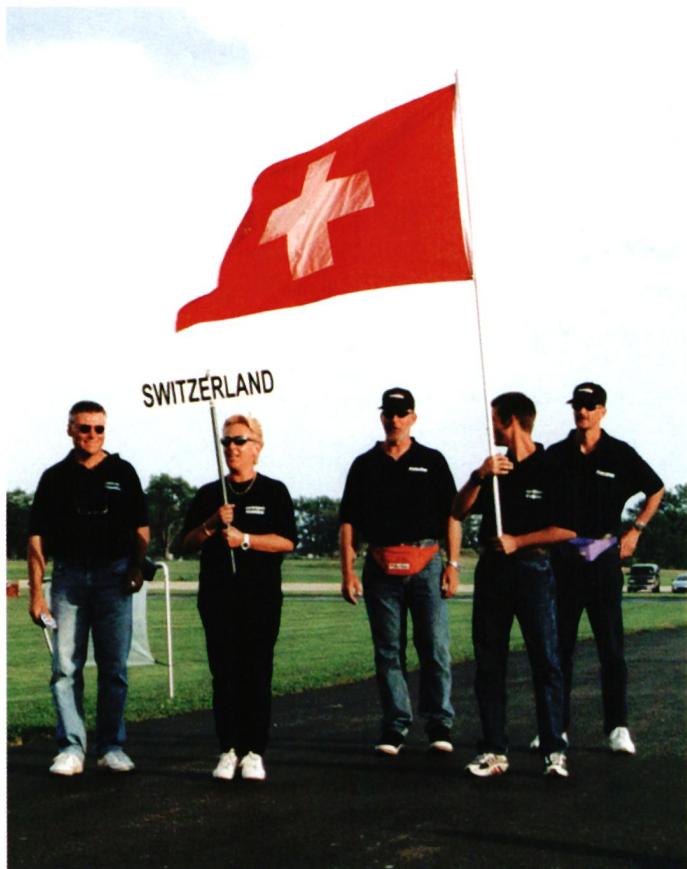
The Swiss team, consisting of Dani Graber, Marinella Graber, Heinz Gasser, Ennio Graber, and Stephan Meier.
| Place | Pilot | Country | Total Points |
|---|---|---|---|
| 1 | Curtis Youngblood | United States | 2,968.012 |
| 2 | Minoru Kobayashi | Japan | 2,965,227 |
| 3 | Yukihiro Dobashi | Japan | 2,955.977 |
| 4 | Kazuyuki Sensui | Japan | 2,929.834 |
| 5 | Manabu Hashimoto | Japan | 2,904.526 |
| 6 | Cliff Hiatt | United States | 2,835.289 |
| 7 | Scott Gray | Canada | 2,822.667 |
| 8 | Johann Hoenle | Germany | 2,783.385 |
| 9 | Wayne Mann | United States | 2,694,623 |
| 10 | Mark Christy | United Kingdom | 2,653,293 |
| 11 | Stefano Lucchi | Italy | 2,641.170 |
| 12 | Wolfgang Worgas | Austria | 2,511.866 |
| 13 | Laurent Lombard | France | 2,498.398 |
| 14 | Pascal Brianchon | France | 2,373.351 |
| 15 | Daniele Graber | Switzerland | 845,926 |
| in addition | |||
| 27 | Ennio Graber | Switzerland | 773,422 |
| 30 | Stephan Meier | Switzerland | 768,703 |
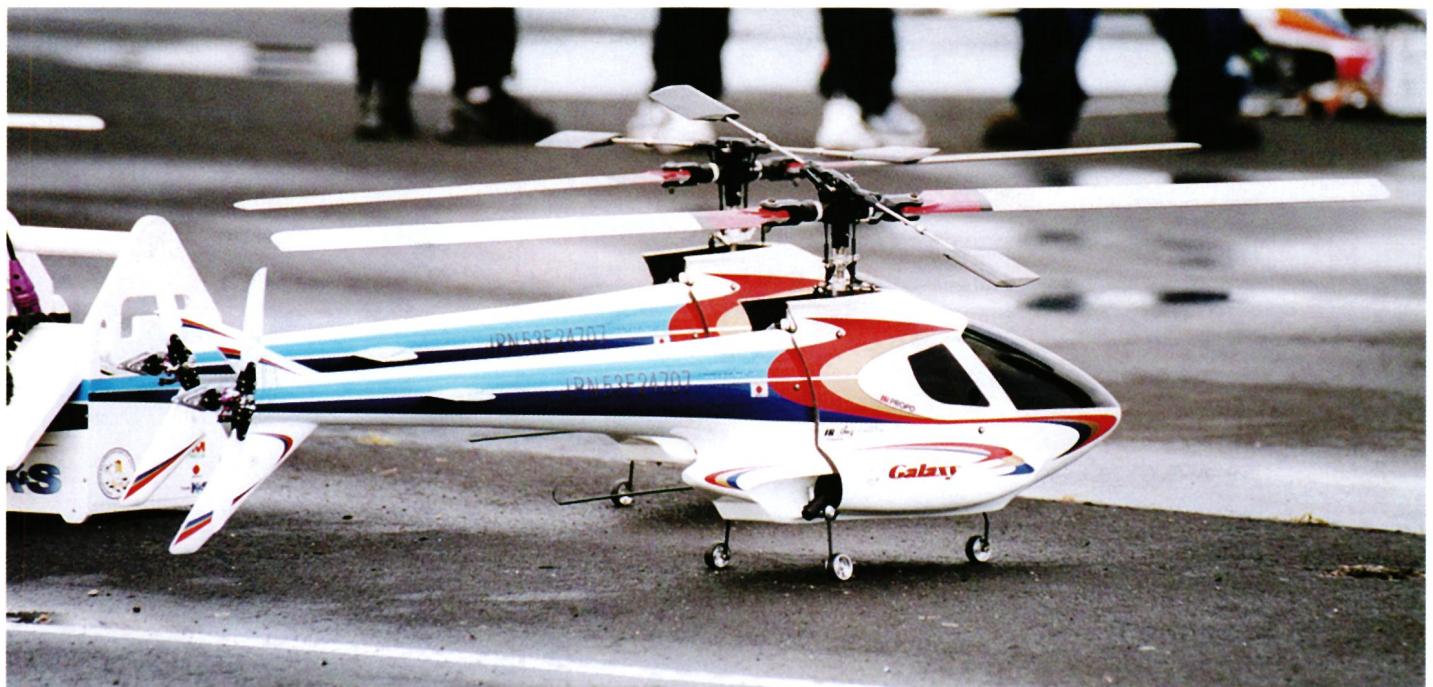
Minoru Kobayashi's models.
In 11th place, he still had a legitimate chance of advancing to the finals. Stephan Meier followed him in 23rd place, and Ennio Graber, who had stepped in at the last minute for Patrick Kessler, came in 25th.
Overall, the competition was already extremely close. Differences of just a few thousandths of a second accounted for several places in the rankings. After two more days of racing under normal weather conditions, the finalists were determined, and the team standings were finalized.
The Japanese team had claimed the World Team Championship title, followed by the U.S. and Great Britain. Everyone was happy to see outgoing team leader Shin Abe win this title. He is now over 70 and has participated in every World Championship since 1985. Under his leadership, the Japanese team has won five individual and several team titles.
The increasingly strong Austrian team finished in 5th place, ahead of the rising French, Italian, and Swiss teams. Germany was unable to field a full team due to Rüdiger Feil’s withdrawal.
Curtis Youngblood was now ahead of reigning world champion Manabu Hashimoto and Yukihiro Dobashi. Johann Hoenle was the top European in 6th place. The young
Canadian Scott Gray had placed fifth, ahead of Johann.
Dani Graber narrowly missed qualifying for the final. Ennio Graber finished 27th and Stephan Meier 30th. In addition to all the Japanese and Americans, one Canadian, one German, one Austrian, one Englishman, two Frenchmen, and one Italian made it to the final.
Now everything was up for grabs again, since only the normalized results from the preliminary round were carried over to the final
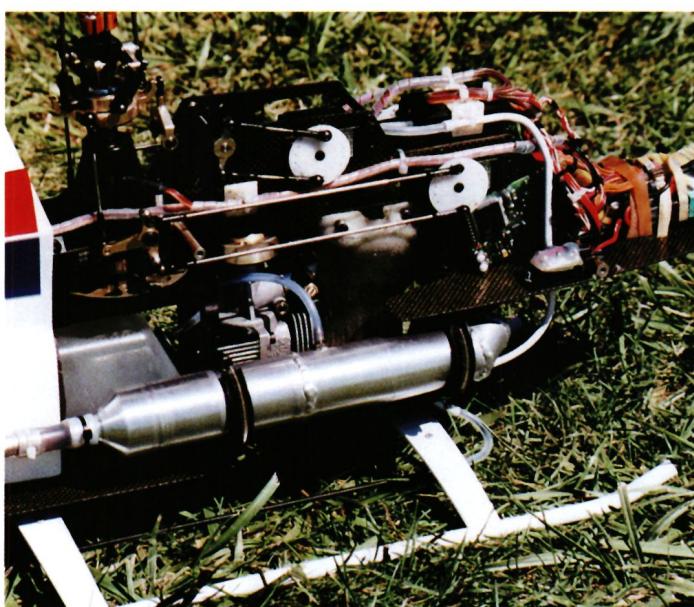
Johann Hoenle's Caliber was equipped with a resor tube. It was one of the few finalists to fly with a low (12.5%) nitrogen content.
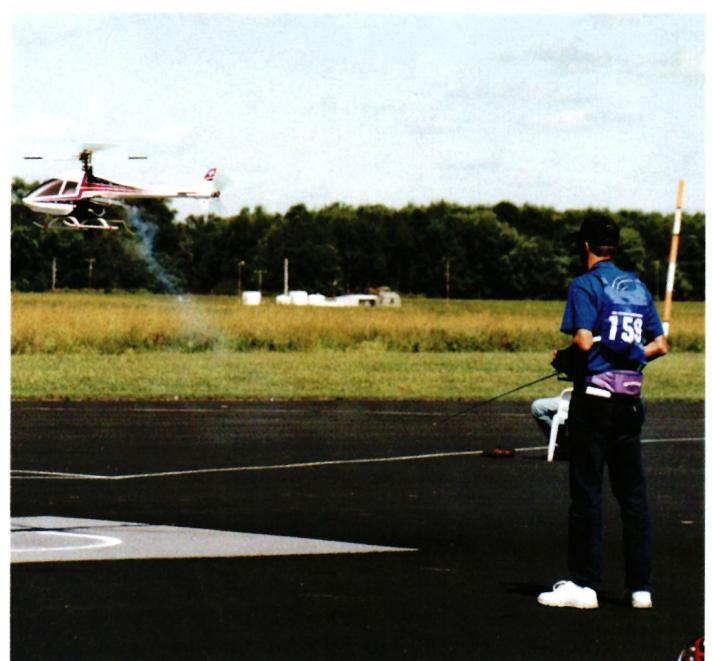
Stephan Meier with his assistant Heinz Gasser as they glide in.
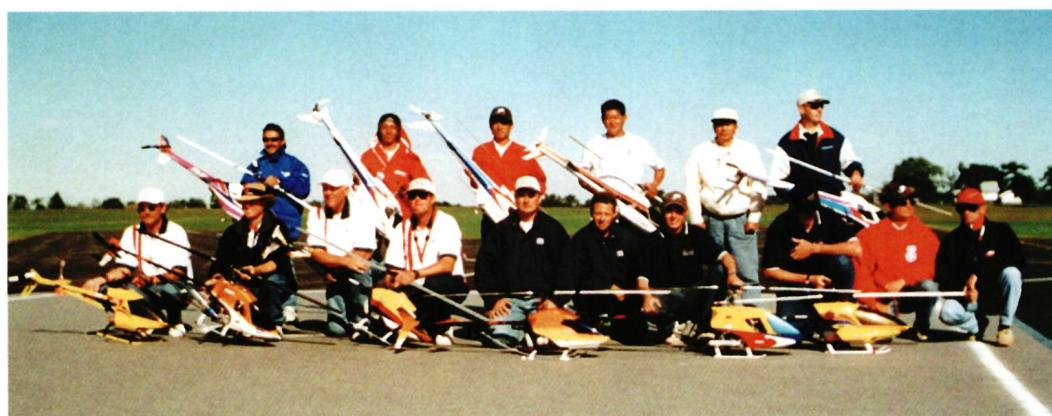
The finalists.
It quickly became clear that the title would likely be decided among Youngblood, Dobashi, and Kobayashi. Hashimoto and Sensui still had a slim chance.
Youngblood, Dobashi, Kobayashi, and Sensui each scored a thousand points. Curtis Youngblood showed nerves in the final and didn’t fly as confidently as he had in the preliminary round.
The suspense lasted until the very end. Curtis Youngblood won his head-to-head matchup against Minoru Kobayashi (a 2.7-point lead out of 2,968 points!), on
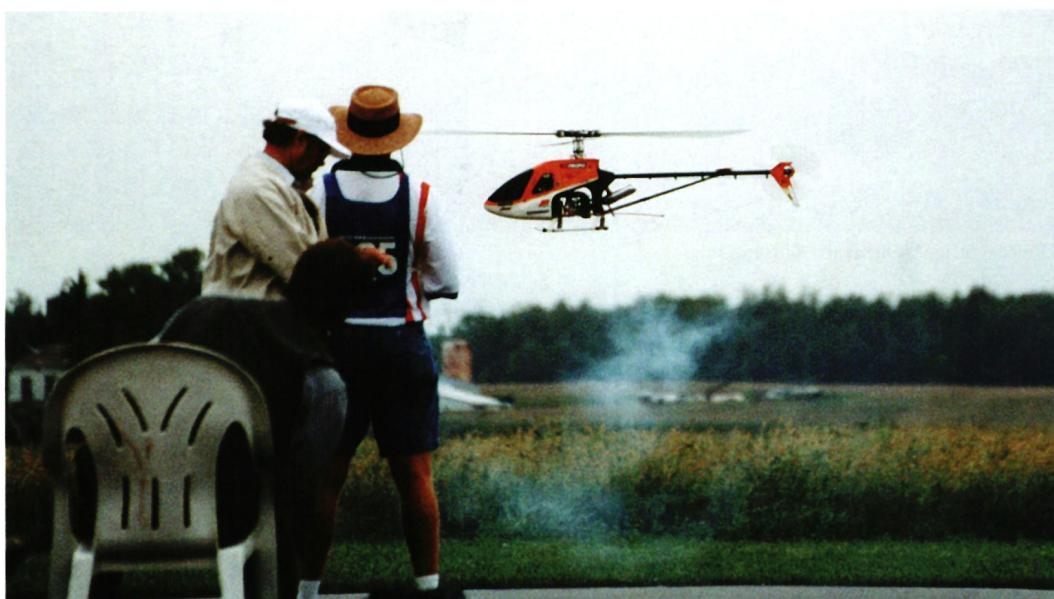
World champion Curtis Youngblood with his father, Dave.
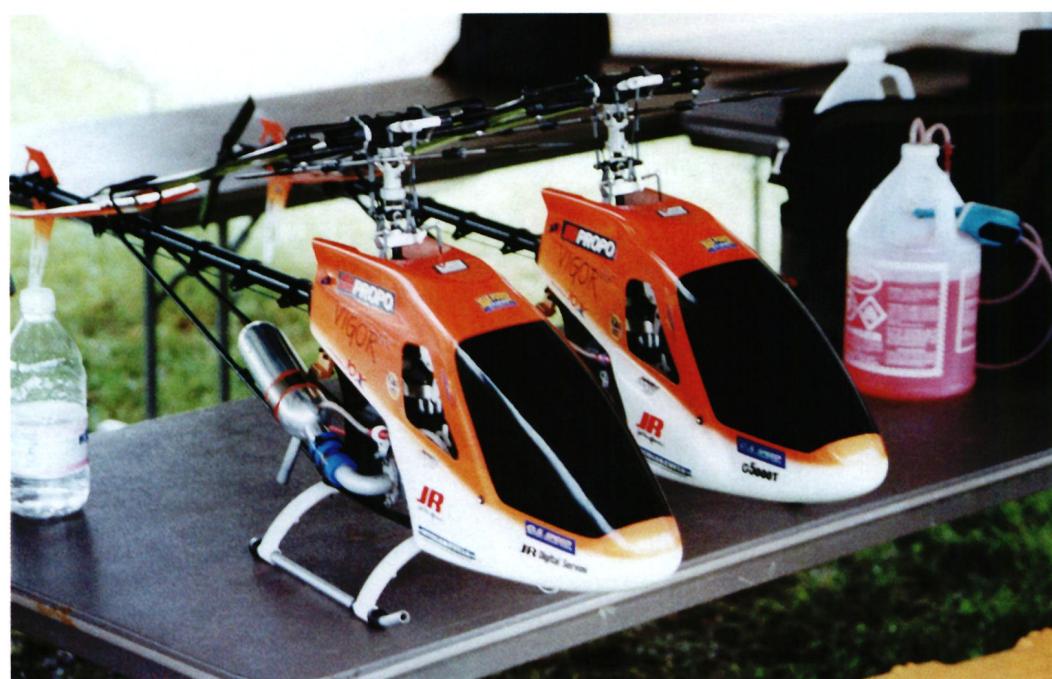
The World Champion's models.
Yukihiro Dobashi, who’s always up for a laugh, finished in 3rd place. Johann Hoenle was the top European, finishing in 8th place.
The teams from Italy, France, England, and Germany are on the rise. Their success is likely due in part to the strong collaboration among individual team members. They train together, monitor each other’s progress, and study the competition.
There wasn’t much new on the technical front. Hirobo, Kyosho, and JR had new head prototypes that are likely to go into production soon. The mixing ratio (paddle to blades) is gradually settling somewhere between 0.75 and 0.85. Only Youngblood took a different approach. He harkened back to earlier times and reverted to a mix ratio of 0.6. He used the old, narrow home paddles. Along with Scott Gray, he was the only finalist with symmetrical
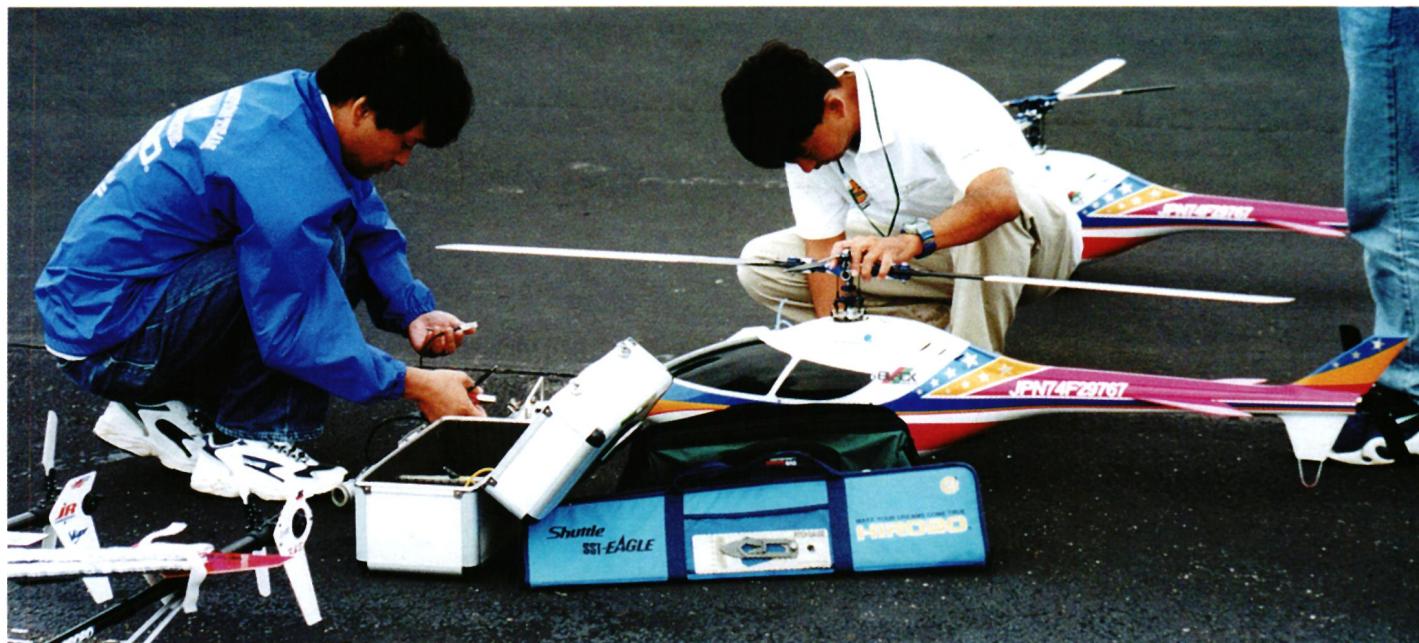
Defending champion Manabu Hashimoto.
Scroll. Various participants used longer rotor shafts to improve hover stability. For the rotor heads, through-shaft designs are becoming increasingly common.
Fuselage fairings appear to be experiencing a definite resurgence. The fast and elegant flying style is gaining more and more popularity. Only Youngblood, Hyatt, Mann, Lombard, and Brianchon used a trainer version. The majority of the Japanese pilots used retractable landing gear.
The major innovations will likely come next year with the official introduction of the 90-series motors. Futaba had ushered in the post-piezo era with the 601 gyro (a new feature is the silicone rotation sensors, which are also used in automotive engineering. According to the manufacturer, they are virtually drift-free.). Other manufacturers will likely follow suit. Several European pilots used Roland Frech’s small-batch-produced onboard computer with great success.
Once again, fewer speed controllers were used. In swashplate linkage, CCPM (Trilink) is clearly gaining ground. Only 3 of the finalists were still flying with mechanical mixing. The new digital servos have helped this technology achieve widespread success.
At JR, a 140-degree linkage was demonstrated that makes the pitch linkage spacing symmetrical, so that even during rapid control movements, there is no longer a speed difference in the pitch servo. According to the
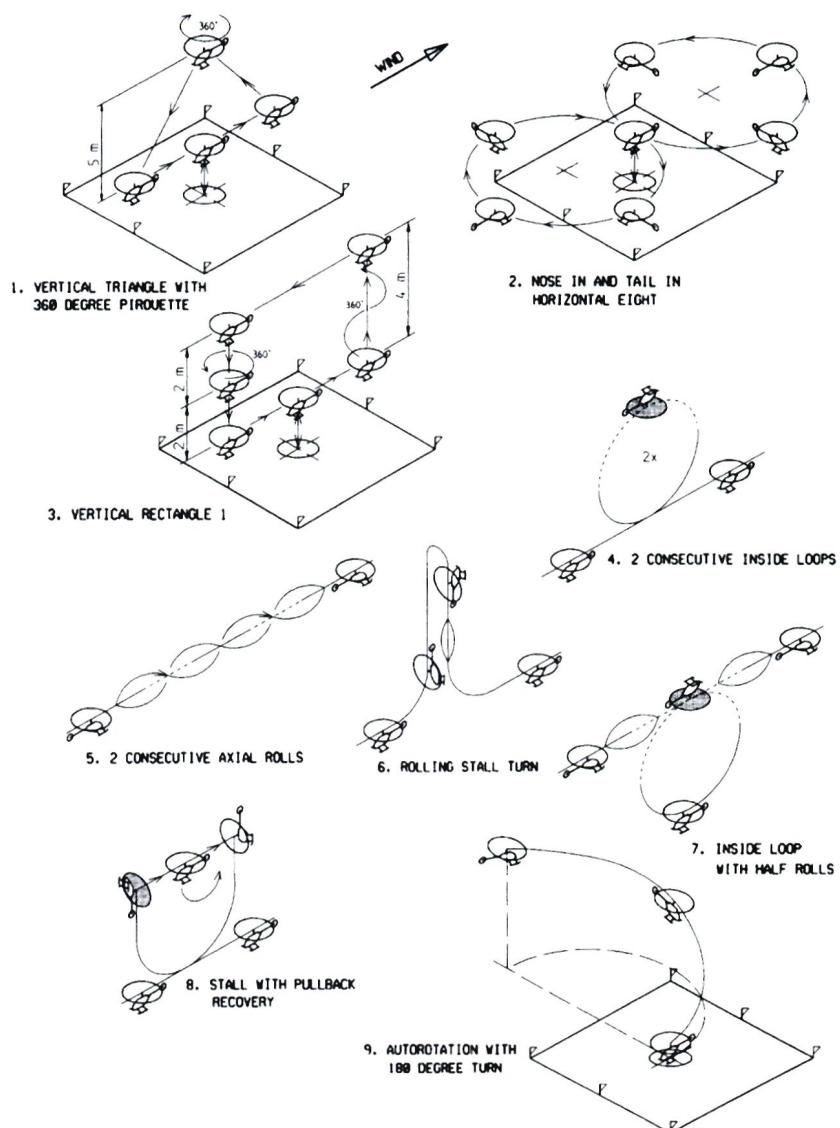
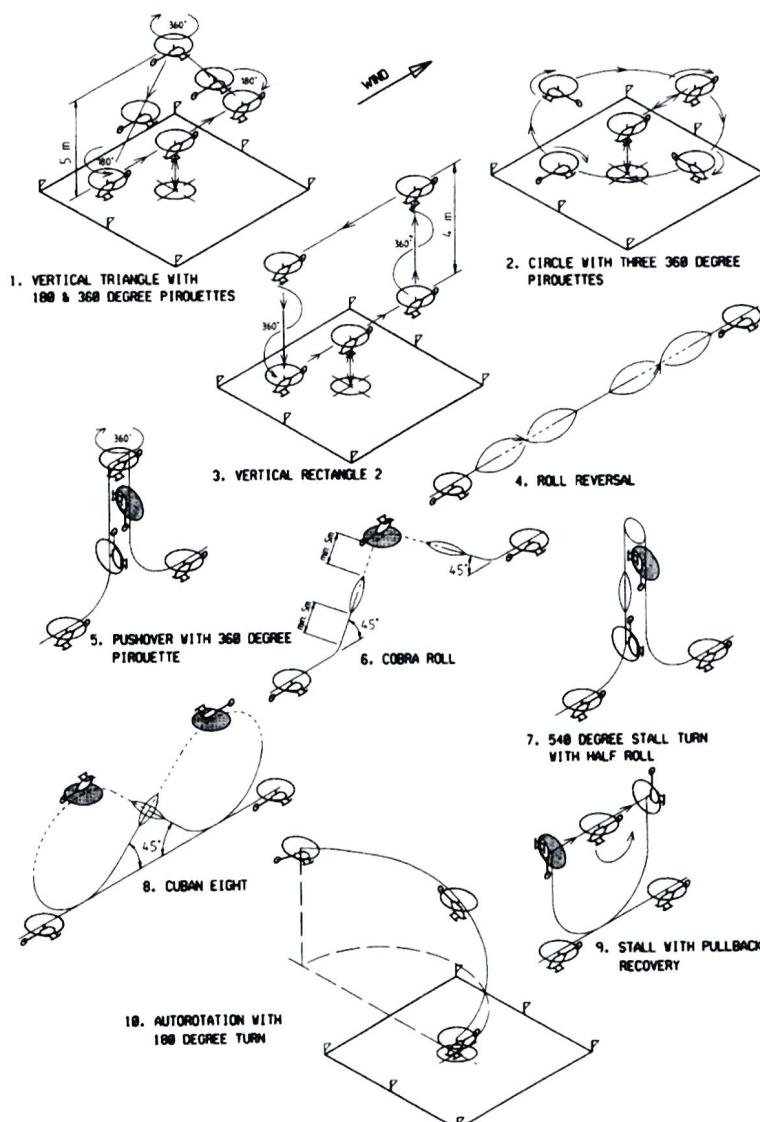
However, pilots say the advantage is barely noticeable during flight. So far, this control method is only supported by JR transmitters. Here, too, the competition will likely follow suit shortly.
Otherwise, there were no new “miracle mixers” or functions on the systems that simplify flying. A skilled pilot is still required.
The World Championships then concluded with a banquet on Saturday evening. At Sunday’s air show—which also marked the opening of the largest helicopter meet in the U.S.—almost no World Championship participants flew. It was a standard 3D event as is customary in the U.S. About 15 pilots fly simultaneously, each in a 15-meter 3D box, until the blades break.
Everyone said their goodbyes and wished each other all the best until the 2003 World Championship in Japan.

EURO CONTEST GLIDER ACRO TOUR AUSTRIA 2026

THE PC-21 STORY
 Emil Giezendanner

TWIN TOWN PARTNERSHIP
 Wolfgang Voeller

SUMMER FUN 2026 AT MG USTER
Martin Wunderli
CORSAIR F4U – A WARBIRD WITH A MEMORABLE LOOK
Jürgen Rosenberger, Jürgen Prinz
52. 2026 ALPS CUP
Emil Giezendanner
YOU KNOW WHAT I MEAN? 125 YEARS OF THE SWISS AERO CLUB
Emil Giezendanner
News from HEBU

TEAM MANAGER "THIS" BOSSHARD
Rodito Nussbaumer
ATOM, THE NEW DOUBLE-DECKER FROM CPLR
 Matthias Bosshard

F3A EUROPEAN CHAMPIONSHIPS IN ST-MACAIRE, FRANCE
Matthias Bosshard
INSIGHTS INTO THE HISTORY OF SEAPLANES

WELCOME, NEW MEMBER!
Andrea Bolliger
What's New at Leomotion.com

PRIDE AND GOOD IDEAS
 Markus Nussbaumer

SMALL, MODEL-LIKE SAILBOATS
Res Dauwalder
FREE FLIGHT IN THE MIDDLE OF SUMMER
Urs Muntwyler
BY YOUTH, FOR YOUTH
Lorena Betschen
34th HAHNENMOOS ALPINE MODEL AIRPLANE CAMP
Res Dauwalder
HORIZON HOBBY/LEMACO NEWS: MICRO OV-10 BRONCO 645 MM BY E-FLITE

COUPE DES ALPES – OBSERVE AND LEARN
Rodito Nussbaumer
TRY-OUT DAY AT MFV WETTINGEN
 Urs Keller

NEWS FROM HEBU
 Julia Bucher

NOS REGION – A HUB FOR ELECTRIC AVIATION
Emil Giezendanner
MEMORIES
 Wolfgang Völler

70 YEARS OF THE NIDWALDEN MODEL AIRPLANE CLUB
Martin Barmettler
A SPECTACULAR F3A WORLD CUP IN THE PRINCIPALITY OF LIECHTENSTEIN
Emil Giezendanner
FROM 0 TO 100
Markus Nussbaumer