
F4 Scale Categories B and C in Poland
In the Scale category, the World Championships and European Championships alternate on a yearly basis.
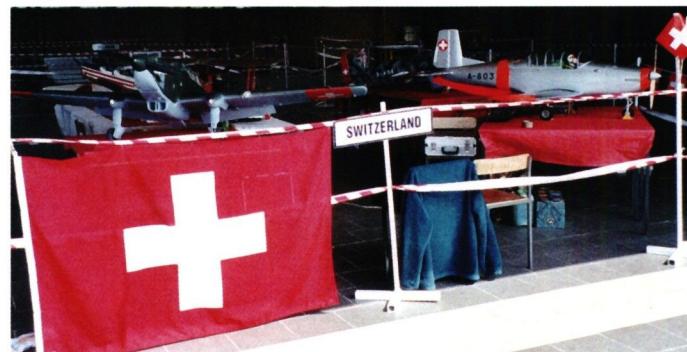
Following the successful World Championships in Interlaken, it was now time for the “small tour” from August 4–11, 2001. Each country was allowed to enter five pilots, three of whom counted toward the team standings. Andreas Lüthi and Hans Ammann from Burgdorf chose not to participate (as did the entire German team, much to the organizer’s regret). Switzerland was able to enter the following pilots:
- Max Schilt, Interlaken (who also served as team manager) Model: K+W G3603
- Gody Fischer, Dübendorf Pilatus P3-05
- Bernard Pettavel, Bex: DH Tiger Moth
- Cedric Pettavel, Bex Klemm 35 d
- Markus Günther, Interlaken, Morane D-3802/A
Peter Gutknecht represented Switzerland as a flight judge.
The town is located about 150 km north of Warsaw, the capital of Poland. The 1,600 km journey could only be completed with an overnight stop. We drove in our own private vehicles.
Peter Gutknecht’s wife, Yvonne, had planned the itinerary perfectly and guided the entire Swiss convoy of five vehicles safely and without detours to their destination. At the sports airfield, the model airplane runway and the circuit were built specifically for this event. Funding for this was provided by the government and political parties because elections were coming up soon.
The Wloclawec Aero Club organized this event flawlessly, and the extremely friendly and pleasant demeanor of the Polish volunteers prevented any disagreements or ill will from arising in the first place.
The weather that week was rain-free, though a harsh, gusty wind of 6–8 km/h blew most of the time, which gave every pilot a hard time on at least one of their flights. That was also the reason why the tethered-flight pilots didn’t begin their flight demonstrations until after 7:00 p.m. Since we RC pilots had already finished for the day, we enjoyed the performances by our tethered-flight friends, who amazed us with their precisely built models and the variety of functions they could perform.
The European champion in this class was Marian Kazirod from Poland with his AVRO Lancaster, ahead of Russia’s Slava Tshubatov (Yak-52) and his compatriot Piotr Zawada, who flew a Miles M 14 Magister. Last year’s world champion, Vladimir Kusy from the Czech Republic, had to compete with a replacement model and was unable to keep up with the leaders. Thirteen participants competed in the F4B category.
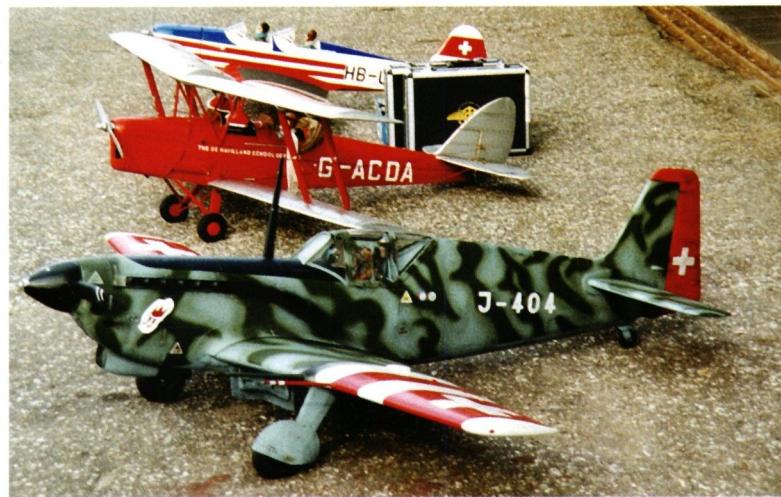
When the construction points were tallied, Max Schilt (1,323 points) and Gody Fischer (1,284 points) had reason to be satisfied. The Pettavels—father and son—also expected this result for their models. Markus Günther, however, had to accept a huge gap between his Morane and the majority of the other models. With 778 construction points—by far the worst result of all participants—the engine shouldn’t even have been started in the first place, considering that the static score is equivalent to a flight run. That was not what they had expected!
A second discussion with Chief Construction Judge Matti Jyllia from Finland revealed that minor structural differences from the original were penalized very harshly, even though they were not entirely unjustified. Perhaps it was also just bad luck that Markus Günther was the first to present his model on the display table. Without letting it get him down, he began his flight demonstrations and was promptly rewarded with a 3rd and 4th place finish.
Gody Fischer had some trouble with the wind direction because he’d practiced his routine over 20 times from the opposite direction back home in Dübendorf! Cedric Pettavel had to modify his flight routine after the first run because he performed an inverted flight with his Klemm during a selected maneuver. Chief judge Christopher Allen from England and his team took issue with this because Cedric had no proof that the original aircraft was actually capable of performing that maneuver. Bernard Pettavel didn’t have an easy time of it in these wind conditions with his somewhat small Tiger Moth. This made his flying performance all the more impressive! The most work and stress fell on
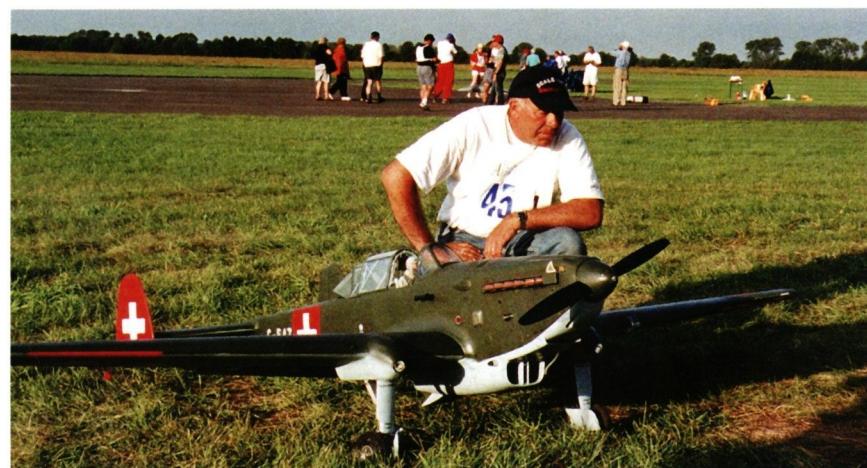
Probably Max Schilt. During training, he flew his G36 until he ran out of fuel and landed in a field, causing the landing gear covers to be torn off. On his first run, he broke through the safety barrier upon landing because, in those wind conditions, he could barely keep his giant bird on the ground, causing one of the landing gear legs to buckle. More repairs!
In between, he also served as team manager and patient flight assistant to Gody Fischer and Markus Günther. He certainly wasn’t always in an enviable position. The Polish air did wonders for his homemade 60-cm³ four-stroke engine, as it ran like a charm every time.
Max Schilt’s wife, Therese, treated us to a little highlight. She organized a sightseeing flight for us Swiss in an Antonov AN-2. Since this 20-minute flight cost only 50 Polish zloty (22 Swiss francs) per person and we still had open seats, we spontaneously invited the landlady and the model transporter to join us on this sightseeing flight. The two of them couldn’t believe their luck, as this was an experience that would otherwise have been financially out of their reach.
In my opinion, the judges had done their job very well and fairly. Particularly helpful was
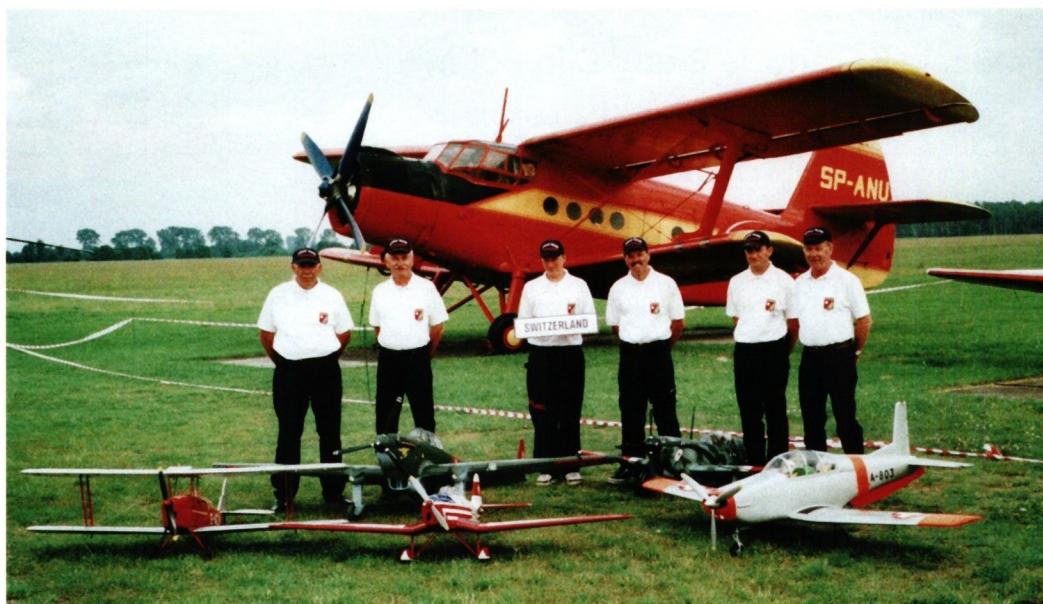
"Our" Peter Gutknecht was always there for us with advice and support, which we greatly appreciated. The judges were particularly impressed by Max Schilt’s calm and true-to-the-original flight demonstration with the C-36. Among competitors, there were rumors of a gyroscope being used to assist the ailerons, which was, of course, completely unfounded.
The modifications made to the model since the World Championships to earn more construction points, as well as reducing the weight to under 12 kg for the F4C class, had paid off for Max. With a 9th-place finish, he achieved the best Swiss result!
The closing ceremony, featuring the announcement of the results, was graced by distinguished guests from the political and military spheres.
The prize table was so generously stocked that there was enough for everyone on the podium to receive a medal, a trophy, and a certificate—whether in the individual or team standings! The banquet on the final evening was a bit unusual for us. In the center stood a huge, lavishly decorated buffet. However, we ate standing up with our plates in hand. This had the great advantage of allowing us to chat once more with many different people about our experiences and what lies ahead.
Without any incidents and with nothing but good memories, we all made it home safely, the models still in working order, and we learned a great deal.
What more could you ask for!
*Markus Günther*
| 1. Pavel Fencel | CZE | Knoller C II | 3,134.50 |
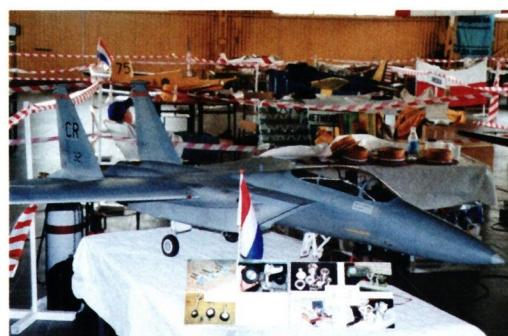
| 2. Gerald Rutten Jr. | NED | F-15 Eagle | 3,080.00 |
| 3. Petr Tax | CZE | Avro 504 K | 3,003.00 |
| 9. Max Schilt | SUI | K+W C-3603 | 2,747.25 |
| 18. Gody Fischer | SUI | Pilatus P3-5 | 2,526.50 |
| 20. Bernard Pettavel | SUI | DH Tiger Moth | 2,337.25 |
| 22. Cedric Pettavel | SUI | Klemm 35 d | 2,551.00 |
| 24. Markus Günther | SUI | Morane D-3802-A | 2,236.50 |
A total of 25 pilots placed.

EURO CONTEST GLIDER ACRO TOUR AUSTRIA 2026

THE PC-21 STORY
 Emil Giezendanner

TWIN TOWN PARTNERSHIP
 Wolfgang Voeller

SUMMER FUN 2026 AT MG USTER
Martin Wunderli
CORSAIR F4U – A WARBIRD WITH A MEMORABLE LOOK
Jürgen Rosenberger, Jürgen Prinz
52. 2026 ALPS CUP
Emil Giezendanner
YOU KNOW WHAT I MEAN? 125 YEARS OF THE SWISS AERO CLUB
Emil Giezendanner
News from HEBU

TEAM MANAGER "THIS" BOSSHARD
Rodito Nussbaumer
ATOM, THE NEW DOUBLE-DECKER FROM CPLR
 Matthias Bosshard

F3A EUROPEAN CHAMPIONSHIPS IN ST-MACAIRE, FRANCE
Matthias Bosshard
INSIGHTS INTO THE HISTORY OF SEAPLANES

WELCOME, NEW MEMBER!
Andrea Bolliger
What's New at Leomotion.com

PRIDE AND GOOD IDEAS
 Markus Nussbaumer

SMALL, MODEL-LIKE SAILBOATS
Res Dauwalder
FREE FLIGHT IN THE MIDDLE OF SUMMER
Urs Muntwyler
BY YOUTH, FOR YOUTH
Lorena Betschen
HORIZON HOBBY/LEMACO NEWS: MICRO OV-10 BRONCO 645 MM BY E-FLITE

34th HAHNENMOOS ALPINE MODEL AIRPLANE CAMP
Res Dauwalder
COUPE DES ALPES – OBSERVE AND LEARN
Rodito Nussbaumer
TRY-OUT DAY AT MFV WETTINGEN
 Urs Keller

NEWS FROM HEBU
 Julia Bucher

NOS REGION – A HUB FOR ELECTRIC AVIATION
Emil Giezendanner
MEMORIES
 Wolfgang Völler

70 YEARS OF THE NIDWALDEN MODEL AIRPLANE CLUB
Martin Barmettler
A SPECTACULAR F3A WORLD CUP IN THE PRINCIPALITY OF LIECHTENSTEIN
Emil Giezendanner
FROM 0 TO 100
Markus Nussbaumer