
Tradition and Progress Go Hand in Hand
Multiplex is one of the major, long-established German companies in the model-making industry. Founded in 1958 in Niefern near Pforzheim, the company focused from the very beginning on the development and manufacture of radio-controlled systems. For example, innovative MPX electronics engineers succeeded in developing the first fully proportional model remote control system.
Multiplex model airplanes are also well known, such as the Big Lift—a classic among tow planes—or the “Alpina,” which, with a wingspan of 4 meters, was one of the most popular large gliders of its time. Multiplex also played a major role in the development of electric flight in the 1970s. Helmut Schenk, a Multiplex employee who continues to tinker in “restless retirement,” developed one of the first remote-controlled electric gliders at that time—the twin-engine “E 1” model—and won the first “Militky Cup” in Pfäffikon with it in 1973. He was also the one who recognized the importance of Japanese Mabuchi mass-produced motors for electric flight, which was still in its infancy at the time. Despite their traditional roots, however, the developers in Niefern always kept their finger on the pulse of the times. They recognized in good time the shift in trends among Central European model builders, who, by the late 1990s, were becoming increasingly interested in foam models that were largely ready to fly. Since then, well-engineered models made from the “durable” rigid foam material ELAPOR have become one of Multiplex’s hallmarks.
Since 2002, Multiplex has been a thriving part of the South Korean HiTEC Group. Despite having similar product lines—both companies had previously manufactured RC transmitters, receivers, and servos—there have never been any internal conflicts of interest, according to General Manager Dieter Wörner.
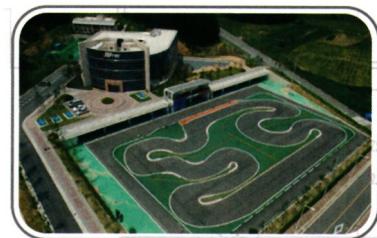
Multiplex/HiTEC has since become a multinational corporation.
In 2007, the company relocated to Bretten-Gölshausen. The expanded company grounds also include an RC car test track (left) as well as a test flight area for small models (behind the hangar).
At the same time, the company is not afraid to take advantage of the resulting synergies. Both product lines are set to continue running in parallel in the future, satisfying different customer needs. Even the visual distinguishing features will remain. Multiplex servos are red and HiTech servos are black—and will stay that way.
The expanding product range made it necessary to move to new facilities in 2006. A location was found about 30 kilometers away in an industrial park in the small town of Bretten in Baden; for the current 105 employees, this was apparently a reasonable distance, as nearly all of them made the inevitable move. Company management reciprocated by providing job security. Dieter Wörner announces with pride that even during the difficult year of 2009, the company managed to get by without any short-time work or layoffs. Instead, the company refocused on its core competence as a manufacturer of RC components and gave the engineers in the development department the time they needed to complete their “homework” with the necessary thoroughness.
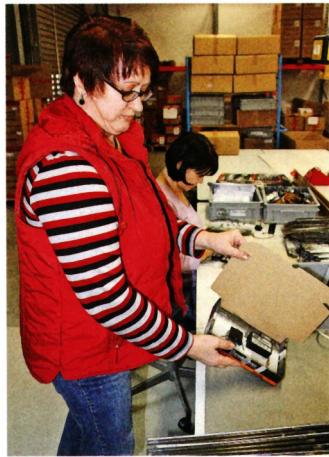
Of course, the soldering is done in the Far East, but the final assembly and packaging of the RC components take place in Bretten.
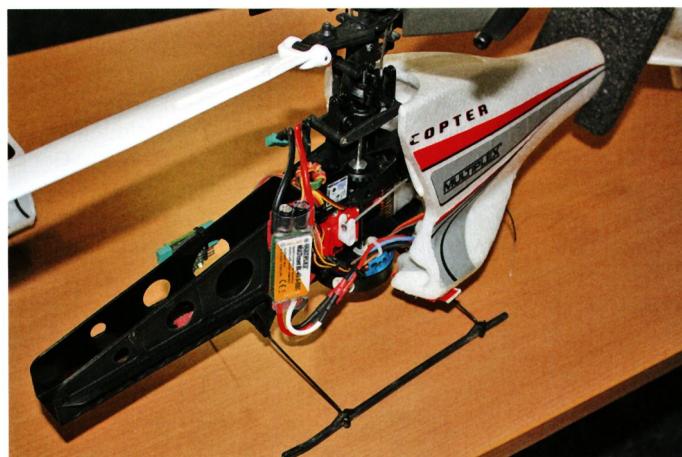
What should you do when your coaxial helicopter starts to get a little boring? The Multiplex FunCopter aims to answer questions like that. This nearly “indestructible” foam-coated helicopter is recommended as a stepping stone into the still very challenging class of “real” helicopters.
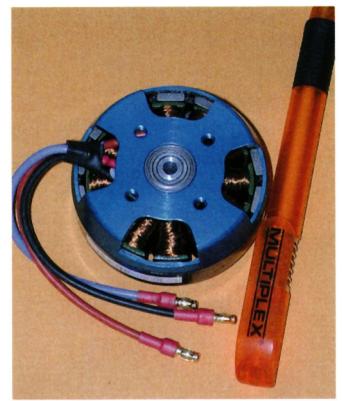
Simplicity is key: The FunCopter's rotor is directly driven by a brushless outrunner motor designed according to the LRK principle and specifically engineered for high torque.
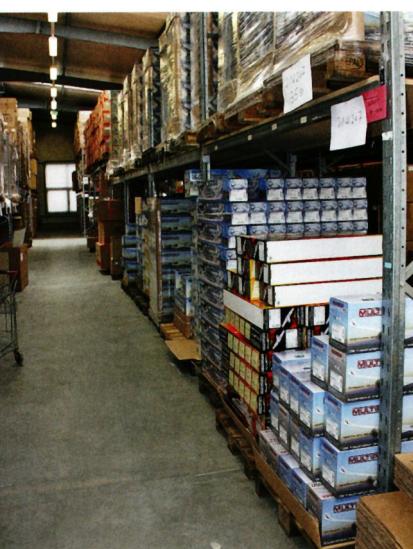
The Multiplex distribution warehouse—a land of milk and honey for every true model airplane enthusiast? Emil Giezen-danner certainly seems to feel right at home there, even if—due to his generation—there’s always a touch of balsa wood nostalgia in the air.
Remote control technology for model airplanes has been undergoing a major transformation for several years now. The shift has been away from the relatively narrowband—and therefore interference-prone—35-MHz technology toward modern 2.4-GHz transmission. The new technology no longer operates on fixed frequencies in 10-kHz increments but instead uses a modern frequency-hopping method with much higher redundancy. This allows information to be transmitted much more reliably from the transmitter to the receiver, especially since the exchange of information between the two is bidirectional. Thus, modern Multiplex M-Link systems naturally also transmit information back to the transmitter, such as the receiver voltage. Sensors for other relevant parameters—such as motor current, temperature, and speed—can also be used. They are transmitted to the receiver via a modern bus system with true diversity (two receiver units, not just switchable antennas). A special feature: The telemetric data is displayed—supported by an audible limit warning—directly on the transmitter display. Therefore, the M-Link system is definitely not designed for installation in third-party products. In Bretten, they believe they can afford this claim to exclusivity, as the Multiplex fan base is among the most loyal in the industry. Apparently, they didn’t hold it against the German-Korean consortium that they had to wait longer than other customers for their (!) 2.4-GHz system. Good things take time!
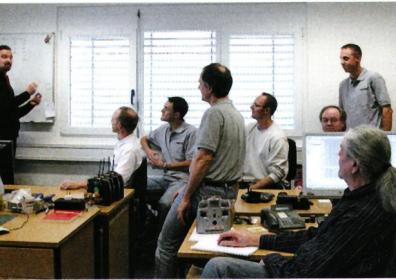
Employee training in the development department.
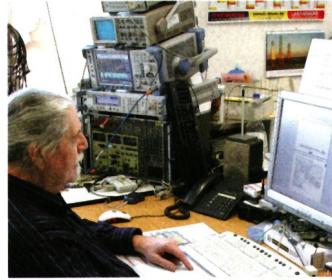
Development cannot happen without measurement and testing.
for other parameters of interest, such as motor current, temperature, RPM, etc. These are transmitted via a modern bus system to a receiver with true diversity (two receiver units, not just switchable antennas). A special feature: The telemetry data is displayed—supported by an audible limit warning—directly on the transmitter display. Therefore, the M-Link system is definitely not designed for installation in third-party products. In Bretten, they believe they can afford this claim to exclusivity, as the Multiplex fan base is among the most loyal in the industry. Apparently, they didn’t hold it against the German-Korean consortium that they had to wait longer than other customers for their (!) 2.4-GHz system. Good things take time!
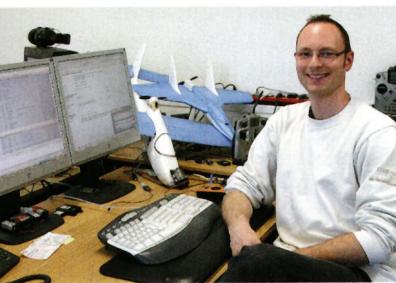
It's also good when a developer always keeps the goal of their work in mind.
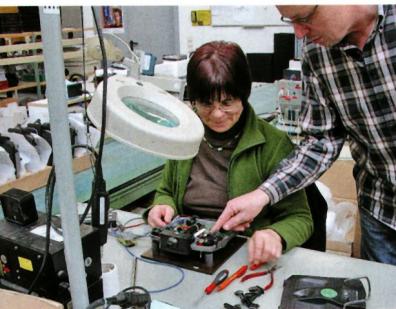
Final assembly of transmitters.
Ludwig Retzbach
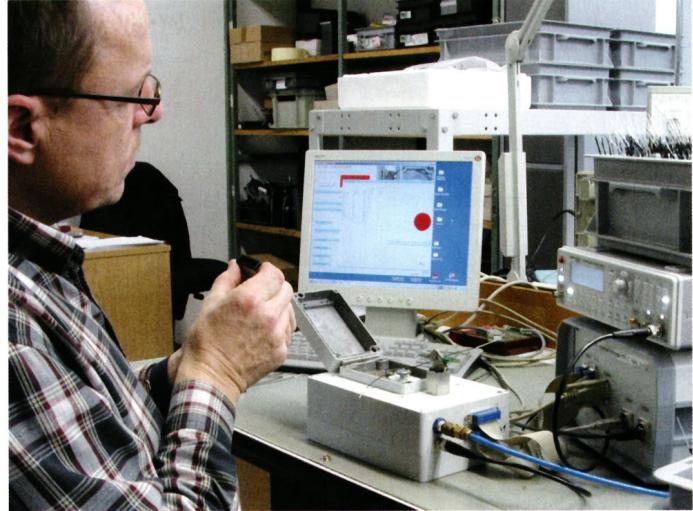
Before anything goes out, it has to be checked.
| 1958 | Company founded by Siegfried Kussmaul |
| 1964 | Launch of the Multiplex brand with the “101” |
| 1973 | Moved to Neuen Weg 2 in Niefern |
| 1980 | Founding of MULTIPLEX Modelltechnik GmbH |
| 2002 | Acquisition by the HiTEC Group; founding of Multiplex Modellsport GmbH & Co. KG |
| 2007 | Relocation to Bretten-Gölshausen – Start of development of M-LINK 2.4 GHz |
| 2008 | 50th anniversary of Multiplex |
| 2009 | Delivery of the M-LINK 2.4 GHz telemetry system, Made in Germany |
| 2010 | Numerous groundbreaking innovations in the field of remote control technology and model aircraft for model sports |

EURO CONTEST GLIDER ACRO TOUR AUSTRIA 2026

THE PC-21 STORY
 Emil Giezendanner

TWIN TOWN PARTNERSHIP
 Wolfgang Voeller

SUMMER FUN 2026 AT MG USTER
Martin Wunderli
CORSAIR F4U – A WARBIRD WITH A MEMORABLE LOOK
Jürgen Rosenberger, Jürgen Prinz
52. 2026 ALPS CUP
Emil Giezendanner
YOU KNOW WHAT I MEAN? 125 YEARS OF THE SWISS AERO CLUB
Emil Giezendanner
News from HEBU

TEAM MANAGER "THIS" BOSSHARD
Rodito Nussbaumer
ATOM, THE NEW DOUBLE-DECKER FROM CPLR
 Matthias Bosshard

F3A EUROPEAN CHAMPIONSHIPS IN ST-MACAIRE, FRANCE
Matthias Bosshard
INSIGHTS INTO THE HISTORY OF SEAPLANES

WELCOME, NEW MEMBER!
Andrea Bolliger
What's New at Leomotion.com

PRIDE AND GOOD IDEAS
 Markus Nussbaumer

SMALL, MODEL-LIKE SAILBOATS
Res Dauwalder
FREE FLIGHT IN THE MIDDLE OF SUMMER
Urs Muntwyler
BY YOUTH, FOR YOUTH
Lorena Betschen
HORIZON HOBBY/LEMACO NEWS: MICRO OV-10 BRONCO 645 MM BY E-FLITE

34th HAHNENMOOS ALPINE MODEL AIRPLANE CAMP
Res Dauwalder
COUPE DES ALPES – OBSERVE AND LEARN
Rodito Nussbaumer
TRY-OUT DAY AT MFV WETTINGEN
 Urs Keller

NEWS FROM HEBU
 Julia Bucher

NOS REGION – A HUB FOR ELECTRIC AVIATION
Emil Giezendanner
MEMORIES
 Wolfgang Völler

70 YEARS OF THE NIDWALDEN MODEL AIRPLANE CLUB
Martin Barmettler
A SPECTACULAR F3A WORLD CUP IN THE PRINCIPALITY OF LIECHTENSTEIN
Emil Giezendanner
FROM 0 TO 100
Markus Nussbaumer