
Lighting and Signaling on Model Airplanes Using Modern Power LEDs
Workshop 4
Christoph and Franz Raible
(Part 2: Practical Application will be covered in the next workshop)
Anyone who has ever considered the possibilities of lighting a model aircraft in a way that is both true to scale and useful for flight operations has quickly realized that, due to the limited light output of the light sources used, such lighting was suitable only for demonstration and decorative purposes. Due to their form factor, durability, and power requirements, only light-emitting diodes (LEDs) are suitable as light sources. Until recently, however, these were simply not powerful enough to fulfill a legitimate function during flight, as they do in commercial aviation. In the meantime, thanks to high-performance light sources available in all necessary colors, this situation has changed so drastically that even the commercial aviation industry is now relying on new LED lighting solutions. For us, this means that new and meaningful applications have also emerged that go far beyond simply replicating the original’s lighting and signaling. With the help of this workshop and the one that follows, you’ll be able to bring your ideas, visions, and projects related to “Light Up Your Aircraft” to life: a fun experience with real purpose is guaranteed.
The lighting requirements for aircraft are not clearly defined and vary from model to model—whether fixed-wing aircraft or helicopters. However, our research has resulted in the following list of common lighting and visual signaling systems. For clarity, we use the English terms. A more detailed description can be found at www.innoflyer.ch.
Navigation Lights: Steady red and green position lights used to indicate the direction of flight. From the pilot’s perspective, the red light is on the left side and the green light is on the right side.
Navigation or Position Lights: Additional white lights located at various positions on the aircraft to improve visibility.
Anti-Collision Beacon Lights: Orange-red flashing lights mounted at the top and bottom of the center of the aircraft.
Strobe Lights: Intense white strobe lights with high visibility due to the selected ratio of on-time to off-time.
Logo Lights: Lighting for logos and airline names affixed to the aircraft for commercial purposes.
Wing Lights: Lighting on the wings and other parts of the aircraft that is visible to the pilot for in-flight inspection purposes.
Taxi Lights: A bright, white spotlight mounted on the nose of the aircraft.
Landing Lights: Bright white lights used to illuminate the runway during takeoff and landing and to improve visibility.
during takeoff and landing maneuvers or night flights when runway lighting is dim.
Runway Turnoff Lights: Bright white lighting to assist with ground maneuvers on dimly lit runways and taxiways.
Wheel Well Lights: Lighting to enable ground crew to inspect the main landing gear.
A lighting system using power LEDs consists of five components: light source, driver, optics, power distributor, and installation hardware.
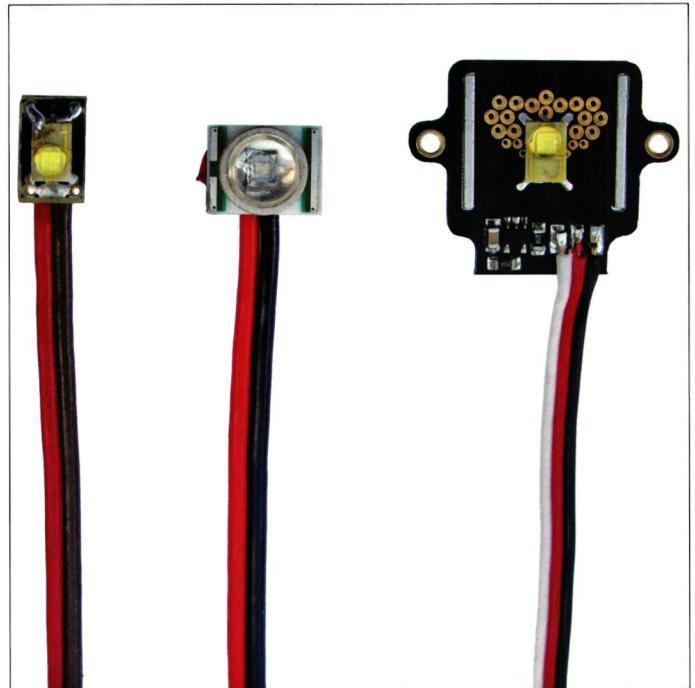
Unlike conventional low-power LEDs with currents below 50 mA, power LEDs must be operated at currents ranging from 200 mA to 1 ampere. This is the only way to achieve high luminous intensity. In doing so, the LED generates a considerable amount of heat that must be dissipated. The LED must never be operated outside its thermal specifications. In practice, this means that the current and the resulting power dissipation must be controlled
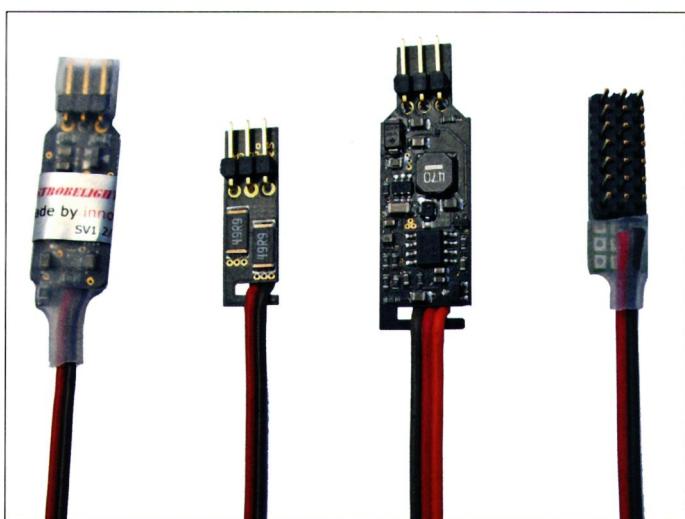
to guarantee safe operation within its specifications. In the simplest case, this control is achieved using a series resistor (Figure 1: Light Sources by innoflyer). The disadvantages of this solution are that, depending on the applied voltage, the power dissipation in the series resistor quickly reaches the limit of controllability. Operating currents exceeding 200 mA with 2 to 3 LiPo cells are no longer practical with this simple series resistor method, as the true performance potential of modern high-power LEDs cannot even be approached with it. Therefore, an LED driver circuit is required that delivers the maximum possible current constantly and largely independently of the connected power supply. In addition, it is advisable to monitor the LED’s temperature and, if necessary, automatically adjust it to actual conditions. This ensures maximum luminous efficiency in all real-world applications (Figure 2: Driver from innoflyer).
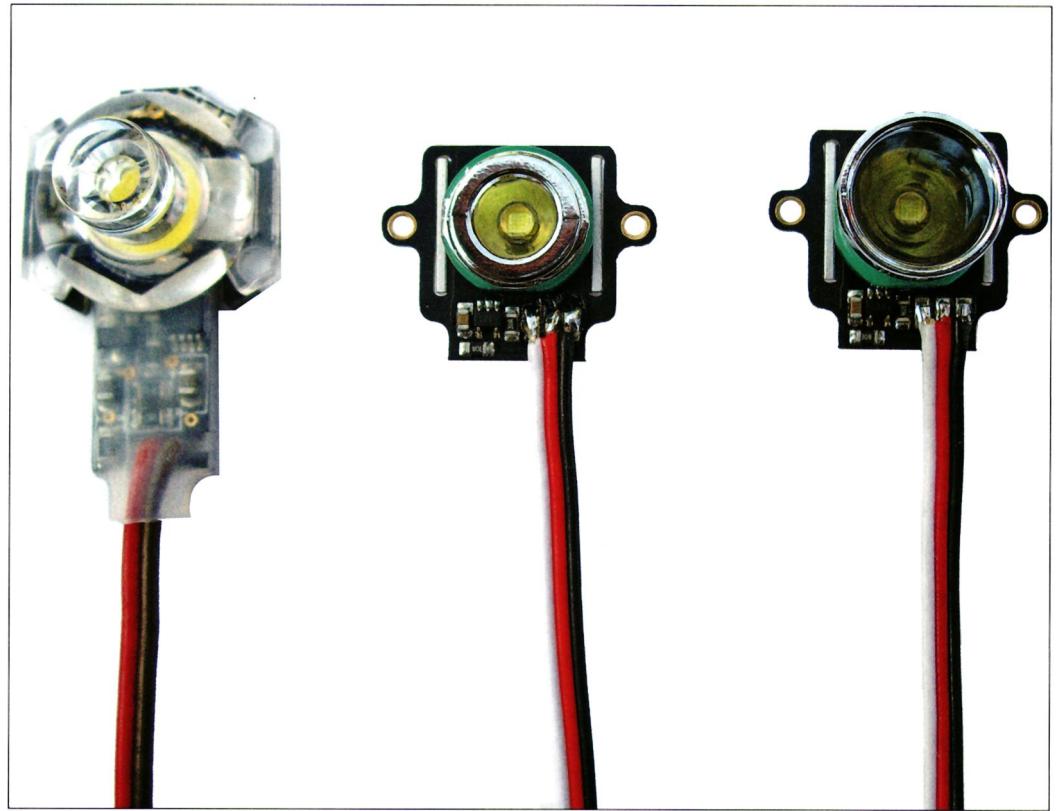
On the optical side, the choice of beam path is crucial. Depending on the type of lighting as outlined in our list, we need tailored and effective optics. Currently, various components suitable for our purposes are available on the market. The optics must always be adapted to the power LEDs used. Only then can a perfect result be achieved (Figure 3: A selection of optics).
Practical installation techniques are also important in a lighting project. Existing solutions, such as those commonly used in remote control technology, can be utilized. Wiring the individual components is straightforward, as usual, and is reliable and safe from an electrical standpoint.
In addition to ensuring that the connected power LEDs operate within their specified electrical and thermal parameters, drivers can also handle additional tasks such as turning the LEDs on and off via a remote control channel. Together with the remote control
transmitter, many interesting and useful functions are possible, such as operating a landing light, activating position lights depending on the flight phase, etc. An intelligent power supply/distribution system enables, on the one hand, flexible
connection options to an existing power supply in the model, while also allowing a switch to an autonomous power supply when capacity constraints require it.
One of the purposes of this somewhat detailed introduction to the topic is to spark your interest in it. “Light Up Your Aircraft” is meant to be more than just a trendy, technology-driven fad in the model aircraft scene. An example from the perspective of operational safety should make this abundantly clear.
Electric-powered model aircraft are “ready for operation” as soon as the power supply is connected. A simple manipulation of the transmitter, or even interference in the radio channel or technical malfunctions, can lead to the motor turning on unexpectedly. We won’t discuss
. Our suggestion, borrowed from full-scale aviation, is quite simple: Let’s install a strobe light and link it to the remote control system so that whenever the power supply is connected, a visual signal reminds the user: “Warning, aircraft ready for operation when flashing”. With the new power LEDs, such a warning is guaranteed to be impossible to miss. This example impressively demonstrates that lighting and visual signaling on a model are particularly useful. Think about your own ideas and be sure to read our second part on this topic as well. We’ll guide you a little further into the practical aspects of working with power LEDs and their potential applications in model aircraft.
You can also find more information on the topic “Light Up Your Aircraft” at www.innoflyer.ch.


News from HEBU

TEAM MANAGER "THIS" BOSSHARD
 Rodito Nussbaumer

YOU KNOW WHAT I MEAN? 125 YEARS OF THE SWISS AERO CLUB
 Emil Giezendanner

HORIZON HOBBY/LEMACO NEWS: MICRO OV-10 BRONCO 645 MM BY E-FLITE

PRIDE AND GOOD IDEAS
 Markus Nussbaumer

TRY-OUT DAY AT MFV WETTINGEN
Urs Keller
F3A EUROPEAN CHAMPIONSHIPS IN ST-MACAIRE, FRANCE
 Matthias Bosshard

52. 2026 ALPS CUP
Emil Giezendanner
ATOM, THE NEW DOUBLE-DECKER FROM CPLR
Matthias Bosshard
SUMMER FUN 2026 AT MG USTER
Martin Wunderli
What's New at Leomotion.com

COUPE DES ALPES – OBSERVE AND LEARN
Rodito Nussbaumer
TWIN TOWN PARTNERSHIP
Wolfgang Voeller
BY YOUTH, FOR YOUTH
Lorena Betschen
34th HAHNENMOOS ALPINE MODEL AIRPLANE CAMP
Res Dauwalder
CORSAIR F4U – A WARBIRD WITH A MEMORABLE LOOK
Jürgen Rosenberger, Jürgen Prinz
SMALL, MODEL-LIKE SAILBOATS
Res Dauwalder
WELCOME, NEW MEMBER!
Andrea Bolliger
FREE FLIGHT IN THE MIDDLE OF SUMMER
Urs Muntwyler
EURO CONTEST GLIDER ACRO TOUR AUSTRIA 2026

INSIGHTS INTO THE HISTORY OF SEAPLANES

THE PC-21 STORY
Emil Giezendanner
NEWS FROM HEBU
 Julia Bucher

FROM 0 TO 100
Markus Nussbaumer
MEMORIES
Wolfgang Völler
NOS REGION – A HUB FOR ELECTRIC AVIATION
Emil Giezendanner
DO YOU KNOW WHAT I MEAN IN THE LAND OF SMILES?
Emil Giezendanner
A SPECTACULAR F3A WORLD CUP IN THE PRINCIPALITY OF LIECHTENSTEIN
Emil Giezendanner