
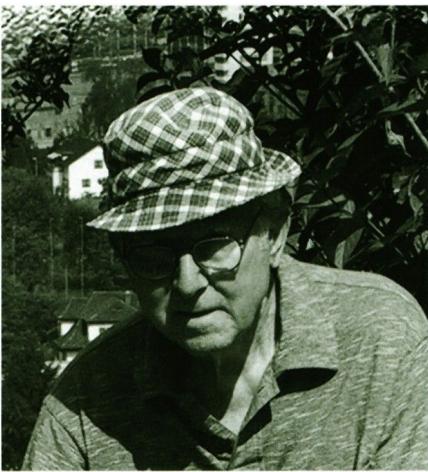
Ernst Bernet, the “mfs” editor specializing in helicopters, has retired
AB: Ernst, you left the editorial team this spring of 2001. When did your time at “modell flugsport” as an editorial staff member begin, and how was information provided in the helicopter section back then, and how is it provided today?
EB: My work on the “mfs” editorial team began in December 1979, at my own suggestion. As a beginner, I constantly struggled with equipment issues and with the often baffling behavior of helicopters. Help from fellow helicopter modelers wasn’t available—there were practically no helicopter modelers back then. Articles about model helicopters appeared only very sporadically in trade journals. So I studied technical books from the full-scale helicopter scene and thus acquired a solid foundation in helicopter technology. What could be more natural than to share the “aha” moments I gained while flying—in the form of “Practical Helicopter Tips”—with helicopter fans scattered far and wide? Emil Giezendanner recognized this gap in the market and provided me with my own column for these practical tips.
AB: That’s been a long time, indeed! How long have you been flying model helicopters, and in what capacity?
EB: I’ve been flying model helicopters since 1975. My first model was the legendary Heli-Baby from Schlüter. Back then, you still flew it with a fixed pitch angle on the main rotor. If you managed to land such a machine safely after a flight—without collective pitch control or a stabilizing gyro—you were rightly proud of your achievement.
Ever since I started flying, I’ve enjoyed the unique flying characteristics of helicopters. I’ve always found aerobatics as an art form to be unnatural for such a complex and mechanically demanding aircraft. I’ve never tried it—though maybe I could have even learned it!
Ernst Bernet still flies this model helicopter occasionally today. Due to its size and weight, the helicopter feels somewhat sluggish, so that despite his advanced age, Ernst is still well able to perform safe hovering maneuvers thanks to his quick reflexes.
AB: So you’ve devoted yourself exclusively to model helicopter flying—have you never thought about flying fixed-wing models as well?
EB: The helicopter is every physicist’s dream and every aerodynamicist’s nightmare. The complexity of this aircraft fascinated me from the very beginning, and besides my professional work, there was no room for any other time-consuming hobby. In the early days, I flew a Graupner Taxi. But that was just a test platform to learn how to handle glow plug engines and digital remote controls without crashing the expensive helicopter into the grass every time because of a malfunctioning engine.

AB: After your active career in model helicopter flying, you continued to serve as a technical editor. Why was that, exactly?
EB: During the rapid growth phase from about 1985 to 1995, new helicopter models from Japan, the U.S., England, and Germany hit the market in quick succession. I received a sample of many of these models to test. My reviews were brutally honest, and as a result, my opinion on a new design carried a certain amount of weight back then. However, due to rapid technological advancements, model helicopters quickly became high-tech devices that, when combined with electronic accessories, could only be evaluated by experts with the appropriate tools. I therefore limited myself to the universal laws of physics and tried to explain why a helicopter sometimes behaves in such an incomprehensible way. That was my goal, and it was understood and appreciated by experts in the field.
AB: Your technical reports have always been very interesting and written with a practical focus. Where or how did you acquire such broad and in-depth technical knowledge?
EB: As I mentioned earlier, through my own experience and by studying helicopter literature from around the world. I translated the often very complex concepts into everyday language, making them accessible to a general audience. That was probably the most important factor in my success.
AB: Ernst, how would you describe the evolution of the helicopter industry from when you first started until today?
EB: As in every field of technology, model helicopter flying began with simple mechanical solutions. The sport was practiced by only a few, but die-hard enthusiasts. As the number of interested people grew, model aviators from the traditional disciplines—who had already exhausted every possibility of fixed-wing flying and were searching for new
Opportunities for involvement drew attention to the “helicopter” challenge.
The increase in interested parties led to market growth, which in turn attracted a steady stream of new manufacturers and accessory suppliers. Today, however, the hobby’s growth is often limited by financial constraints. When a helicopter equipped with electronic accessories soon costs several thousand francs, further expansion is hardly possible. The demands of electronics and programming have also reached a level that deters many potential enthusiasts from getting started.
AB: In addition to your interesting articles in “mfs,” you’ve also written technical books, and they’ve obviously been well-received by helicopter enthusiasts. What were your main concerns and topics in these books? How many books have you actually published, and in what print runs?
EB: My goal in writing these publications was always to describe little-known characteristics and behaviors of helicopters in a way that’s easy for everyone to understand. Whenever I discovered something interesting, I wanted to share it with other helicopter pilots. I compiled my own experiences and theoretical foundations in my first book, *The RC Helicopter: Theory and Practice of Radio-Controlled Helicopter Models*. It was first published in 1981 in a small print run and was later taken over by the publisher vth in Baden-Baden. To date, a total of about 6,000 copies have been sold.
A second book, *Modell-Helikopter-Fundgrube* (Model Helicopter Treasure Trove), was self-published in 1998. It contains a collection of articles from helicopter trade journals. These articles have appeared over the past few years. However, they are scattered all over the world and are almost impossible to find for a helicopter enthusiast just starting out in the hobby today. So I have tried to make the knowledge of the past accessible today. Like all my publications, this book is also aimed at beginners and casual hobbyists. Experts already know so much that it’s hard to offer them any further advice.
AB: Are there any wishes or suggestions—whether general ones for us model aircraft enthusiasts or specifically for helicopter pilots—that you’d like to share with us?
Dear Ernst
, We gave you a fitting send-off with a fine glass of wine at our last editorial meeting. Nevertheless, I can’t resist taking this opportunity to once again thank you very much on behalf of our editorial team for your contributions and input to our magazine over the past twenty years. Not only have you written helicopter articles for the vast majority of weekend flyers, but you’ve also supported the “modell flugsport” company with both advice and practical help. I haven’t forgotten many of your comments and ideas. We’ve learned a great deal from you. I wish you all the best in your well-deserved retirement and as many wonderful hours as possible with your helicopters.
Emil Ch. Giezendanner
EB: No, not really! Most model aviators pursue their hobby in the way they feel is right for them—and hopefully in accordance with the association’s and group’s guidelines.
AB: You’re now the proud age of 77. What, if anything, will keep you connected to model aviation in the future?
EB: As long as my health allows me to perform the coordination of situational awareness and control inputs necessary for gliding, I’ll pop by the airfield every now and then to test my coordination skills.
AB: Ernst, thank you very much for this very interesting interview. I, Emil Giezendanner, and the entire editorial team wish you, your wife, and your family all the best, good health, and well-being, and hope to see you again at one or another model aircraft event.

EURO CONTEST GLIDER ACRO TOUR AUSTRIA 2026

THE PC-21 STORY
 Emil Giezendanner

TWIN TOWN PARTNERSHIP
 Wolfgang Voeller

SUMMER FUN 2026 AT MG USTER
Martin Wunderli
CORSAIR F4U – A WARBIRD WITH A MEMORABLE LOOK
Jürgen Rosenberger, Jürgen Prinz
52. 2026 ALPS CUP
Emil Giezendanner
YOU KNOW WHAT I MEAN? 125 YEARS OF THE SWISS AERO CLUB
Emil Giezendanner
News from HEBU

TEAM MANAGER "THIS" BOSSHARD
Rodito Nussbaumer
ATOM, THE NEW DOUBLE-DECKER FROM CPLR
 Matthias Bosshard

F3A EUROPEAN CHAMPIONSHIPS IN ST-MACAIRE, FRANCE
Matthias Bosshard
INSIGHTS INTO THE HISTORY OF SEAPLANES

WELCOME, NEW MEMBER!
Andrea Bolliger
What's New at Leomotion.com

PRIDE AND GOOD IDEAS
 Markus Nussbaumer

SMALL, MODEL-LIKE SAILBOATS
Res Dauwalder
FREE FLIGHT IN THE MIDDLE OF SUMMER
Urs Muntwyler
BY YOUTH, FOR YOUTH
Lorena Betschen
HORIZON HOBBY/LEMACO NEWS: MICRO OV-10 BRONCO 645 MM BY E-FLITE

34th HAHNENMOOS ALPINE MODEL AIRPLANE CAMP
Res Dauwalder
COUPE DES ALPES – OBSERVE AND LEARN
Rodito Nussbaumer
TRY-OUT DAY AT MFV WETTINGEN
 Urs Keller

NEWS FROM HEBU
 Julia Bucher

NOS REGION – A HUB FOR ELECTRIC AVIATION
Emil Giezendanner
MEMORIES
 Wolfgang Völler

70 YEARS OF THE NIDWALDEN MODEL AIRPLANE CLUB
Martin Barmettler
A SPECTACULAR F3A WORLD CUP IN THE PRINCIPALITY OF LIECHTENSTEIN
Emil Giezendanner
FROM 0 TO 100
Markus Nussbaumer