
The Best Way to Promote Model Aviation: Model-Building Classes for Teens
Local model aircraft clubs are by far the best ambassadors for our wonderful hobby. Personal contact with young people, parents, teachers, and local authorities has therefore become of central importance to model aviation. In addition, a large number of model flying clubs maintain exemplary cooperation with local and regional media, thereby providing tremendous and cost-effective PR support. Below, we highlight an exemplary example and thank all groups and clubs for their great dedication and for their coverage (Ed.).
On Friday afternoon, April 20, 2007, as part of the Pro-Juventute Vacation Pass program, 2 girls, 16 boys, and 4 flight instructors gathered at the Marbach Model Aircraft Club’s airfield in beautiful weather. This time, however, unlike in previous years, the focus was not on building a hand-launched glider, but on flying a real model airplane using a radio-controlled system. This took place in a teacher-student format using electric model gliders with wingspans ranging from 1.80 m to 5 m.
The course began at 1:30 p.m., and sure enough, all the model aviation enthusiasts were present. After a brief orientation, the participants were divided into four groups and assigned to the instructor pilots—Daniel Hofmann, Michael Müller, Robert Deutschmann, and Mirco Pizzeghello—at the flight simulator.
So, how do you teach a “newcomer to the scene” how to fly without the plane crashing and having to be carried off the airfield in a big plastic bag? The infrastructure of a model flying club is ideal for this purpose.
On the one hand, there’s practice with the model flight simulator on the computer, and on the other, flying a model in the air at the club’s airfield. To spare both equipment and nerves, this is only possible in what’s known as “instructor-student mode.”
Now, about the PC simulator. Thanks to today’s technology, it’s now perfectly possible to photograph the club’s airfield (or any other terrain) as a
360° × 180° panorama and integrate it into the flight simulator in such a way that every student sitting at the simulator in the club hut said, “Cool, that looks exactly like it does outside!” After a brief introduction—which, of course, wasn’t really of interest to today’s PlayStation generation and was uniformly dismissed with the words: “Yeah, we get it, and it’s not even that hard,” they all came back down to earth pretty quickly from their “high-altitude flights” with crashed models. It was nice to watch and hear how the kids grew quieter and quieter, yet still remarked that the model planes weren’t all that easy to fly. And when some of them said after their umpteenth attempt, “It’s impossible to land a model,” Mirco promptly proved them wrong, and they were quite amazed when he landed the digital models gently on the simulated airfield without any trouble or damage.
In teacher-student mode, as the name suggests, there’s the teacher—who should have the instructor transmitter and, above all, the necessary flying experience—and then the student with the student transmitter. The instructor and student transmitters are connected via a communication cable. It doesn’t matter at all whether you’re flying a powered airplane, a helicopter, or a glider. We ultimately decided on the latter because an electric-powered glider is really the best option for those with little or no flying experience
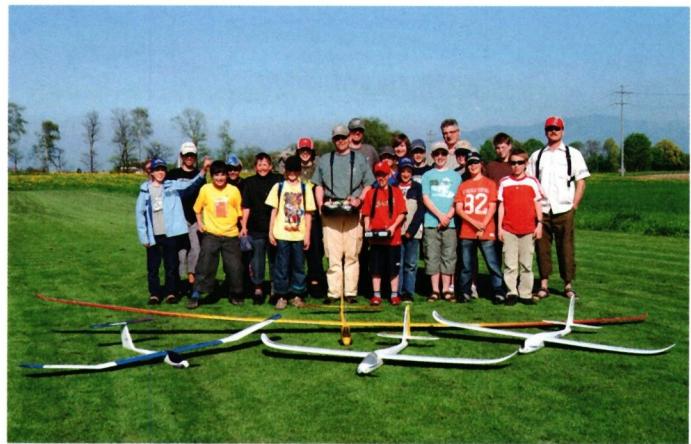
is suitable. The gliders used (e.g., Easyglider) can be flown slowly and may occasionally make the occasional steering error. After the instructor—who retains full control of the model—launched it from hand and brought it to a sufficient altitude using the electric motor, he was able to flip a switch on his transmitter, and from that point on, all control functions were handed over to the student. While some students struggled with movements of the control stick that were far too large and, above all, too fast, for others the challenge was over by the time the model had to be turned in mid-air. This is because when the model is flying toward you, flying to the right means steering to the left. These are the moments when the instructor is put to the test, as he must always be able to steer the model back to a safe, normal flight attitude, no matter how precarious the situation.
The kids had the opportunity to take turns flying on the simulator and with the real models for just under three hours. Some progress became apparent quite quickly. There were even flights during which the instructor didn’t have to intervene all that often. Eight-year-old Andrina Benz also proved her talent and, above all, really showed the boys how it’s done...
At 3:30 p.m., it was time for a breather, and Mirco switched from the simulator
remote control for barbecue tongs and sizzled up some “Zack-Zack” schnitzel for the whole team. Model flying must really work up an appetite. Because the schnitzel sandwiches literally flew off the table. And they must have been really good, too, because the last five schnitzel sandwiches had to be cut into quarters so everyone could get another little piece. After this snack break, the boys were re-energized enough to spontaneously start a water fight, and the grass around our airfield no longer suffered from any acute water shortage...
With their batteries fully recharged, they continued flying until 5:00 p.m., and so the afternoon of flying came to a successful close.
Judging by the enthusiasm of all participants, it’s safe to say that the Marbach Model Flying Club once again made the right choice with this Pro-Juventute student program, and we will continue to support the Oberrheintal Vacation Pass in a similar manner in the future.
In closing, we would like to thank all participants: the students, who turned out in such large numbers and surely had a lot of fun; the teacher-pilots at the controls and on the computers for their great dedication during their free time; and especially Patrick Huggenberger and Peter Schefer, who provided us with their equipment.
For more information, including photos of the airfield, visit:
<http://www.mfv-marbach.ch>, Mirco
Pizzeghello


News from HEBU

F3A EUROPEAN CHAMPIONSHIPS IN ST-MACAIRE, FRANCE
 Matthias Bosshard

What's New at Leomotion.com

YOU KNOW WHAT I MEAN? 125 YEARS OF THE SWISS AERO CLUB
 Emil Giezendanner

52. 2026 ALPS CUP
Emil Giezendanner
PRIDE AND GOOD IDEAS
 Markus Nussbaumer

HORIZON HOBBY/LEMACO NEWS: MICRO OV-10 BRONCO 645 MM BY E-FLITE

EURO CONTEST GLIDER ACRO TOUR AUSTRIA 2026

BY YOUTH, FOR YOUTH
 Lorena Betschen

TEAM MANAGER "THIS" BOSSHARD
Rodito Nussbaumer
SMALL, MODEL-LIKE SAILBOATS
Res Dauwalder
TRY-OUT DAY AT MFV WETTINGEN
Urs Keller
34th HAHNENMOOS ALPINE MODEL AIRPLANE CAMP
Res Dauwalder
CORSAIR F4U – A WARBIRD WITH A MEMORABLE LOOK
Jürgen Rosenberger, Jürgen Prinz
SUMMER FUN 2026 AT MG USTER
Martin Wunderli
WELCOME, NEW MEMBER!
Andrea Bolliger
FREE FLIGHT IN THE MIDDLE OF SUMMER
Urs Muntwyler
THE PC-21 STORY
Emil Giezendanner
TWIN TOWN PARTNERSHIP
Wolfgang Voeller
ATOM, THE NEW DOUBLE-DECKER FROM CPLR
Matthias Bosshard
COUPE DES ALPES – OBSERVE AND LEARN
Rodito Nussbaumer
INSIGHTS INTO THE HISTORY OF SEAPLANES

NEWS FROM HEBU
 Julia Bucher

FROM 0 TO 100
Markus Nussbaumer
MEMORIES
Wolfgang Völler
NOS REGION – A HUB FOR ELECTRIC AVIATION
Emil Giezendanner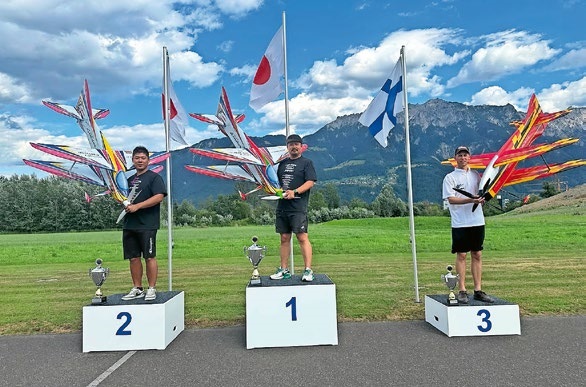
A SPECTACULAR F3A WORLD CUP IN THE PRINCIPALITY OF LIECHTENSTEIN
Emil Giezendanner
DO YOU KNOW WHAT I MEAN IN THE LAND OF SMILES?
Emil Giezendanner