
The Development of the Plastic Glider
Anyone interested in RC gliding beyond the kits available in stores and who wants to learn more about the “full-size prototypes” simply can’t do without this book. It could be described as the definitive guide for “enthusiasts” of beautiful, scale-accurate plastic RC glider models.
This is not just a catalog of aircraft models. The planes were built by people and are flown by people. Personal stories are woven into their history. Everything is interconnected here. –
The new era of gliding—the age of plastic—began about 20 years ago. With new designs constantly emerging, there is no end in sight to this development. Today, gliding fields around the world are home to plastic gliders of all kinds. With their elegant shapes and exceptional surface finish, they stand out clearly from conventional models. Even at smaller competitions, the scene is dominated by these gleaming white plastic “birds.” At the last two World Championships, nearly all gliders were made of plastic, and the majority were German designs. Top performances across all continents, with fantastic record-breaking feats, are being achieved in plastic gliders. Without a doubt, the development of plastic gliders has ushered in a new era in the history of gliding.
But in addition to high-performance gliders, training gliders and two-seaters are also increasingly being manufactured from this new material. Performance flying is experiencing a remarkable improvement not only at the top level but also in the nearly daily cross-country flights organized by clubs.
The plastic construction, with its excellent surface finish, resulted in a significant increase in flight performance (by about 30 percent); in fact, it was this surface finish that made the use of laminar profiles possible in the first place. Another major advantage of plastic gliders is their greater resilience during flight and easier maintenance.
Although only a short time has passed since the maiden flight of the first plastic glider in 1957, the early days of this development have almost been forgotten. Well-known names from that era, such as Phoenix, BS-1, SB-7, and D-36, are hardly known anymore. The cornerstones of this development—which took place predominantly in Germany—are the efforts of the academic flying clubs in collaboration with scientific institutes, research centers, and, not least, industrial manufacturers. In Germany alone, more than 50 different models were built, totaling over 3,000 units.
This book provides an overview of this development. The individual aircraft types are presented with a data sheet, drawings, and photos. A table containing chronological records and a comparison of similar aircraft models is included. Following some basic explanations, the most important structural features and design parameters are described. The plastic construction method and its materials are presented, and the individual stages of industrial production for a plastic glider are described. The appendix lists the addresses of manufacturers and the most important flying clubs and institutions. Detailed bibliographic references follow.
Available at bookstores or from the publisher Modell-Flugsport.


News from HEBU

TEAM MANAGER "THIS" BOSSHARD
 Rodito Nussbaumer

YOU KNOW WHAT I MEAN? 125 YEARS OF THE SWISS AERO CLUB
 Emil Giezendanner

HORIZON HOBBY/LEMACO NEWS: MICRO OV-10 BRONCO 645 MM BY E-FLITE

PRIDE AND GOOD IDEAS
 Markus Nussbaumer

TRY-OUT DAY AT MFV WETTINGEN
Urs Keller
F3A EUROPEAN CHAMPIONSHIPS IN ST-MACAIRE, FRANCE
 Matthias Bosshard

52. 2026 ALPS CUP
Emil Giezendanner
ATOM, THE NEW DOUBLE-DECKER FROM CPLR
Matthias Bosshard
SUMMER FUN 2026 AT MG USTER
Martin Wunderli
What's New at Leomotion.com

COUPE DES ALPES – OBSERVE AND LEARN
Rodito Nussbaumer
TWIN TOWN PARTNERSHIP
Wolfgang Voeller
BY YOUTH, FOR YOUTH
Lorena Betschen
34th HAHNENMOOS ALPINE MODEL AIRPLANE CAMP
Res Dauwalder
CORSAIR F4U – A WARBIRD WITH A MEMORABLE LOOK
Jürgen Rosenberger, Jürgen Prinz
SMALL, MODEL-LIKE SAILBOATS
Res Dauwalder
WELCOME, NEW MEMBER!
Andrea Bolliger
FREE FLIGHT IN THE MIDDLE OF SUMMER
Urs Muntwyler
EURO CONTEST GLIDER ACRO TOUR AUSTRIA 2026

INSIGHTS INTO THE HISTORY OF SEAPLANES

THE PC-21 STORY
Emil Giezendanner
NEWS FROM HEBU
 Julia Bucher

FROM 0 TO 100
Markus Nussbaumer
MEMORIES
Wolfgang Völler
NOS REGION – A HUB FOR ELECTRIC AVIATION
Emil Giezendanner
DO YOU KNOW WHAT I MEAN IN THE LAND OF SMILES?
Emil Giezendanner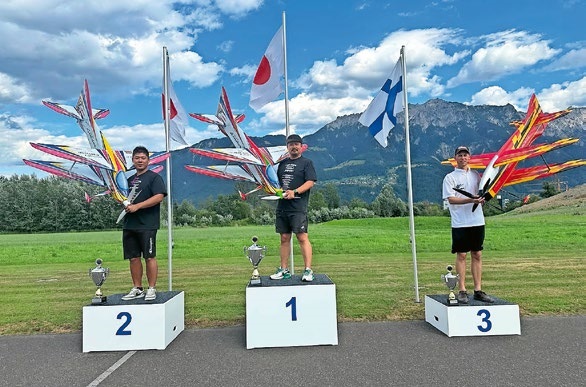
A SPECTACULAR F3A WORLD CUP IN THE PRINCIPALITY OF LIECHTENSTEIN
Emil Giezendanner