
Large Sailboats: Yesterday, Today, and Tomorrow
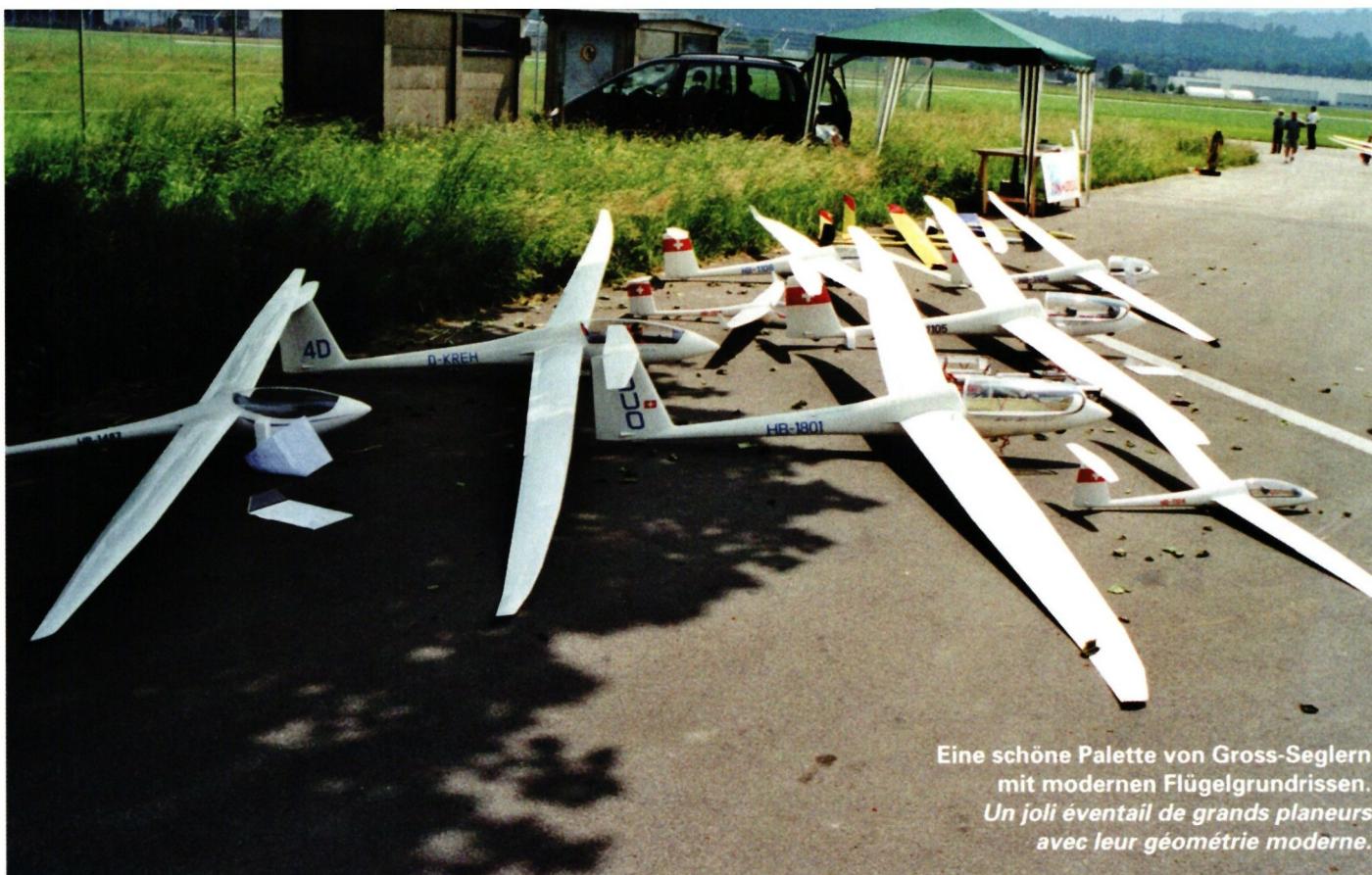
The following report is an expanded version of a presentation the author delivered on December 9, 2000, as part of the International Large-Scale Sailplane Symposium in Winterthur. It serves as a retrospective, an assessment of the current state of affairs, and a look into the future of the recreational discipline of model aviation.
What exactly is a large glider? The regulations of the Swiss model aviation umbrella organization do not include a definition of these aircraft. Since this model category does not “officially” exist at all, we rely on the bylaws of the Large Glider Interest Group (IGG). Twenty years ago, the IGG defined a large glider as a model glider built on a 1:4 scale or with a wingspan of at least 350 cm. Anyone who shows up at a large glider gathering today with a model that meets these minimum dimensions will be met with a somewhat pitying smile, especially in Germany, where a veritable craze for gigantic models has taken hold. However, the IGG’s definition remains valid. It is undisputed that wingspan alone is not the only criterion for classifying a model as a large glider.
We quickly get to the heart of the matter when we use the objectives pursued—or not pursued—as criteria rather than the minimum wingspan.
The most important criteria are as follows:
- It is a replica of a manned prototype
- The replica is as true to scale as possible
- The flight behavior and flight characteristics are as similar as possible to those of the “large” models
- In designing the model, there are no “guidelines”—that is, no restrictions imposed by regulations—to be observed, and there are no constraints dictated by trends in a specific competition category. The only constraint is the resemblance to the original
- Flying enjoyment and visual appeal are the primary focus. These aspects are generally given priority over pure performance
If one attempts to condense these criteria into a brief summary, the following definition stands out—one that I still find most appealing today: Large gliders are not enlarged models, but rather scaled-down full-size aircraft!
But before we spend too much time wrestling with ultimately fruitless questions of definition, let’s take a look back. How have large gliders evolved from their beginnings to the present day? It’s clear that a complete history of the development of large gliders would go beyond the scope of an article like this. Therefore, I’ll limit myself to highlighting a few key milestones in their development, which are strongly influenced by my personal experiences.
When I was a boy, model gliders featured thin, square-shaped, utilitarian fuselages made of balsa wood. The wings, constructed using a ribbed framework, were covered with paper, silk, and later with plastic film. Wingspans reached a maximum of 3 m, and the strongly curved profile remained deep all the way to the wing tip. The V-shape was pronounced so that the model—usually without ailerons—could be steered into a turning flight using only the rudder. These were aircraft that had a truly “model-like” appearance and flight behavior, as had been familiar for decades prior.
But then a gradual shift began—a move away from that model-like appearance. Occasionally, model kits or plans for gliders appeared that stood out for their astonishing resemblance to manned prototypes. One of these models was the Cirrus by Graupner, which arrived in model shops as a kit an estimated 30 years ago. Its plastic fuselage had a shape similar to the real aircraft; the slender ribbed wings had significantly less chord depth, and the aspect ratio of approximately 1:16 was sensationally high for that time. Many older model aviators surely still remember this model. At the very least, they probably recall what happened during less-than-perfect landings in cold weather: the ABS fuselage would shatter like glass. Despite this weakness, the Graupner Cirrus was nonetheless a very remarkable model that surprised even experts. When this model had just come onto the market, I, as a teenager, took part in the model-building course at the Hahnenmoos Pass. There, the late Arnold Degen—the widely respected instructor who held the title of “AeCS Model Aircraft Expert”—taught the morning theory sessions. Among other things, he explained that model gliders with an aspect ratio of more than 1:10 were no good. In the afternoon, it was time for practical flying. The highest-flying model was consistently a Cirrus with Styrofoam wings—a replica of the Graupner Cirrus that a model aviator had built.
Some other notable milestones in the development of large gliders were certainly the following:
In the 1970s, the Teck—the famous flying hill near Stuttgart—became one of the first centers for large gliders, no doubt not least because the construction of man-carrying gliders (Schleicher, Glasflügel) was based there. My first trip to the Teck was an unforgettable experience. For the first time, I saw “real” large gliders in flight. I watched spellbound as an elegant Kestrel, a fast BS 1, and a majestic ASW 12—all gliders with wingspans around 450 cm—soared upward in the thermals. These models featured voluminous, nearly scale-accurate fuselages. The wings, made of balsa-planked Styrofoam cores, were spray-painted white. These beauties were piloted by what were already considered “more mature guys” back then—names like Tscheulin, Schaufler, Gewalt, or Stuck from Alsace, to name just a few. There was fierce competition among them. Each of these luminaries gathered a following around him. They watched with suspicion as the competition unveiled its latest model. These models were predominantly equipped with NACA 2412 or 2415 wings and were built as lightly as possible. Deeply impressed, I immediately decided to buy a fuselage for a 1:4-scale Glasflügel Jumbo. Once I got home, I was shocked to discover that the wings I was to build had a wingspan of 450 cm and would barely fit in my hobby room at the time. These German designs could be admired time and again at the annual large-glider gatherings held at Hahnenmoos. Competition was fierce, and flying was done come what may. At one of these gatherings, Uwe Gewalt even flew a model whose wooden wing skin hadn’t been finished yet. Because his model had crashed, he had to resort to using the replacement model, which wasn’t even finished yet! Just a few years later, a new era began when the first large gliders built entirely using fiberglass-reinforced plastic (FRP) technology appeared. At this point, it’s essential to mention the name Christian Ruch. He carried out a project that was spectacular for its time: a scale-accurate 1:3 LS 1f, which he mass-produced using plastic molds. The monocoque wings featured plastic or aluminum honeycomb as a reinforcing material, and the shells were bonded using vacuum technology. The 19% (!) thick Wortmann profile of the original served as the root profile. Even though this model had some flaws in its finish by today’s standards, its performance and flight characteristics were unparalleled for its time, especially when it was spectacularly demonstrated by the fearless Christian Ruch at Hahnenmoos.
Some time later, another highlight of the “all-fiberglass league” appeared on the market: the LS 3 from Sommer in Germany. This aircraft, too, was equipped with a profile from large-scale aviation—specifically, a Wortmann FX 62-K-131 with flaps. A treat from a plastics engineering perspective, it was rather challenging to fly.
These models inspired Paul Pfenninger and me to undertake our own project. It was a 1:4-scale Moskito from Glasflügel, made entirely of fiberglass, which required the production of over 25 molds and jigs. The wings, constructed using a shell technique with balsa core, featured the Wortmann FX 60-163, 60-140, and 60-126 airfoil set—a profile from full-scale aviation that was frequently used in model flying at the time. The build dragged on (including nights!) for an entire winter. But then the model flew—and did so impressively.
This illustrates the stages of development through a few specific examples. Looking back, it is clear that further development proceeded steadily but in small steps. Revolutionary, sudden leaps in performance, construction, and quality of the models—such as those seen in the F3B class or in electric flight—were not observed. One of the reasons for this was likely that there were no championships for large gliders that would have allowed for a direct comparison of performance and facilitated the exchange of technology across cantonal and national borders.
Over the course of these many years, virtually all manned prototypes have been replicated as large gliders. Often, the models took to the skies before the originals did. As the real-life aircraft became increasingly similar in appearance, the models also exhibited a growing uniformity. However, this uniformity has been broken up in recent years by new wing geometries featuring multiple trapezoids, winglets, and ears.
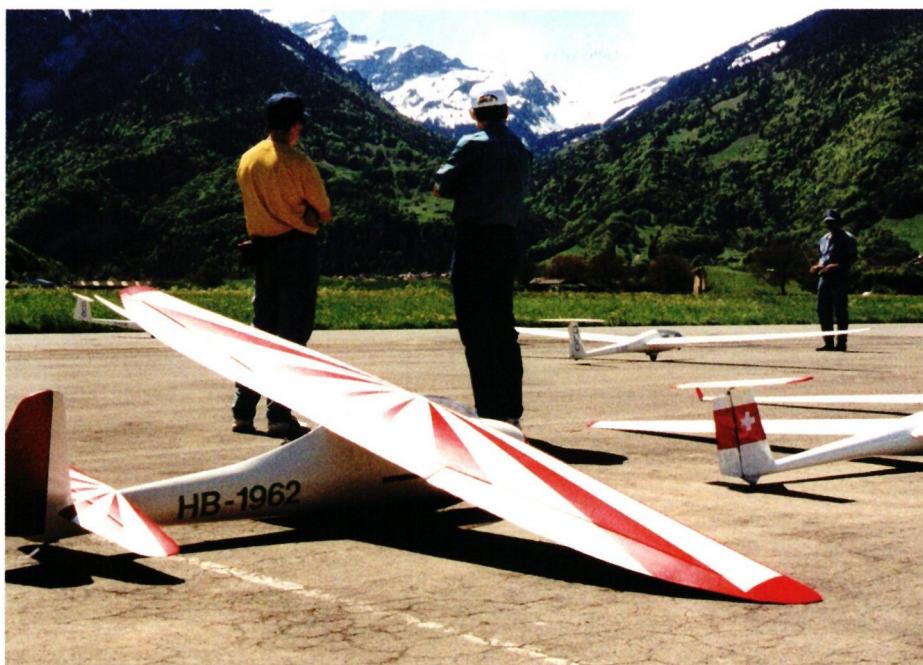
This uniformity was likely one reason why more vintage gliders have been built on the Groß-Segler scale. These leisurely gliding vintage gliders also provide a beautiful contrast in flight to the elegant “super orchids.” Unfortunately, flying wings built to the large-glider scale have remained a rarity. Yet every now and then, someone has taken on the design challenge. PSS models on a large glider scale are practically nonexistent on the continent. In England, large and very large powerscale soaring models have been among the highlights in the sky for years. The reason this category hasn’t made the leap to the continent is likely that the required flying sites and conditions—namely, grassy hills and steady, dynamic slope lift—are found primarily in England. Another category, however, has gained many followers in recent years: large aerobatic gliders. These are replicas of famous models specifically designed for aerobatics, such as the Fox, Swift, Mü 28, and others.
To be continued

EURO CONTEST GLIDER ACRO TOUR AUSTRIA 2026

THE PC-21 STORY
 Emil Giezendanner

TWIN TOWN PARTNERSHIP
 Wolfgang Voeller

SUMMER FUN 2026 AT MG USTER
Martin Wunderli
CORSAIR F4U – A WARBIRD WITH A MEMORABLE LOOK
Jürgen Rosenberger, Jürgen Prinz
52. 2026 ALPS CUP
Emil Giezendanner
YOU KNOW WHAT I MEAN? 125 YEARS OF THE SWISS AERO CLUB
Emil Giezendanner
News from HEBU

TEAM MANAGER "THIS" BOSSHARD
Rodito Nussbaumer
ATOM, THE NEW DOUBLE-DECKER FROM CPLR
 Matthias Bosshard

F3A EUROPEAN CHAMPIONSHIPS IN ST-MACAIRE, FRANCE
Matthias Bosshard
INSIGHTS INTO THE HISTORY OF SEAPLANES

WELCOME, NEW MEMBER!
Andrea Bolliger
What's New at Leomotion.com

PRIDE AND GOOD IDEAS
 Markus Nussbaumer

SMALL, MODEL-LIKE SAILBOATS
Res Dauwalder
FREE FLIGHT IN THE MIDDLE OF SUMMER
Urs Muntwyler
BY YOUTH, FOR YOUTH
Lorena Betschen
HORIZON HOBBY/LEMACO NEWS: MICRO OV-10 BRONCO 645 MM BY E-FLITE

COUPE DES ALPES – OBSERVE AND LEARN
Rodito Nussbaumer
34th HAHNENMOOS ALPINE MODEL AIRPLANE CAMP
Res Dauwalder
TRY-OUT DAY AT MFV WETTINGEN
 Urs Keller

NEWS FROM HEBU
 Julia Bucher

NOS REGION – A HUB FOR ELECTRIC AVIATION
Emil Giezendanner
MEMORIES
 Wolfgang Völler

70 YEARS OF THE NIDWALDEN MODEL AIRPLANE CLUB
Martin Barmettler
A SPECTACULAR F3A WORLD CUP IN THE PRINCIPALITY OF LIECHTENSTEIN
Emil Giezendanner
FROM 0 TO 100
Markus Nussbaumer