
Large Sailboats: Yesterday, Today, and Tomorrow
If we compare the current state of large-scale model sailing with what it was 20 years ago, we can observe the following:
- The models have gotten larger. The scales of 1:4 or 1:3.5, which were originally the most common, have been replaced by scales ranging from 1:3 and 1:2.5 down to 1:2.
- The models have become heavier. This has been made possible by the development of specialized towing machines with powerful motors.
- Wing loading has increased significantly.
- The models have become faster.
- As for airfoil profiles, Wortmann, NACA, and Eppler have taken a back seat. Profiles developed specifically for large gliders—particularly HQ, MH, etc.—are now predominantly used, as well as profiles from the F3B sector, particularly RG.
- The models have clearly become stronger. At the first IGG meetings, it was not uncommon for one or two models to break apart in midair—such as a wing splitting in two during towing or the spar bridge breaking during a normal loop. Today, this is a thing of the past. It is now a given that a large glider can complete a high-speed flight even in gusty conditions without any aileron flutter. In this area, too, the field has benefited from the cutting-edge technology developed in the F3B sector.
- The designs have generally become better and sturdier, but also more complex. Flat steel has disappeared; round steel and, increasingly, carbon fiber spar bridges are now standard.
- The selection of plastic fuselages and ready-to-fly models has grown significantly. Manufactured in low-wage countries, they are primarily distributed through Germany. This country has been a leader in the development and manufacture of man-carrying gliders for decades. It is therefore probably no coincidence that a comparable industry has also developed in the same country in the large glider sector. Aerodynamically sophisticated, perfectly constructed all-fiberglass, and practically ready-to-fly “super gliders” are available. The costs of development, mold making, and production are high, which is reflected in the retail prices. However, these prices do not seem to deter buyers; on the contrary, there are reportedly waiting lists.
- Today’s large gliders feature all the functions of their real-world counterparts. Retractable landing gear is standard, and flaps are gaining popularity.
- Another important observation is that pilots have improved. Fortunately, the days when people would discreetly take cover when certain pilots began their approach are over.
Summarizing the current state of the art, one comes to the conclusion that nothing is impossible anymore:
- Wingspans of up to 10 meters and more, and takeoff weights of around 30 kg, are no longer unusual.
- A dozen servos distributed throughout all-FRP wings, tail surfaces, and fuselage, along with polystyrene/abachi wings with FRP skins perfectly finished with two-component paints, no longer attract much attention.
- The interior design of the cockpit is becoming increasingly perfect—a clear trend of recent years, though not one that has emerged exclusively in the very recent past. An example of a perfect cockpit is that of Jürg Pfändler’s Twin Astir. He, who sadly passed away far too soon, recreated himself as a model pilot and thus lived on, at least in this way. His fly-bys are unforgettable—during which the model pilot, controlled remotely, would turn his head toward the spectators and wave to them warmly with one hand.
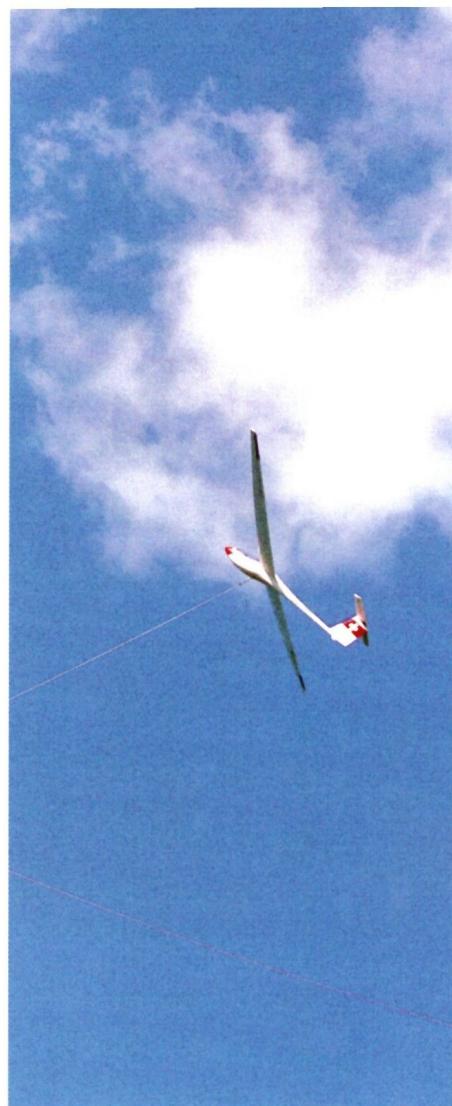
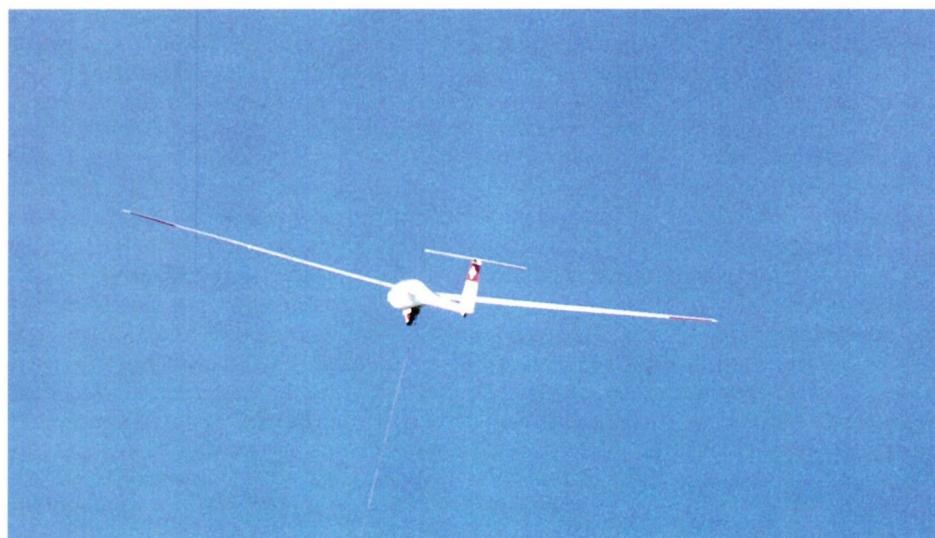
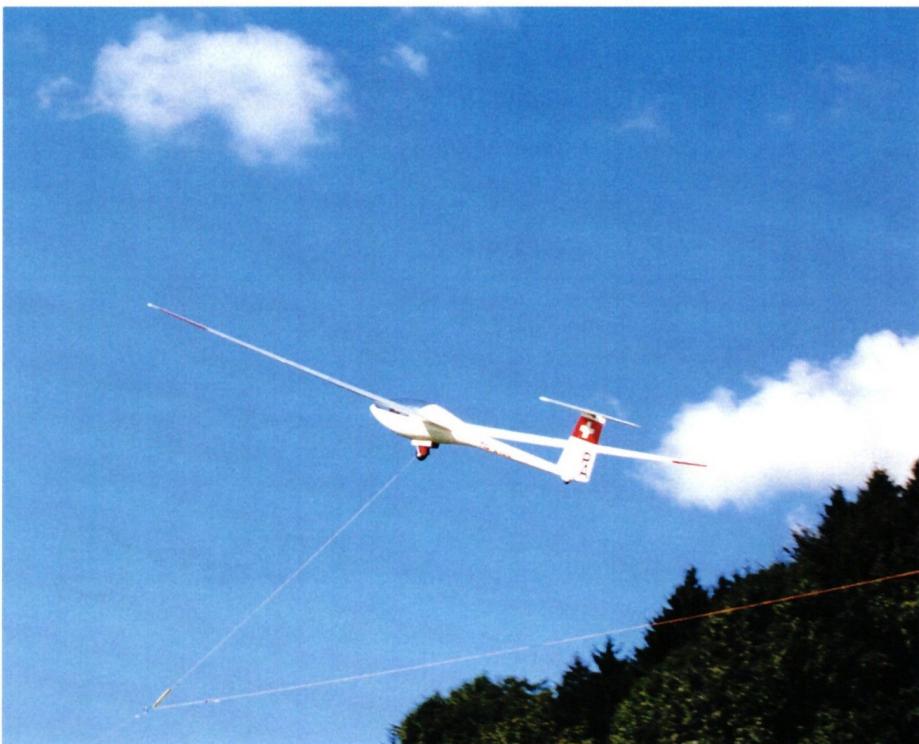
However, a discussion of large gliders would be incomplete without also including some thoughts on the various launch methods. Today, aircraft towing is clearly the primary method. The development of high-performance tow planes was certainly a key factor in the widespread popularity of large gliders today. A tow launch has now become a standard and safe method of launch.
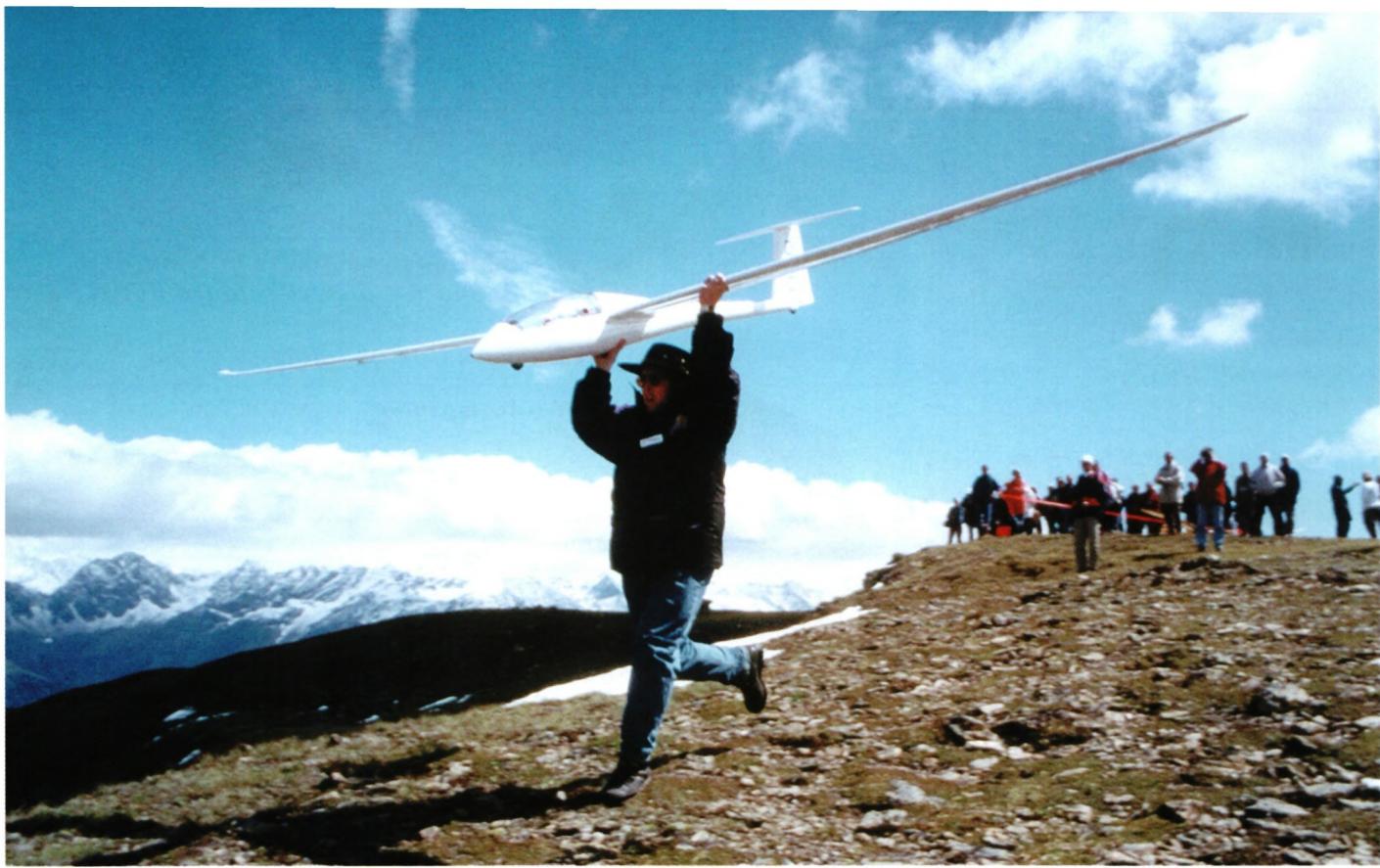
When flying on a slope, the models are launched by hand, which, however, requires some strength and experience—or a sufficient headwind. Otherwise, a catapult is recommended. In my opinion, this tool is used far too rarely, because a catapult could prevent many “wobbly” launches and launch crashes.
Launching large gliders with a winch is surprisingly rare. In many places, there’s a persistent misconception that this method is too risky. The Erlenbach Model Club, of which I am a member, has been using winch launches almost exclusively for years, with the large gliders being launched from the ground. This works without any problems, especially when using a V-cable and double hooks.
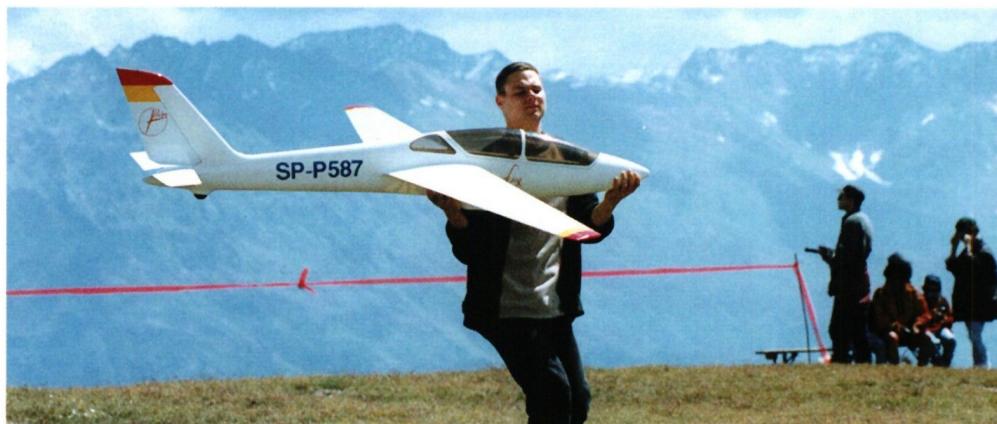
Occasionally, self-launching large gliders also appear, which are capable of taking off from the runway without outside assistance. There are some excellent designs with electric propulsion and a retractable engine that extends and retracts from the top of the fuselage, which demonstrate astonishing climb performance. Electric propulsion systems with a conventional propeller arrangement at the tip of the fuselage are rarely found. The lack of historical accuracy limits this propulsion configuration to utility models.
But what does the future hold? Since I am not a professional futurist, my ideas about the future development of large-scale gliding should be viewed more as visions. Here are a few of them:
Telemetry will be used more and more—not only in large-scale model aircraft, but especially in this branch of model aviation. In the near future, on-board measurement of key flight parameters such as speed, climb/sink rate, and altitude will be standard. This information will be transmitted to the pilot. There are already variometers on the market that reliably perform these tasks. However, it would be desirable for an onboard computer or a ground-based computer to continuously analyze this measured data. On the one hand, this would be an ideal aid for properly flying in a large glider. In this area, there is still much room for improvement today. As is well known, the flight-in procedure is a labor of patience and is often “replaced” by adjusting the manual trim and the electronic subtrim. Even if one puts a great deal of effort into the flight-in, one ultimately never knows for sure whether one has come close to the optimum. A smart computer program could use the data measured during flight to make suggestions for optimization—for example, regarding EWD, center of gravity, rudder deflections, and rudder differentiation. On the other hand, such a computer could also provide tactical decision-making aids, such as indicating the speed for best glide. If we look to the “big players,” we see that flight computers are now standard equipment in every modern glider.
If we follow the example of man-carrying gliders in other respects, we are likely to see more self-launching large gliders at airfields in the future. Among large gliders, more than 50% of new sales have been self-launching gliders for several years now. The main reasons for this are independence from tow planes, the ability to take off before environmentally mandated restrictions take effect, the ability to take off before thermals set in, as well as autonomous and quiet climb to more distant thermal areas, and greater safety during cross-country flying. Some of these arguments are also relevant in model aviation. However, this requires that the self-propulsion of a large glider be significantly quieter than the engines of even the quietest tow planes available today. This will allow flying outside of powered flight hours, and takeoffs will also be possible at airfields that are currently reserved for gliding only due to noise restrictions. New generations of batteries or other energy storage media will one day make many things possible that are still considered fantastical today. Here, too, let’s take a look at a promising project in the field of manned gliding. The Antares, a self-launching, single-seat glider with an electric propulsion system, is already flying as a test aircraft. Equipped with NiMH batteries in the wings, an outrunner electric motor, and a folding propeller, the aircraft climbs at 4.4 m/s after takeoff, then continues at an average rate of 2.9 m/s, reaching an altitude of 1,900 m above ground level. These are fantastic achievements, some of which will certainly be incorporated into the development of self-launching large gliders. However, a prerequisite for the widespread adoption of this launch method is certainly that mature retractable engine systems—which can be installed without great effort—come onto the market and that their acquisition costs decrease.
Large-scale gliding is one of the most fascinating branches of model aviation. After more than thirty years of development, the field has reached a high level of technical sophistication. The future has begun!
Georg Staub
All photos: Jack Kägi

EURO CONTEST GLIDER ACRO TOUR AUSTRIA 2026

THE PC-21 STORY
 Emil Giezendanner

TWIN TOWN PARTNERSHIP
 Wolfgang Voeller

SUMMER FUN 2026 AT MG USTER
Martin Wunderli
CORSAIR F4U – A WARBIRD WITH A MEMORABLE LOOK
Jürgen Rosenberger, Jürgen Prinz
52. 2026 ALPS CUP
Emil Giezendanner
YOU KNOW WHAT I MEAN? 125 YEARS OF THE SWISS AERO CLUB
Emil Giezendanner
News from HEBU

TEAM MANAGER "THIS" BOSSHARD
Rodito Nussbaumer
ATOM, THE NEW DOUBLE-DECKER FROM CPLR
 Matthias Bosshard

F3A EUROPEAN CHAMPIONSHIPS IN ST-MACAIRE, FRANCE
Matthias Bosshard
INSIGHTS INTO THE HISTORY OF SEAPLANES

WELCOME, NEW MEMBER!
Andrea Bolliger
What's New at Leomotion.com

PRIDE AND GOOD IDEAS
 Markus Nussbaumer

SMALL, MODEL-LIKE SAILBOATS
Res Dauwalder
FREE FLIGHT IN THE MIDDLE OF SUMMER
Urs Muntwyler
BY YOUTH, FOR YOUTH
Lorena Betschen
HORIZON HOBBY/LEMACO NEWS: MICRO OV-10 BRONCO 645 MM BY E-FLITE

COUPE DES ALPES – OBSERVE AND LEARN
Rodito Nussbaumer
34th HAHNENMOOS ALPINE MODEL AIRPLANE CAMP
Res Dauwalder
TRY-OUT DAY AT MFV WETTINGEN
 Urs Keller

NEWS FROM HEBU
 Julia Bucher

NOS REGION – A HUB FOR ELECTRIC AVIATION
Emil Giezendanner
MEMORIES
 Wolfgang Völler

70 YEARS OF THE NIDWALDEN MODEL AIRPLANE CLUB
Martin Barmettler
A SPECTACULAR F3A WORLD CUP IN THE PRINCIPALITY OF LIECHTENSTEIN
Emil Giezendanner
FROM 0 TO 100
Markus Nussbaumer