
Better to use wood than resin and fabric
This large-scale model of the Hütter 28 II has been on display several times at air shows and in magazines. The glider immediately catches the eye with its compact shape and very short fuselage. Markus Frey built it on a 1:2 scale. This report describes how he came to build it and what challenges he had to overcome.
In the summer of 2002, Markus Frey traveled to Hahnenmoos, unaware of what was to come, to attend the IGG gathering. While flying his F3J glider in the updraft off the Schalmygrat, he noticed two yellow vintage gliders among the many others in the air. He recognized one of them immediately as a Moswey III. He really liked the other, more stocky-looking model, but couldn’t identify it.
A year later, a report appeared in the magazine AUFWIND about the Hütter 28 II, built by Richard Oberholzer on a 1:3 scale. There it was again—that model—and now it had a name. The launch photo in that report stayed with Markus Frey. He soon decided to build a 1:2 scale replica of this vintage aircraft.
While searching for blueprints, Markus Frey came across the IG Albatros, from whose archives he was able to obtain several plans. There he was referred to Lilly Grundbacher, the owner of the only original still in existence in Europe. Her Hütter 28 II had once belonged to Eugen Aeberli, a Swiss gliding pioneer. In late 2003, Markus Frey was allowed to photograph this original aircraft, which was airworthy but in need of restoration. The current owner provided him with additional documents, including the missing 1:2-scale detailed plans. With that, the documentation was complete. During his research, Markus Frey learned that the Austrian designers Wolfgang and Ulrich Hütter had set out to build a glider that was as small and light as possible. In 1936, they essentially designed the glider around themselves. There was no room for the elbows in the cramped cockpit; they protrude into the wing roots through openings cut into the structure. With an empty weight of just 100 kg, the maximum takeoff weight was only 180 kg. The hoped-for glide ratio of 28—which gave the glider part of its name—was not quite achieved.

Markus Frey then set to work with great enthusiasm. After having the original plans scaled to the correct size at the copy center, he began by working on the tail surfaces. For the ribs, he used 5-mm-thick balsa wood, and for the spars, pine strips. He wrapped the 0.4 mm thick plywood skin around the leading edge of the airfoil and made the trailing edge from poplar plywood. Within three weeks, the tail surfaces were already finished. Markus Frey had once again lived up to his reputation as a fast builder. Now it was time for the fuselage. Here, Markus Frey had to slow down his construction pace out of consideration for his girlfriend, who had “suffered” somewhat from his previous project, a large SG 38. So he had his colleague Rolf Fritschi in Dintikon mill the fuselage frames. Rolf scanned the 19 frame drawings, after which the milling machine spent a total of 50 hours cutting through the poplar plywood. The frames are 6 mm thick up to the main spar; beyond that, they are 4 mm thick for weight reasons. Two feet were left on each frame, allowing the frames to be mounted neatly and aligned on the workboard. After the pine stringers (6×6 and 5×5 mm, respectively) were quickly installed using white glue and cyanoacrylate adhesive, key components were mounted, namely the servos for the ailerons and elevator, as well as for the tow hitch. At this stage, the elevator linkage—consisting of a carbon tube and supported at two points—was already installed. The fittings for the main spar and the elevator mounting—which Rolf Fritschi had milled from 3-mm aluminum—were also securely screwed to the fuselage frames. Now it was time for the skinning. Markus Frey “soaked” the 0.6-mm birch plywood in water, applied Ponal Express to the frames and stringers, and pressed the wet skin panels onto them with a hot iron. There was a hissing sound and a foul odor in his workshop, but he made such rapid progress that it was as if he were working with superglue. For the skid suspension, Markus Frey used four squash balls, similar to the original, where five tennis balls absorb the heaviest landing impacts. The construction, which had been moving along quickly up to that point, came to a standstill when he had to fit the many small and narrow planking pieces at the fuselage-wing junction. Markus Frey hit his first rough patch and couldn’t see an end in sight. Once this work was finally completed, he had to take a three-week break.
| Original | 1:2 scale model | |
| Wingspan | 12 m | 6 m |
| Length | 4.75 m | 2.37 m |
| Flight weight | max. 180 kg | 19.5 kg |
| Wing area | 7.6 square meters | 2.8 square meters |
| Wing loading | max. 23 kg/sq m | 70 g/cubic decimeter |
| Profile | Gö 535 | Gö 535 |

- Servos:
Ailerons: Hitec DS5745
; Elevator: Hitec 705
; Rudder: Hitec 705
; Towing hook: Hitec HS 645
; Air brakes: Hitec HS 225MG - Receiver:
Graupner/JR DS24 - Power supply:
2×5-cell NiCd 3000
mAh, Solid battery switch

Now it was the wings’ turn. They were given the original airfoil—a Gö 535 from the root to the bend—which was then tapered to a semi-symmetric airfoil at the wingtip. This airfoil configuration contributes to the lively aileron response. Rolf Fritschl milled the ribs from 4-mm-thick poplar plywood with numerous cutouts and added small supports to them, which will be removed after construction. Each wing features 20 continuous ribs and an additional 20 half-ribs in front of the spar. The spar was glued together from pine strips and measures 15×15 mm at the root and 5×3 mm at the wingtip. Due to space constraints and to make handling easier, Markus Frey assembled the inner and outer wing sections separately, with the undersides facing up, thereby also saving himself the trouble of building a slipway. After planking with aircraft plywood—0.6 mm on the inside 0.4 mm on the outside—which, as with the fuselage, was ironed on and pulled around the nose reinforced with a pine strip—the inner and outer wing sections could be glued together at a right angle using a milled aluminum part, giving the wing its characteristic bend. Like the original, the brakes feature two flaps per wing half. The spar fittings at the root were screwed to the spar stringers using M3 screws. The spar fittings on the wings are connected to the spar bridge mounted on the fuselage using four M10 screws.
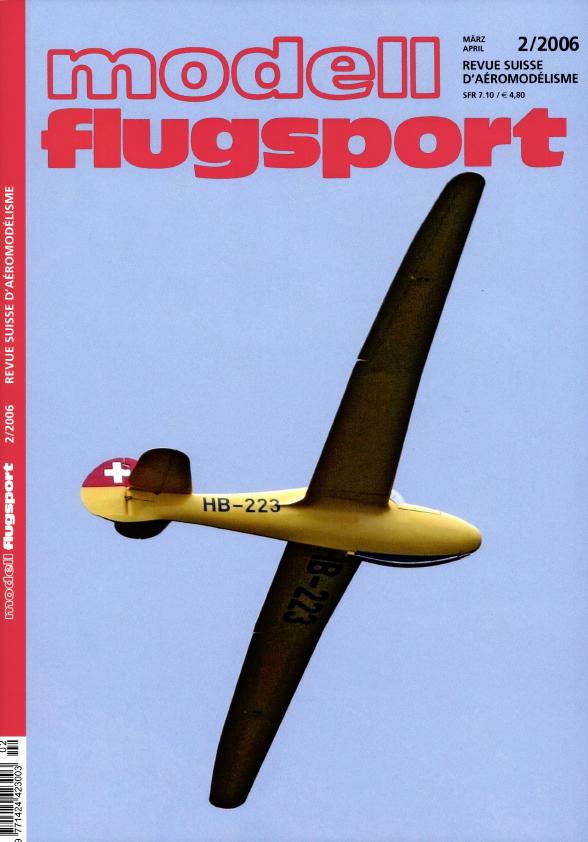
This completed the airframe assembly, and the finishing work followed—a process whose effort is all too often underestimated. After Markus Frey had covered the fuselage with thin fiberglass cloth, the entire airframe was weighed for the first time and found to be surprisingly light at 12.7 kg. After the wings and tail surfaces had been covered with yellow Solartex fabric, Markus Frey transported the Hütter 28 II to the Hallauer auto paint shop in Tägerig. Once all the covered parts had been primed with spray filler there, Markus Frey sanded until the pads of his fingers were raw, until the entire aircraft could be sprayed with two coats of light yellow two-component automotive paint. The highly experienced painter succeeded in applying a thin yet fully opaque paint film weighing just 370 g. Bruno Thali provided the masking films, which Markus Frey used to spray-paint the registration number HB-223 and the Swiss cross. After crafting a canopy mold from Styrodur and a total of 15 layers of fiberglass cloth and smoothing its surface with polyester putty and filler, it was Bruno Greuter’s turn to deep-draw a beautiful canopy from PET.
All that remained was to install the radio control system. A week before the planned maiden flight, this nearly resulted in a major disaster. After Markus Frey had installed the batteries and the receiver, a short circuit occurred while he was programming one of the airbrake servos! This caused a cable fire; smoke began to billow from the wing, and the fire spread along the cable all the way to the receiver. Thanks to a courageous effort to extinguish the fire with water, Markus Frey was just able to avert a total loss.
The maiden flight also seemed to be ill-fated. A storm was raging as Markus Frey was preparing his Hütter 28 II at the Müswangen airfield on May 6, 2005. As if that weren’t enough—when he turned the remote control back on after passing the range test, it suddenly stopped working. It turned out that the receiver’s crystal had given out. Markus Frey was on the verge of canceling the maiden flight. But he was itching to fly; the film crew with Urs Pircher and interested fellow club members wanted to see something, and the tow plane was ready as well. After the replacement crystal had been obtained and tested, Markus Frey decided to take off. No sooner had Silvio Meier opened the throttle wide on his “Airtruck” tow plane than the Hütter 28 II was already in the air. The tow in the gusty air consisted of a single straight run, during which the aircraft and tow plane advanced about 100 m relative to the ground but climbed to about 300 m. Markus Frey was therefore extremely relieved after he had safely brought his Hütter 28 II—which also proved to be very tail-heavy—back down to the ground following this adventurous maiden flight.
Since then, after increasing the lead ballast in the nose of the fuselage by another 500 grams, the Hütter 28 II has completed numerous flights and delighted both its builder and countless spectators. It is not its flight performance that sets it apart, although a glide ratio of 21 measured by GPS at around 50 km/h is surprisingly good. Rather, it is its unconventional flight characteristics that make the Hütter 28 II an interesting aircraft. It practically just waits for its pilot to make a mistake. Because of its short tailplane lever arm, it must always be guided precisely with the rudder while flying straight ahead. It reacts very sharply to elevator inputs. Turns must be initiated with the rudder and then supported with a little opposite aileron. Exiting the turn is done using the ailerons and rudder. If you don’t then dictate the new course with decisive rudder corrections, this headstrong old lady will fly off in some random direction. The air brakes seem to have little effect, but must be retracted during the final approach before landing; otherwise, due to a loss of lift, the Hütter 28 II will suddenly slam into the ground. The poor effectiveness of the brakes is one reason why Markus Frey diligently practices gliding approaches. He simply loves airplanes that challenge him as a pilot.

It’s hard to believe your ears when Markus Frey explains that the Hütter 28 II is already too small for him. He would build it today at a scale of 1:1.5 because it looks small next to other models at a scale of 1:2. He’s already working on his next project, a Rhönlerche, again in the “modest” 1:2 scale. Following his first vintage model—an SG 38 at a 1:2 scale, which unfortunately broke—the Rhönlerche will be his third major vintage model. It’s the diversity, the unique, unconventional shapes, and the sometimes stubborn nature of these vintage models that fascinate him. He also prefers to build with wood rather than resin and fabric. If aircraft production in his workshop continues at the current pace, we’ll have plenty more eye-catchers to report on...
*Photos: Markus Frey, Urs Pircher, and Roger Gunzinger*


EURO CONTEST GLIDER ACRO TOUR AUSTRIA 2026

THE PC-21 STORY
 Emil Giezendanner

TWIN TOWN PARTNERSHIP
 Wolfgang Voeller

SUMMER FUN 2026 AT MG USTER
Martin Wunderli
CORSAIR F4U – A WARBIRD WITH A MEMORABLE LOOK
Jürgen Rosenberger, Jürgen Prinz
52. 2026 ALPS CUP
Emil Giezendanner
YOU KNOW WHAT I MEAN? 125 YEARS OF THE SWISS AERO CLUB
Emil Giezendanner
News from HEBU

TEAM MANAGER "THIS" BOSSHARD
Rodito Nussbaumer
ATOM, THE NEW DOUBLE-DECKER FROM CPLR
 Matthias Bosshard

F3A EUROPEAN CHAMPIONSHIPS IN ST-MACAIRE, FRANCE
Matthias Bosshard
INSIGHTS INTO THE HISTORY OF SEAPLANES

WELCOME, NEW MEMBER!
Andrea Bolliger
What's New at Leomotion.com

PRIDE AND GOOD IDEAS
 Markus Nussbaumer

SMALL, MODEL-LIKE SAILBOATS
Res Dauwalder
FREE FLIGHT IN THE MIDDLE OF SUMMER
Urs Muntwyler
BY YOUTH, FOR YOUTH
Lorena Betschen
HORIZON HOBBY/LEMACO NEWS: MICRO OV-10 BRONCO 645 MM BY E-FLITE

34th HAHNENMOOS ALPINE MODEL AIRPLANE CAMP
Res Dauwalder
COUPE DES ALPES – OBSERVE AND LEARN
Rodito Nussbaumer
TRY-OUT DAY AT MFV WETTINGEN
 Urs Keller

NEWS FROM HEBU
 Julia Bucher

NOS REGION – A HUB FOR ELECTRIC AVIATION
Emil Giezendanner
MEMORIES
 Wolfgang Völler

70 YEARS OF THE NIDWALDEN MODEL AIRPLANE CLUB
Martin Barmettler
A SPECTACULAR F3A WORLD CUP IN THE PRINCIPALITY OF LIECHTENSTEIN
Emil Giezendanner
FROM 0 TO 100
Markus Nussbaumer