
1976 European Remote-Control Aerobatics Championship (F3A)
A competition featuring Europe’s best RC pilots under the most challenging conditions.
Another strong performance by Wolfgang Matt of Liechtenstein.
The German team takes gold in the team competition. The Swiss team—R. Schumacher and the Giezendanner brothers—finished in fourth place, behind Austria.
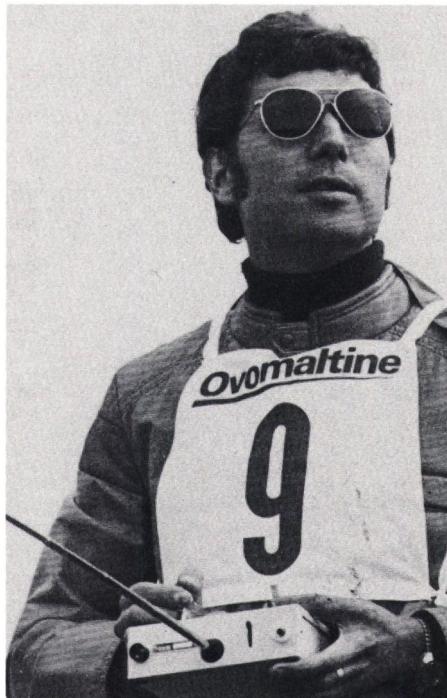
After three rounds, Bruno Giezendanner was in third place but, due to some bad luck with the weather, narrowly missed out on the bronze medal. His fifth-place finish once again confirms the Swiss pilot’s world-class status.
The 1976 European Championships in Belgium demonstrated once again, with unmistakable clarity, that the FAI’s international model aviation movement had fallen into a serious crisis. Although organizers often go to great lengths, in many cases the necessary expertise is lacking, because enthusiasm and idealism alone are simply no longer enough today. Organizers need precise instructions on what to do and what not to do, and where to do it. In Switzerland, therefore, all Swiss championships in the RC categories are discussed in advance at a joint meeting with the organizers and the technical committee—and even then, there are still plenty of problems. FAI events, well, that’s just the way it is—probably a matter of tradition. Chris Olsen, president of the RC Subcommittee of CIAM (FAI Model Flying Commission), is sitting somewhere in the Saudi Arabian desert, reading the book *How to Become Energetic* for the eleventh time—yet alarmingly little is still getting done (understandable given the heat!). However, the fact that things are happening elsewhere and work is being done on the future of RC aerobatics is something the FAI and CIAM will likely have to acknowledge with astonishment in a few years. In the United States, an association for RC aerobatics has existed for two years, bringing together the best aerobatic pilots in the U.S. and already holding its own championships this year. As is well known, the 3rd Professional World Championships will take place in Las Vegas this November, and there is a significant risk that this event will slowly but surely eclipse the FAI World Championships. No wonder the folks at the FAI have nothing but scorn and derision for the Las Vegas organizer. Well, you can feel however you want about such events with such high cash prizes (personally, I’m not a fan), but ranting and mocking doesn’t do much to help. As long as, at FAI European Championships, the competition area borders on a meadow and even the reigning world champion breaks his landing gear, and the judges in all seriousness recommend landing in the outer field so the model can be rolled out from there, no one should be surprised if FAI championships slowly but surely take on a provincial and amateurish character.
I do not wish to comment further on the organization at this point. The food in the military airfield’s cafeteria, as well as the hospitality and friendliness in general, deserve special praise. Despite many difficult obstacles, the atmosphere remained friendly.
In terms of flying, I have noticed a significant refinement of the aerobatics program in Bern since 1975—despite occasionally adverse weather conditions (stormy, erratic winds interspersed with powerful thermal bubbles). However, it must also be noted here that pilots generally had access to even more powerful engines, which, of course, was particularly noticeable in the presence of these strong crosswinds.
While the flying style up until about 1965 viewed emulating the great powered aerobatics as the ultimate goal and pinnacle of achievement, today we can safely say that aerobatics with RC models has vastly surpassed our “big” brothers, including the legendary AKROSTAR. In terms of engine power, the resulting speed, maneuver size, and precision, powered aerobatics can no longer keep up. So we clearly lack here the great role model that was once so highly regarded. What we see today at an RC aerobatics championship corresponds, in the world of full-scale aviation, to aerobatic displays by state-of-the-art fighter jets. This fact may also have found its way into the styling of aerobatic models, a trend that had actually been around for a long time but only experienced its decisive breakthrough with the Japanese world champion model, the BLUE ANGEL. Today, it would never occur to any elite international pilot to try to emulate an AKROSTAR or a CHIPMUNK with his model.
There isn’t much to say about remote-control technology, since little has changed in this area since Bern. The fact that the championship proceeded with virtually no interference is not due to technical improvements in the RC systems, but rather to the low-interference environment. The 11-meter band also performed much more reliably there than, for example, in Bern—or here at all.
Radio monitoring worked flawlessly—even during practice! Flights were also conducted simultaneously from two launch sites.
European systems naturally dominated the market. The company Simprop/BRD had by far the most systems in the “race” and, with Matt taking 1st place, Prettner 2nd, and Bertolani 4th, was also the manufacturer of the most successful RC system. It is also interesting to note that the reigning European champion in the team competition—namely, the Federal Republic of Germany—used RC systems from Microprop and Graupner.
I have already mentioned that, on average, engine power has increased significantly, even though not even a full year had passed since Bern. While last year the top European pilots were still using “standard” engine configurations—in some cases with power boosts via resonance tubes—this year the American fuel injection pump (Perry system), usually paired with the matching carburetor of the same name, was, so to speak, the order of the day. The performance boost provided by this pump is considerable and results in an increase in RPM of at least 300 to 600, which is naturally noticeable during aerobatics—especially in stronger winds. Another major advantage of the Perry pump is the consistent fuel supply in all flight attitudes and the hassle-free installation of the tank, since there are no suction problems and, consequently, the fuel level is no longer a critical factor. In the future, this is likely to be of considerable importance for the design of aerobatic models.
However, quite a few pilots had to contend with other problems. The two leaders, Matt and Prettner, each suffered a crankshaft fracture in their engines due to material fatigue. This phenomenon is understandable to anyone who has followed the development of such an engine: First, the engine was released with its accompanying muffler, which had a relatively small expansion chamber. Then work was done on the mufflers. Larger volume (MINIVOX) and the removal of the baffles meant higher RPMs. Later, the resonance tube and the hard-chromed sleeve were introduced, resulting in a significant increase in RPM. In the third phase came an invention from the U.S. in the form of a sophisticated diaphragm pump driven by the pressure or vacuum in the crankcase. Now, considering the original design specifications and choice of materials, it must be said that the engine is now overtaxed for the power output it was originally intended to deliver. It’s always problematic to turn a “mass-market engine” into a racing engine—the reverse would be better!
The short runway, which made it necessary for the model to bounce across the bumpy meadow after landing, didn’t seem to agree with the retractable landing gear of various competitors. In particular, the traditional mechanical landing gear systems, which are servo-operated, became a source of concern even for the top competitors. Everywhere, the teams were working on their landing gear. I believe that the criterion here should be quick and trouble-free replacement.
Once again, there were no surprises. In no other model aircraft category do things progress as slowly as in aerobatics, and if we take a look at our aerobatic colleagues in circuit flying, this rule is confirmed. Aerobatics requires years of development.
The top positions were set right after the first round: Matt, Prettner, Hoppe, B. Giezendanner, Bertolani, Neckar.
The other Swiss skaters, E. Giezendanner and K. Schnyder, were in the top third of the standings.
After the third run, the standings were as follows:
1. Prettn/A
2. Matt/FL
3. B. Giezendanner/CH
The European championship title was now within reach for Hanno Prettn, and everyone was eager to see how the showdown would play out. For us Swiss, Bruno Giezendanner’s position was, of course, a great source of joy, but we were realistic enough to know just how difficult it would be to defend that spot.
The exciting fourth round began right on schedule in the morning. The weather had stabilized again, which meant that the wind would start blowing in from the sea around 11:00 a.m. In the morning, there was absolutely no wind. During this time, Bruno’s rivals—namely Hoppe and Bertolani—were able to complete top-notch flights. René Schumacher would also have had the opportunity to fly in calm conditions. However, his takeoff was postponed, first due to outside interference and later because of Holy Mass. Too bad for René, because he, too, could have used a top flight. When René was finally allowed to take off,
The wind also picked up right on schedule. It wasn't quite as strong as it had been in the afternoon—but it was something, at least. The sea breeze (from the north) tends to pick up noticeably as the day goes on, reaching nearly gale-force by evening.
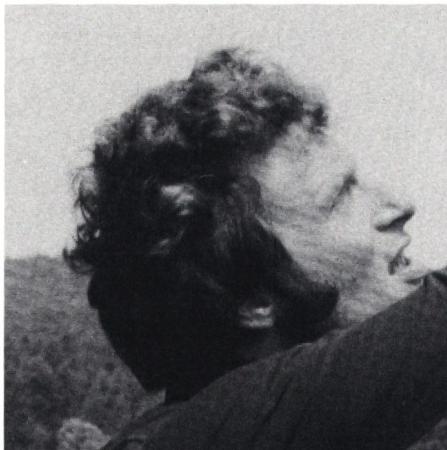
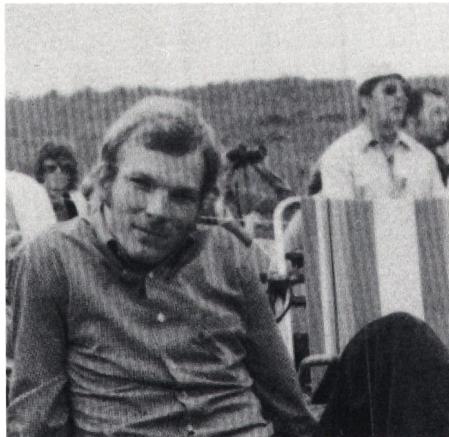
Hanno Prettn, too, seemed not quite up to the task of living up to his status as a European Championship contender. In the heat of the moment during his decisive flight, he mixed up two maneuvers—and that was the end of his dream. Wolfgang was then able to take off with peace of mind and reclaim the lead. Of course, that doesn’t detract from his performance—quite the opposite. Bruno delivered a clean flight. Nevertheless, given the prevailing winds, he couldn’t match the scores posted by Bertolani and Hoppe. As nice as a bronze medal would have been, his excellent 5th-place finish as the sole Swiss competitor is a testament to the class of the two-time world champion. His unconventional SCORPION also proved its potential. This performance shows that Bruno remains a world-class pilot and has managed to overcome his streak of bad luck in a truly remarkable way. Statistically speaking, luck and bad luck are distributed evenly among all pilots. E. Giezendanner
1. I. Math | Li | 13,600 |
2. H. Prettn | A | 13,295 |
3. G. Hoppe | D | 12,700 |
4. B. Bertolani | I | 12,435 |
5. B. Giezendanner | CH | 12.345 |
6. H. Neckar | D | 12,100 |
7. R. Pasqualini | I | 11,900 |
8. G. Metterhausen | D | 11,460 |
9. S. Brambilla | I | 11,420 |
10. G. Cappuyns | B | 11.175 |
11. G. Werion | B | 11,090 |
12. D. Fritz | A | 10,930 |
13. F. Schaden | A | 10,745 |
14. B. Kjellgren | SW | 10,695 |
15. R. Schumacher | CH | 10.490 |
16. D. Hardaker | GB | 10.405 |
17. E. Giezendanner | CH | 10.220 |
18. K. Schnyder | CH | 10.140 |
19. R. Berretta | I | 10.095 |
20. K. Holm | SW | 9,995 |
21. D. Chabert | F | 9.860 |
22. J. Van Vliet | N | 9.775 |
23. T. Tubee | N | 9,640 |
24. A. Laffite | F | 9,635 |
25. B. Lundstrom | SW | 9.615 |
26. K. Dalsheim | SW | 9.535 |
27. J. Van Beek | N | 9,500 |
28. R. Lefebvre | B | 9,280 |
29. R. Van Rennes | N | 9,250 |
30. J. Mersch | L | 9,135 |
31. E. Toft | DN | 8,925 |
32. C. Bossart | F | 8,900 |
33. Y. Van Gompel | B | 8,335 |
34. J. Rojo | E | 7,860 |
35. J. Tonnar | L | 7,835 |
36. M. Bone | GB | 7,770 |
37. W. Widenborg | DN | 7.675 |
38. T. Jentegaard | NW | 7,480 |
39. B. Hedegaard | DN | 6,335 |
40. J. Olsen | DN | 6,135 |
41. K. Binks | GB | 4,180 |
1. Federal Republic of Germany | 35,930 |
2. Italy | 35,280 |
3. Austria | 34,445 |
4. Switzerland | 32,750 |
5. Belgium | 30,385 |
6. Sweden | 29,985 |
7. Netherlands | 28,635 |
8. France | 28,090 |
9. Denmark | 22,855 |
10. United Kingdom | 21,955 |
11. Luxembourg | 16,750 |
12. Liechtenstein | 13,600 |
13. Spain | 7,860 |
14. Norway | 7,480 |
5.1.1 through 5.1.12 Technical Rules
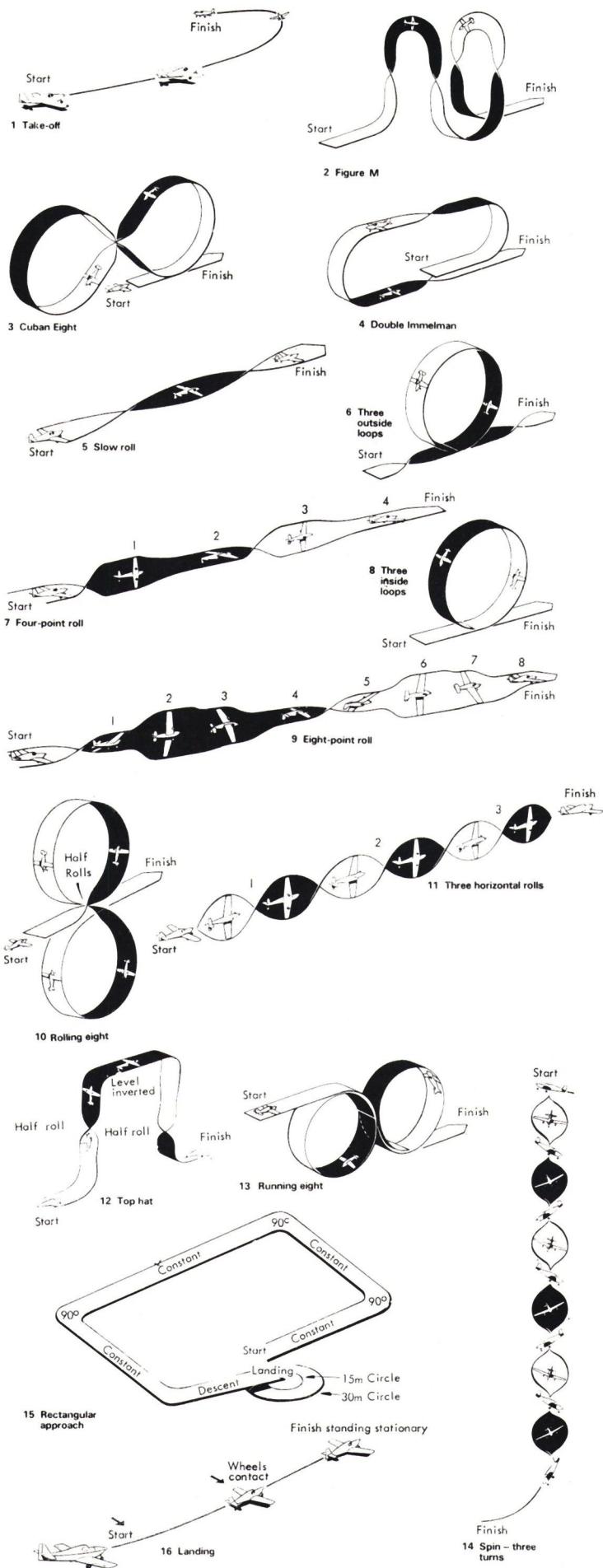
5.1.13 Figure Program (Description)
5.1.13 Figure Program (Drawing)
Maximum wing area (s × t) | 150 dm² |
Maximum total weight | 5 Kp |
Minimum wing loading | 12 gp/dm² |
Maximum surface load | 75 gp/dm² |
Maximum engine displacement | 10 cm³ |


News from HEBU

HORIZON HOBBY/LEMACO NEWS: MICRO OV-10 BRONCO 645 MM BY E-FLITE

PRIDE AND GOOD IDEAS
 Markus Nussbaumer

TEAM MANAGER "THIS" BOSSHARD
 Rodito Nussbaumer

YOU KNOW WHAT I MEAN? 125 YEARS OF THE SWISS AERO CLUB
 Emil Giezendanner

F3A EUROPEAN CHAMPIONSHIPS IN ST-MACAIRE, FRANCE
 Matthias Bosshard

ATOM, THE NEW DOUBLE-DECKER FROM CPLR
Matthias Bosshard
SUMMER FUN 2026 AT MG USTER
Martin Wunderli
TRY-OUT DAY AT MFV WETTINGEN
Urs Keller
What's New at Leomotion.com

52. 2026 ALPS CUP
Emil Giezendanner
TWIN TOWN PARTNERSHIP
Wolfgang Voeller
34th HAHNENMOOS ALPINE MODEL AIRPLANE CAMP
Res Dauwalder
CORSAIR F4U – A WARBIRD WITH A MEMORABLE LOOK
Jürgen Rosenberger, Jürgen Prinz
SMALL, MODEL-LIKE SAILBOATS
Res Dauwalder
WELCOME, NEW MEMBER!
Andrea Bolliger
FREE FLIGHT IN THE MIDDLE OF SUMMER
Urs Muntwyler
COUPE DES ALPES – OBSERVE AND LEARN
Rodito Nussbaumer
EURO CONTEST GLIDER ACRO TOUR AUSTRIA 2026

BY YOUTH, FOR YOUTH
Lorena Betschen
INSIGHTS INTO THE HISTORY OF SEAPLANES

THE PC-21 STORY
Emil Giezendanner
NEWS FROM HEBU
 Julia Bucher

FROM 0 TO 100
Markus Nussbaumer
MEMORIES
Wolfgang Völler
NOS REGION – A HUB FOR ELECTRIC AVIATION
Emil Giezendanner
DO YOU KNOW WHAT I MEAN IN THE LAND OF SMILES?
Emil Giezendanner
Have you almost forgotten about aircraft that take off and land vertically?
Emil Giezendanner