
RC Motorized Flight: Canard SC
Why do all airplanes look the same these days?
Back in the early days of aviation, every “wannabe pilot” tried to design and fly their own airplane based on their own ideas. From peacock feathers to wooden planks, bouncing machines, and ejector seats—or simply, airplanes that looked different from the rest.
The first manned flight lasting several seconds was carried out using a duck-wing biplane built by the Wright brothers. Charles Lindbergh crossed the Atlantic for the first time in 1927 aboard the “Spirit of St. Louis.” Today’s airplanes have not changed as drastically in form from the design seen with the “Spirit of St. Louis.” Perhaps due to its enormous success, aircraft were developed further based on a single, rigid design right up to the very end.
Fortunately, you still come across something unconventional every now and then at air shows—for example, the super-fast “Vari-Eze,” ultralights, delta wings, and others. There are no limits to aviation!!!
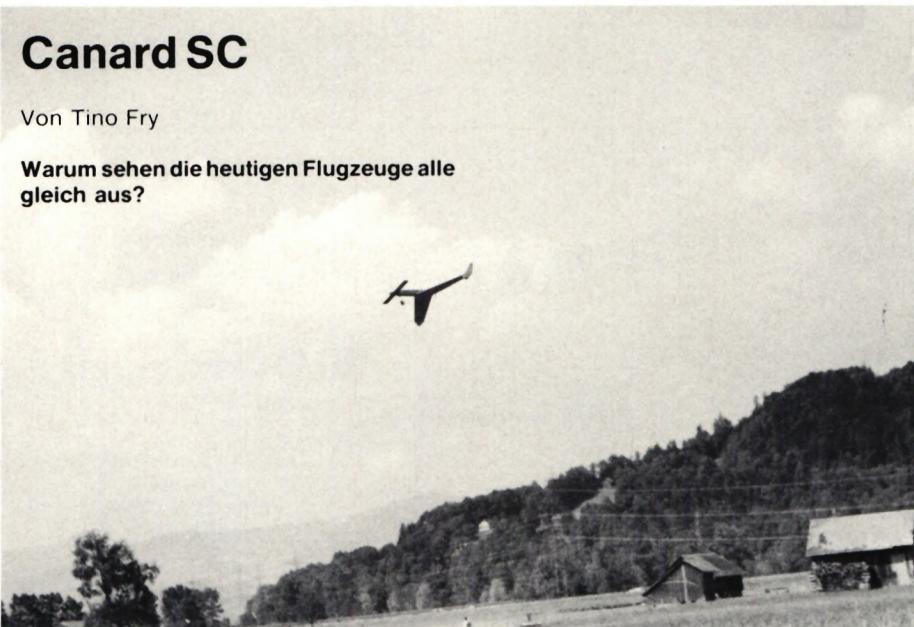
While building a Vari-Eze—a project during which I learned a great deal from the "Duck"—I found myself wondering why this airplane had such
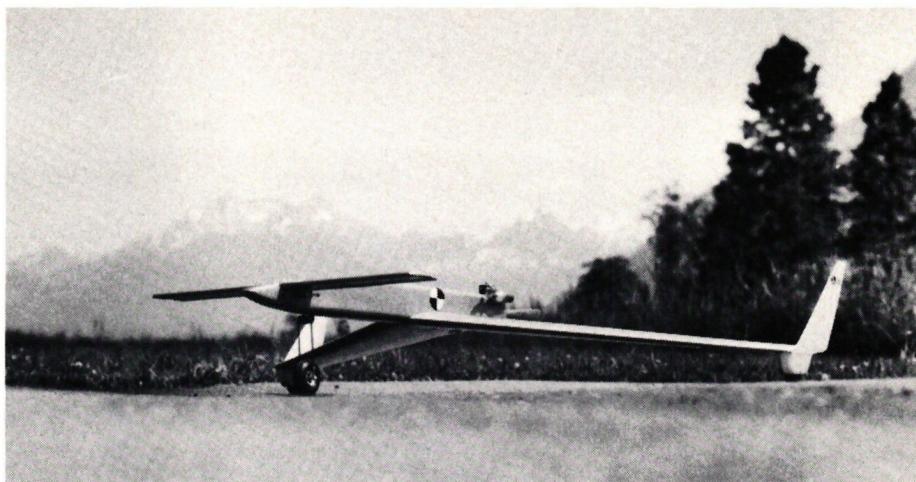
It achieves such high top speeds despite its low engine power. It became clear to me right away. The "Duck" definitely has better aerodynamics than those of conventional designs.
- For structural reasons, the fuselage can be designed to be shorter.
- The wings can be designed with a smaller wing area, and the airfoils can be tailored to the specific application (similar to a jet).
- Drag coefficients can be kept to a minimum (induced + interference).
I took advantage of these important—yet significant—points and designed my own “Duck” based on the following criteria:
- Engine: 3.5–10 cm³—ideal for a 4-stroke engine!
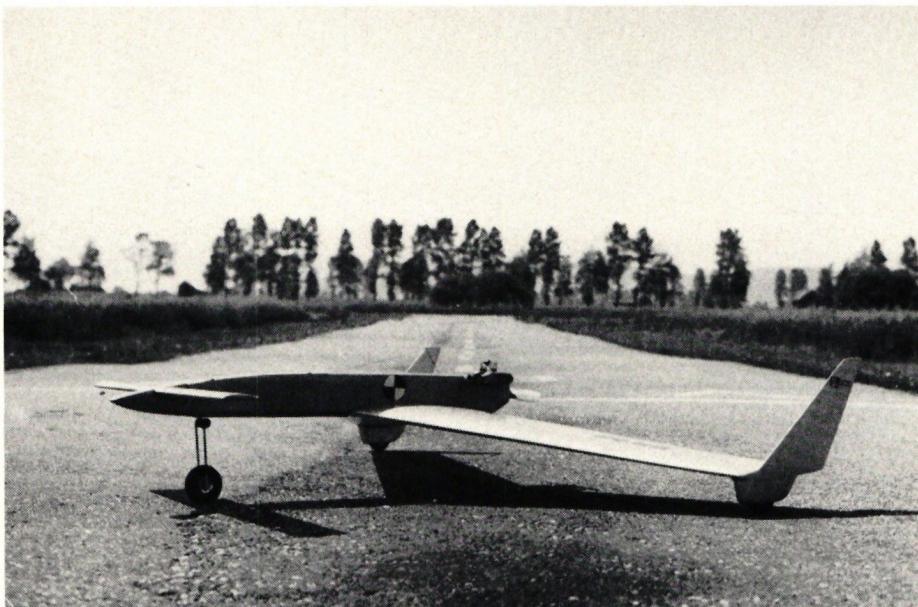
- High speed –
good slow-flight characteristics –
suitable for aerobatics –
Transport: fits in a car trunk –
Landing gear integrated into the wing tips. My
prototype (Speed Canard) flew right away
with a 3.5-cm³ engine. It reaches speeds
comparable to those of conventional and
10-cm³ engines.
Its low-speed flight behavior is incredible
. A “stall” is simply
impossible, even with abrupt
control inputs.
The subtlety of the aerodynamics is evident
throughout the entire flight. The “Speed Canard” responds
superbly
to even the slightest movements of the control stick and
can be flown in the smallest of spaces. Its appearance takes some
getting used to.
It is therefore essential to
“never” take your eyes off the aircraft! Takeoffs
and landings are extremely simple
, even under extreme conditions. In ground effect
, the SC can be run down almost to a standstill
. After
an entire afternoon of flying
, not a single drop of oil was visible on the aircraft
, thanks to the tail-mounted engine, which runs on synthetic
fuel.
So, a real joy, whether you’re a beginner or a pro
! I’m currently working full steam ahead on further
developing the “Speed Canard”
!
The new model (SCZ) will feature even more refined aerodynamics
, including air brakes.
The SCZ will have
a 10-cm³ 4-stroke engine, and the nose landing gear will be
retractable. In my
opinion, airplanes have been “built
backwards” for over
half a century!
1:1 construction plans are available from the designer,
as well as wing and fuselage parts.
Valentino Fry, 8633 Wolfhausen


News from HEBU

TEAM MANAGER "THIS" BOSSHARD
 Rodito Nussbaumer

YOU KNOW WHAT I MEAN? 125 YEARS OF THE SWISS AERO CLUB
 Emil Giezendanner

HORIZON HOBBY/LEMACO NEWS: MICRO OV-10 BRONCO 645 MM BY E-FLITE

PRIDE AND GOOD IDEAS
 Markus Nussbaumer

TRY-OUT DAY AT MFV WETTINGEN
Urs Keller
F3A EUROPEAN CHAMPIONSHIPS IN ST-MACAIRE, FRANCE
 Matthias Bosshard

52. 2026 ALPS CUP
Emil Giezendanner
ATOM, THE NEW DOUBLE-DECKER FROM CPLR
Matthias Bosshard
SUMMER FUN 2026 AT MG USTER
Martin Wunderli
What's New at Leomotion.com

COUPE DES ALPES – OBSERVE AND LEARN
Rodito Nussbaumer
TWIN TOWN PARTNERSHIP
Wolfgang Voeller
34th HAHNENMOOS ALPINE MODEL AIRPLANE CAMP
Res Dauwalder
CORSAIR F4U – A WARBIRD WITH A MEMORABLE LOOK
Jürgen Rosenberger, Jürgen Prinz
SMALL, MODEL-LIKE SAILBOATS
Res Dauwalder
WELCOME, NEW MEMBER!
Andrea Bolliger
FREE FLIGHT IN THE MIDDLE OF SUMMER
Urs Muntwyler
EURO CONTEST GLIDER ACRO TOUR AUSTRIA 2026

BY YOUTH, FOR YOUTH
Lorena Betschen
INSIGHTS INTO THE HISTORY OF SEAPLANES

THE PC-21 STORY
Emil Giezendanner
NEWS FROM HEBU
 Julia Bucher

FROM 0 TO 100
Markus Nussbaumer
MEMORIES
Wolfgang Völler
NOS REGION – A HUB FOR ELECTRIC AVIATION
Emil Giezendanner
DO YOU KNOW WHAT I MEAN IN THE LAND OF SMILES?
Emil Giezendanner
A SPECTACULAR F3A WORLD CUP IN THE PRINCIPALITY OF LIECHTENSTEIN
Emil Giezendanner