
Perfection and Limits
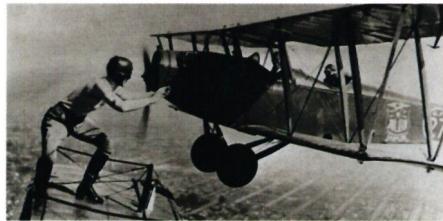
The desire to fly specific maneuvers in airplanes is probably as old as flight itself. Mastering one’s aircraft to the fullest—that is, aerobatics—requires talent and perseverance. Aerobatics is a very serious sport in all branches of aviation and is practiced without any risk. This is also one of the most important differences from the acrobatics of the past, where pushing the limits and taking risks were deliberately sought after.
| Correct Name Dénomination correcte | Aerial acrobatics Cascades aériennes | Flight acrobatics Acrobaties aériennes | Aerobatics Voltige |
|---|---|---|---|
| Definition of Activities Examples | e.g. , – Walking on the wings. – Transferring from one aircraft to another in flight. – Walking on the wing of an aircraft in flight. – Transferring from one aircraft to another in flight. | e.g. , – Flying in tight formation with overlapping wings. – Picking up handkerchiefs with the wingtip .– Collisions with buildings, etc .– Flying in tight formation with overlapping wings .– Catching a handkerchief with part of the aircraft .– Collisions with buildings, etc. | Execution of precisely defined flight maneuvers. Performing a freestyle maneuver program composed of individual maneuver elements. Execution of precisely defined maneuvers. Performing a freestyle program consisting of a sequence of simple maneuvers. |
Classification | Air shows (1910 to 1930) | From around 1950, demanding aerial sports. | |
Risk | Very high, “playing with death” Très gros, “Flirt avec la mort” | A very serious aviation discipline with a moderate level of risk |
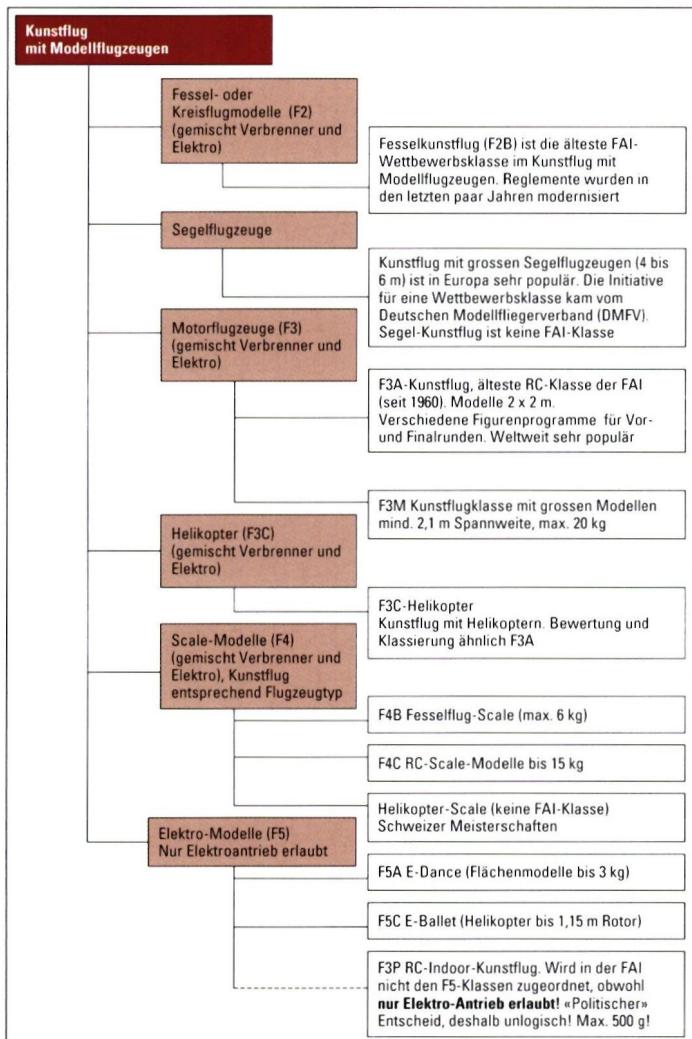
The very first “aerobatic maneuvers” were performed unintentionally with model airplanes. When the center of gravity and elevator controls were set incorrectly, free-flight model airplanes would often perform loops, rolls, and spirals repeatedly—even without any input from the pilot. As long as this didn’t happen too close to the ground, no accidents occurred. The first controlled maneuvers were performed by tethered-flyers, so to speak, on a “long line.” This wonderful class (F2B) remains very popular to this day—especially in Eastern European countries. Remote-controlled aerobatics began as early as the late 1950s. The RC systems were often cobbled together from parts of old military radio equipment, and not infrequently by American and British occupation soldiers in Europe. As is well known, the first RC aerobatics world championships took place in Dübendorf in 1960. The overwhelming dominance of U.S. RC aerobatic pilots, which was already becoming apparent at that time, would persist for decades, although the Japanese and Europeans were repeatedly able to prevent their total triumphs. With the first World Championships in 1960, the International Air Sports Federation (FAI) assumed a leading role in aerobatics as the very first RC class and assigned it the “F3A” designation within the FAI model aviation classification system—or, as it was ingeniously termed, “Radio-Controlled Aerobatic Power Model Aircraft.”
Part of the classification was carried out by the FAI
The development of the F3A aerobatics class has generally kept pace with technological advancements. It has rarely been ahead of the curve or set the pace; rather, it has lagged behind in a conservative manner. The rapid succession of World and European Championships has prevented major developmental leaps. The participants simply lack the time for experimentation. As a result, modifications are made only in small steps from year to year, without taking on significant risk. The prescribed maneuver programs, model specifications, and certain trends in flying styles have influenced model designers at least as much as newer technologies. The rapid spread of electric propulsion since the 2005 World Championship must be viewed as the latest—and, for the time being, final—high point of major technical innovations. It has ushered in a veritable cultural shift in F3A aerobatics. Of course, servos, batteries, propellers, and so on continue to be improved. But a leap like the one from internal combustion engines to electric propulsion is unlikely to happen again—unless the model specifications were fundamentally changed. The entire F3A class has now reached such a high level of perfection that the technical and flying effort required to surpass it is increasing exponentially.

EURO CONTEST GLIDER ACRO TOUR AUSTRIA 2026

THE PC-21 STORY
 Emil Giezendanner

TWIN TOWN PARTNERSHIP
 Wolfgang Voeller

SUMMER FUN 2026 AT MG USTER
Martin Wunderli
CORSAIR F4U – A WARBIRD WITH A MEMORABLE LOOK
Jürgen Rosenberger, Jürgen Prinz
52. 2026 ALPS CUP
Emil Giezendanner
YOU KNOW WHAT I MEAN? 125 YEARS OF THE SWISS AERO CLUB
Emil Giezendanner
News from HEBU

TEAM MANAGER "THIS" BOSSHARD
Rodito Nussbaumer
ATOM, THE NEW DOUBLE-DECKER FROM CPLR
 Matthias Bosshard

F3A EUROPEAN CHAMPIONSHIPS IN ST-MACAIRE, FRANCE
Matthias Bosshard
INSIGHTS INTO THE HISTORY OF SEAPLANES

WELCOME, NEW MEMBER!
Andrea Bolliger
What's New at Leomotion.com

PRIDE AND GOOD IDEAS
 Markus Nussbaumer

SMALL, MODEL-LIKE SAILBOATS
Res Dauwalder
FREE FLIGHT IN THE MIDDLE OF SUMMER
Urs Muntwyler
BY YOUTH, FOR YOUTH
Lorena Betschen
HORIZON HOBBY/LEMACO NEWS: MICRO OV-10 BRONCO 645 MM BY E-FLITE

34th HAHNENMOOS ALPINE MODEL AIRPLANE CAMP
Res Dauwalder
COUPE DES ALPES – OBSERVE AND LEARN
Rodito Nussbaumer
TRY-OUT DAY AT MFV WETTINGEN
 Urs Keller

NEWS FROM HEBU
 Julia Bucher

NOS REGION – A HUB FOR ELECTRIC AVIATION
Emil Giezendanner
MEMORIES
 Wolfgang Völler

70 YEARS OF THE NIDWALDEN MODEL AIRPLANE CLUB
Martin Barmettler
A SPECTACULAR F3A WORLD CUP IN THE PRINCIPALITY OF LIECHTENSTEIN
Emil Giezendanner
FROM 0 TO 100
Markus Nussbaumer