
The Physics of Model Rockets
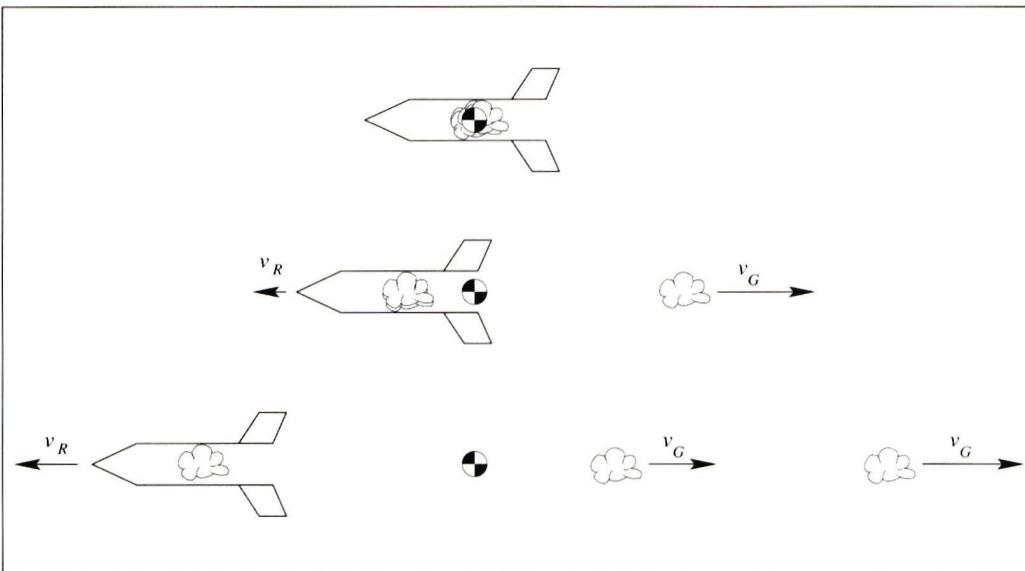
A body remains at rest or in uniform motion if no forces act upon it. By the time Newton formulated this fundamental insight, rockets had already been known in China for a few centuries. For a composite body, Newtonian physics states that the center of mass remains at rest or in uniform motion. Two dancers spin around their common center of mass, which moves leisurely through the ballroom or even remains in place. If one part breaks away, the rest must move in the opposite direction—and the heavier the detached part is, and the faster it moves away from the common center of mass, the faster the rest must move. When two billiard balls collide, they will scatter in such a way that their common center of mass moves exactly as it did before the collision. A rocket engine consists of a container that expels hot gas at high speed. The centers of mass of the container and the gas must move in such a way that their common center of mass remains unchanged. If the gas moves quickly, it has the longer lever arm and can therefore compensate for the container’s motion with less mass
(see fig.). The decisive quantity is therefore the product of mass and velocity, known as impulse (unit: Ns, newton-seconds). The impulses of the container and the escaping gas are equal in magnitude but opposite in direction:
$$m_{\text{container}} v_{\text{container}} = m_{\text{gas}} v_{\text{gas}}$$
As physicists say: momentum is conserved. A rocket engine is a momentum generator: the momentum of the escaping gas is equal in magnitude but opposite in direction to the momentum of the rocket engine. Gas continues to flow in until the engine stops burning, so the rocket constantly receives additional momentum, equal to the momentum of the escaping gas. If the engine is installed in a rocket that is accelerating as a whole, the momentum of the entire rocket is what matters. A heavy rocket will reach a lower velocity than a light one. A rocket weighing 100 g (0.1 kg) with a rocket engine producing 10 Ns will therefore reach a final velocity of $10/0.1 = 100$ m/s (360 km/h). A rocket engine can expel the gas through a large opening in a short time; in this case, the impulse is generated in a very short time. The velocity achieved is the acceleration multiplied
by the time during which it occurs, i.e., $v = at$. The impulse, on the other hand, is $mv = mat$. However, the product of mass and acceleration is also the thrust acting on the rocket. It can be seen that the impulse is also the product of thrust and burn time. An engine can generate its impulse by burning for a long time with low thrust, or for a short time with high thrust. In particular, an engine is largely characterized by its impulse and its average thrust.
In our discussion so far, we have neglected the fact that the rocket’s mass changes. In model rockets, the mass of the propellant is negligible compared to the total mass of the rocket. In large, real-world rockets, however, it accounts for the majority of the mass; this makes calculating acceleration and terminal velocity somewhat more complicated and is reflected in Tsiolkovsky’s rocket equation. Interested readers can find further literature on this topic in the list of links.
The method used to generate pressure in the container has no bearing on the force produced when the gases escape. What matters are the mass of the escaping particles and their escape velocity.
Here are a few examples:
Balloon: When inflated, the elastic skin is stretched. This creates internal pressure. Air escapes through the opening and accelerates the released balloon. Here, the energy is physically stored in the elastic force of the balloon’s skin and the compressed gas; moderate outflow velocity, low particle mass.
Water rocket: The air in the container is compressed as it is pumped up. After release, the pressure forces the water out and accelerates it. The energy is stored physically in the compressed gas; low outflow velocity, moderate particle mass, but very high total mass. Without water, the rocket rises only slightly because the outflowing mass is too small!
Rocket: The fuel in the engine burns, producing hot gases at very high pressure. Here, the energy is chemically stored in the fuel; very high exhaust velocity, moderate mass.
Aircraft engine: Works on the same principle as a rocket engine. However, a large portion of the fuel—namely, oxygen—is not carried on board but is drawn from the surrounding environment. This increases efficiency, though operation is only possible within the Earth’s atmosphere.
Impulse Drive in Star Trek: Normally, a starship in the science fiction series Star Trek (Star Trek: The Original Series) uses warp drive, which—defying all laws of physics—enables travel faster than light. Sometimes, however—in the event of technical problems or when navigating slowly in orbit around a planet—warp drive would simply be too powerful, so impulse drive is used instead. We don’t know exactly what that is—after all, we don’t live in the 24th century—but based on the name, we can assume it’s an impulse generator similar to the engines in our model rockets.
Model rocket builders experience the application of the law of impulse in their hobby with every launch. The propulsion systems of our model rockets are typically solid-fuel propellant charges. Black powder is used as the propellant in small engines, while a mixture of ammonium perchlorate and gum is used in larger ones. Black powder motors are built with propellant charges ranging from approximately 3 to 25 g; larger motors cannot be reliably built with black powder, as they tend to explode. The charge is ignited by a wire coated with an ignition agent, which is heated by an electric current. Once the propellant charge has burned out, it ignites the delay charge, which then, after 3–10 seconds, ignites the ejection charge for the recovery system (parachute or parachute parachute).
A rocket's flight performance is determined by its mass and aerodynamic efficiency, assuming the propellant charge remains constant.
Light rockets reach high speeds when the propellant burns out. Multistage rockets sometimes come close to the speed of sound; single-stage rockets reach up to 150 m/s, which is equivalent to over 500 km/h!
Aerodynamic forces increase with the square of the velocity. Drag (parallel to the
longitudinal axis, opposite the direction of flight) can reach a value in the range of 20 N at 150 m/s, which corresponds roughly to the weight of a 2-kg mass. If, under these forces, a nose cone is not securely fastened and wobbles even slightly, it can snap off in a fraction of a second, effectively tearing the rocket apart on the spot. Even a fin that is crooked or not secured tightly enough can cause the rocket to spin out of control.
For a high-power rocket, one must also calculate, among other things, how close it can get to the speed of sound—or whether it will even exceed it. This has serious implications for the design. The fins, in particular, must be built to be very stable due to the shock waves near the speed of sound and in the supersonic range. When properly designed, these rockets can reach speeds exceeding Mach 2 and altitudes of several thousand meters.
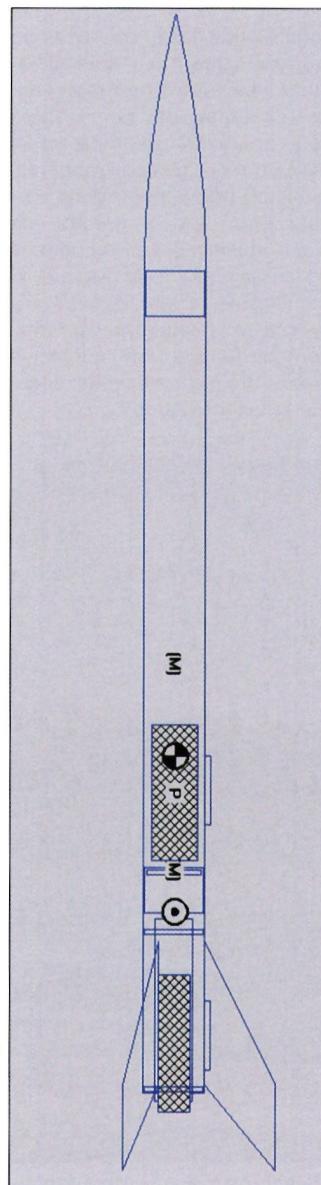
The image shown here depicts a classic Level 1 rocket (Black Brant Vb; PML version) in a computer simulation (RockSim, Apogee Rocketry). Shown are all parts of the airframe (nose, fuselage, fins, motor mount), the parachute (P for Parachute), the piston (below the parachute; used for clean ejection and as protection against the hot
gases), as well as the rocket motor (H123W). The two circular symbols indicate where, according to the simulation, the center of gravity (CG; checkered pattern) and the center of pressure (CP) will be located.
The center of gravity is calculated based on material densities, while the center of pressure is determined using the Barrowman method, which provides fairly accurate results for angles of attack up to about 5–10°. This is more than sufficient for the rocket’s flight, since the forward velocity is significantly higher than the expected crosswinds.
As soon as the rocket tilts slightly, the angle of attack generates lift on all parts of the rocket (nose, body, fins)
. The resultant of all these component forces acts at the center of pressure. The component perpendicular to the rocket’s longitudinal axis creates a moment that rotates the rocket back toward the direction of flight. Stabilization thus occurs in the same way as with an arrow or a spear.
To increase flight stability, one can add ballast to the nose, enlarge the fins, or extend the body. All these measures increase the distance between the CG and the CP, thereby increasing the torque. Before each launch, the rocket builder checks the relative positions of the CG and CP; the rocket may only be launched if it has sufficient stability.

EURO CONTEST GLIDER ACRO TOUR AUSTRIA 2026

THE PC-21 STORY
 Emil Giezendanner

TWIN TOWN PARTNERSHIP
 Wolfgang Voeller

SUMMER FUN 2026 AT MG USTER
Martin Wunderli
CORSAIR F4U – A WARBIRD WITH A MEMORABLE LOOK
Jürgen Rosenberger, Jürgen Prinz
52. 2026 ALPS CUP
Emil Giezendanner
YOU KNOW WHAT I MEAN? 125 YEARS OF THE SWISS AERO CLUB
Emil Giezendanner
News from HEBU

TEAM MANAGER "THIS" BOSSHARD
Rodito Nussbaumer
ATOM, THE NEW DOUBLE-DECKER FROM CPLR
 Matthias Bosshard

F3A EUROPEAN CHAMPIONSHIPS IN ST-MACAIRE, FRANCE
Matthias Bosshard
INSIGHTS INTO THE HISTORY OF SEAPLANES

WELCOME, NEW MEMBER!
Andrea Bolliger
What's New at Leomotion.com

PRIDE AND GOOD IDEAS
 Markus Nussbaumer

SMALL, MODEL-LIKE SAILBOATS
Res Dauwalder
FREE FLIGHT IN THE MIDDLE OF SUMMER
Urs Muntwyler
BY YOUTH, FOR YOUTH
Lorena Betschen
HORIZON HOBBY/LEMACO NEWS: MICRO OV-10 BRONCO 645 MM BY E-FLITE

34th HAHNENMOOS ALPINE MODEL AIRPLANE CAMP
Res Dauwalder
COUPE DES ALPES – OBSERVE AND LEARN
Rodito Nussbaumer
TRY-OUT DAY AT MFV WETTINGEN
 Urs Keller

NEWS FROM HEBU
 Julia Bucher

NOS REGION – A HUB FOR ELECTRIC AVIATION
Emil Giezendanner
MEMORIES
 Wolfgang Völler

70 YEARS OF THE NIDWALDEN MODEL AIRPLANE CLUB
Martin Barmettler
A SPECTACULAR F3A WORLD CUP IN THE PRINCIPALITY OF LIECHTENSTEIN
Emil Giezendanner
FROM 0 TO 100
Markus Nussbaumer