
Wood is cozy
At this point, I’d like to briefly talk about the jet trainer I built myself. About two years ago, I, too, caught the turbine bug. After a spectacular “Jet over Switzerland” event in Buochs, I was hooked. Shortly after that event, I treated myself to the legendary “Kangaroo” from Fiber-classics and the matching Turbine Jet-Cat P80 from Zipperer. A short time later, I gained my first flying experience with a jet-powered model aircraft.
But I soon realized that it wasn’t the flying, but rather the landing that presented its own special challenges. The “Kangaroo” truly lives up to its name. Monday, Tuesday... To make matters worse, the landing gear that came with the model was far too flimsy. After almost every landing, this meant I had to straighten or repair the landing gear. I also had to add a lot of lead to the tail to get the center of gravity reasonably correct. At this point, I’d like to mention that I already have quite a bit of flying experience—after all, I’ve been flying model airplanes for over thirty years. I mention this only in passing, because
I wouldn’t recommend that anyone start model flying with a turbine-powered model. My main concerns here are safety and responsibility toward third parties. In the new JETMAG magazine, Issue No. 1, I saw a picture of a very simply constructed jet trainer. It was presented at a jet meet in the Netherlands. The model was developed by Karl Paul and is supposed to be available as a kit from Toni Clark in the future. So I called Toni Clark right away. But unfortunately, it’s going to be quite a while before such a kit will be available! For understandable reasons, there
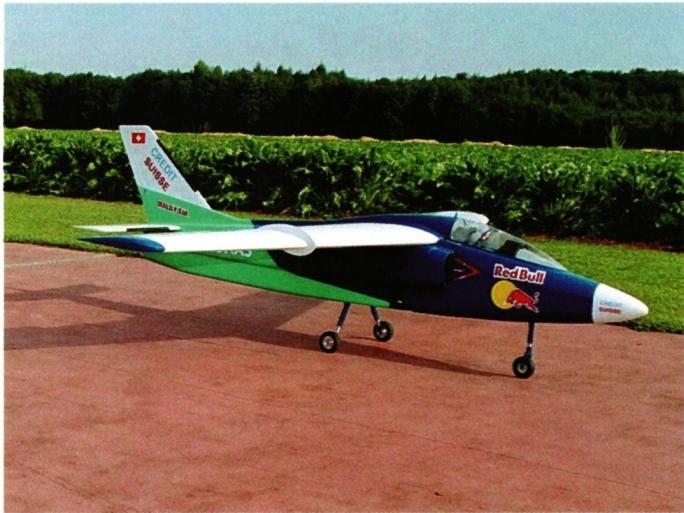
There wasn't even a blueprint. A wave of disappointment swept over me. But then there was my neighbor, Paul Haller, a well-known figure in the world of scale models. A real woodworm, so to speak. That’s Paul Haller for you. He advised me to just build the thing myself. No sooner said than done! I started drawing; I deliberately wanted my own design to differ from Karl Paul’s model both in dimensions
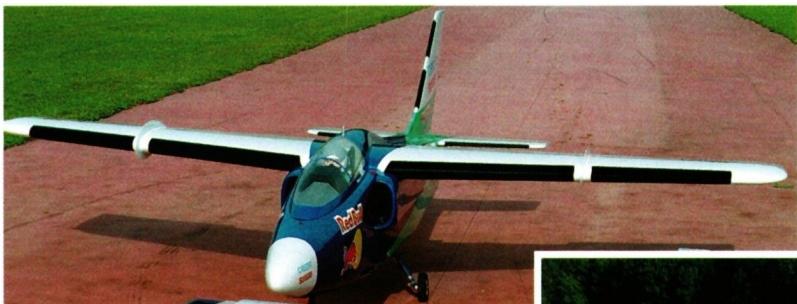
construction method. The idea of a slow-flying, good-natured high-wing jet, however, was to remain. So the focus wasn’t on appearance, but on functionality. Since I had never designed a model myself or built one out of wood in all those years, the task wasn’t all that easy—but all the more
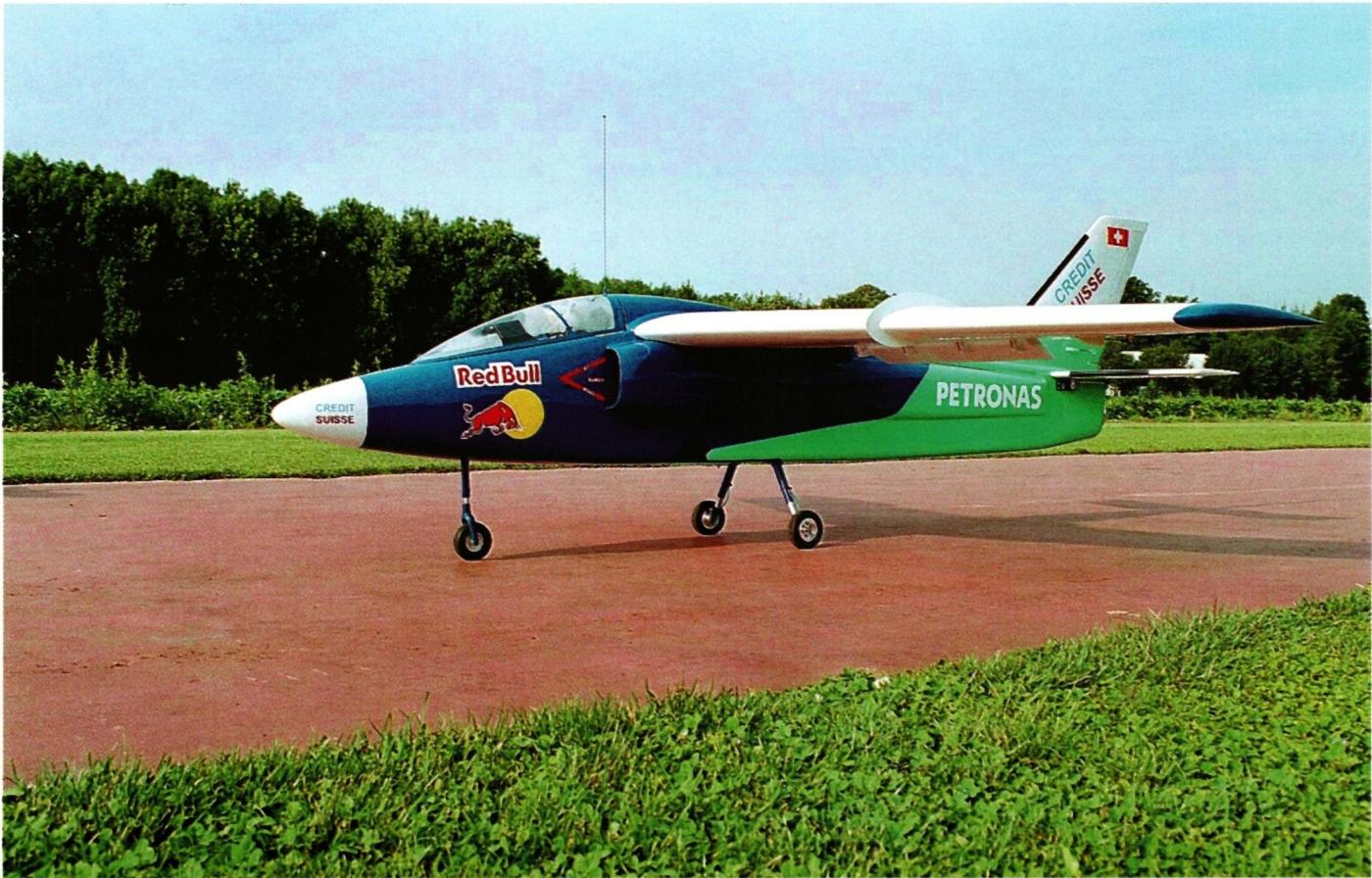
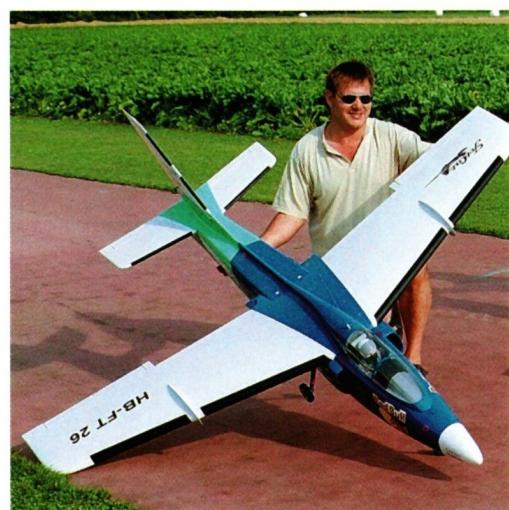
Even more exciting! Rene Wirthlin, a fellow club member, decided on the spur of the moment to build a similar model at the same time. So, under the supervision of P. Haller, the two Jet-Tainers were each completed in 350 hours.
The test flights are scheduled to take place soon, and we’re very excited to see what our experiences will be like. The design and construction process was a blast, and we’re already planning our next wooden model!
So I’ve not only caught the turbine bug, but also the woodworking bug! To anyone who’s hesitant to take on a project like this, I can only say: Go for it! I’ve never gained so much experience in such a short time in my entire model-flying career.
| Features | Lateral, Side, Height, Flaps, Retractable Landing Gear, and Brakes |
| Construction | Wood/FRP |
| Wingspan | 2100 mm |
| Fuselage length | 2,250 mm |
| Weight | approx. 13 kp |
| Propulsion | Jet-Cat P120 |
| Landing gear | Springair 600 |
| Brakes | Ramtec |
| Paint | 2-component |

EURO CONTEST GLIDER ACRO TOUR AUSTRIA 2026

THE PC-21 STORY
 Emil Giezendanner

TWIN TOWN PARTNERSHIP
 Wolfgang Voeller

SUMMER FUN 2026 AT MG USTER
Martin Wunderli
CORSAIR F4U – A WARBIRD WITH A MEMORABLE LOOK
Jürgen Rosenberger, Jürgen Prinz
52. 2026 ALPS CUP
Emil Giezendanner
YOU KNOW WHAT I MEAN? 125 YEARS OF THE SWISS AERO CLUB
Emil Giezendanner
News from HEBU

TEAM MANAGER "THIS" BOSSHARD
Rodito Nussbaumer
ATOM, THE NEW DOUBLE-DECKER FROM CPLR
 Matthias Bosshard

F3A EUROPEAN CHAMPIONSHIPS IN ST-MACAIRE, FRANCE
Matthias Bosshard
INSIGHTS INTO THE HISTORY OF SEAPLANES

WELCOME, NEW MEMBER!
Andrea Bolliger
What's New at Leomotion.com

PRIDE AND GOOD IDEAS
 Markus Nussbaumer

SMALL, MODEL-LIKE SAILBOATS
Res Dauwalder
FREE FLIGHT IN THE MIDDLE OF SUMMER
Urs Muntwyler
BY YOUTH, FOR YOUTH
Lorena Betschen
HORIZON HOBBY/LEMACO NEWS: MICRO OV-10 BRONCO 645 MM BY E-FLITE

34th HAHNENMOOS ALPINE MODEL AIRPLANE CAMP
Res Dauwalder
COUPE DES ALPES – OBSERVE AND LEARN
Rodito Nussbaumer
TRY-OUT DAY AT MFV WETTINGEN
 Urs Keller

NEWS FROM HEBU
 Julia Bucher

NOS REGION – A HUB FOR ELECTRIC AVIATION
Emil Giezendanner
MEMORIES
 Wolfgang Völler

70 YEARS OF THE NIDWALDEN MODEL AIRPLANE CLUB
Martin Barmettler
A SPECTACULAR F3A WORLD CUP IN THE PRINCIPALITY OF LIECHTENSTEIN
Emil Giezendanner
FROM 0 TO 100
Markus Nussbaumer