
Wazaaa on the race for the banner
During our 2001 Mini Air Show, one of the event organizers suggested holding a banner race, open only to the club’s young members. The decision was made to provide the engines to the future competitors as a thank-you for their help with the club’s various events. All that remained was to design the model for this rather special and unusual “task.”
From the very beginning of the model’s design, I tried to adhere to the following specifications: lightness—or rather, low wing loading—sturdiness, and quick construction, all to ensure the model would be best suited for the types of flights to be performed. In fact, banner races are often stressful, and you don’t always have the flight under control the way you’d like. The model must be able to withstand sudden, forceful movements of the control sticks without stalling or breaking in flight. Since accidents are to be expected, it must be easy to repair.
So I opted for a Sagex model with a slightly unusual kraft paper formwork to ensure quick and sturdy construction. It’s a flying wing, as these can withstand rough handling and are capable of wide speed variations without unexpected stalls when properly centered.
The wing's dimensions are: 1 meter wingspan and 73 cm in length. It weighs approximately 1.2 kg and has a wing area of 45 dm², giving it a relatively low wing loading of 26 g/dm². There is no spar! The motor mount is actually a 3-mm-thick poplar CTP plate that runs the entire length of the wing, to which the motor is screwed.
The wing is equipped with three standard servos capable of exerting approximately 3 kg of force to control the two ailerons and the throttle via radio mixers. The motor used is an OS 40 LA (suitable motors range from 2.5 to 7.5 cm³), driving a 10 × 5" propeller. A fuel tank of 150 to 200 cm³ is more than enough for ten minutes of flight. A three-channel receiver and a 600 mAh battery are recommended for two or three trouble-free flights. I use an 880 mAh, 4.8-volt NiMH battery that’s completely flat, which works great. It’s much lighter than a NiCd battery with a lower capacity.
I had already heard about the models from the Cherbourg club in France, where the Paysant-Le-Roux family builds both VGM and PSS models out of Sagex and kraft paper (packaging paper). So I set out without hesitation to try this simple yet effective construction method. Construction begins by cutting out the two wing halves with a hot wire using the vanishing point method. In these wing halves, openings are cut out for the electronics, and a groove is cut down the center of the profile (symmetrical biconvex) to accommodate a 10-cm-wide 3-mm-thick poplar plywood (CTP) mounting plate. This plate runs the entire length of the wing and will serve as the motor mount. After gluing the wing halves and the spar together, you need to attach the trailing edge, install the servo mounts, install the fuel tank, and enclose the radio compartments. The wing is then ready for covering with kraft paper. An article on the kraft paper covering method is in the works.
For the finish, you can use any kind of paint as long as it is oil-resistant, since oil is one of the main causes of deterioration in a kraft paper wing. Personally, I used acrylic paint, which I then coated with two-component automotive clear coat. After numerous flights, I haven’t noticed any signs of aging. Contrary to what one might think, the finish is of very high quality! In addition, you can apply Monocote after painting, since it adheres very well to the clear coat: just be careful with the heat from the iron, as the Sagex may melt without warning...
After painting, all that’s left is to install the ailerons, glue the vertical stabilizers into the slots provided before gluing the trailing edge, and make the covers for the radio and fuel tank compartments. All these parts are covered with Monocote.
Since there’s no launch glide, someone will have to launch the glider for me. I’m going to glue a launch glide to the upper surface soon so I can manage on my own. The ailerons are set 2 to 3 mm up. Once in the air, you realize it’s very precise, and at full throttle, it accelerates and flies very fast. Flying right along the runway and doing English turns are a real treat. But the Wazaaa can also fly very slowly. At very low speeds, there’s no risk of stalling. With a little wind, it’s even possible to fly backward or in a gliding mode. You can even land this way. The only challenge is the lack of a movable rudder at high angles of attack. It would be very useful for 45-degree flight as well as for 3D maneuvers. It’s also possible to perform some rather unique maneuvers such as flat spins—both stopped and rising—or positive and negative loops with a diameter of one or two meters at most. Conventional maneuvers are a breeze, particularly rolls: slow, faceted, or strung together very quickly. Series of ten rolls per second are quite mind-blowing...
My wing’s flight characteristics have far exceeded my expectations. Several are currently flying in our club, and others are under construction. Every pilot who’s tried it has thought it was fantastic, and that’s always a pleasure!
For anyone who might be interested, I still have a few cores and radio control boards left.
I’ve started another small model to test the Sagex-kraft paper technique, which will serve as a test bed for my larger model that’s already under construction. Maybe I’ll keep you posted.
It remains to be seen whether any Wazaaaaaaaaaaaa will survive the harsh realities of the tape-race competition!!!
Nicolas SEDLATCHEK
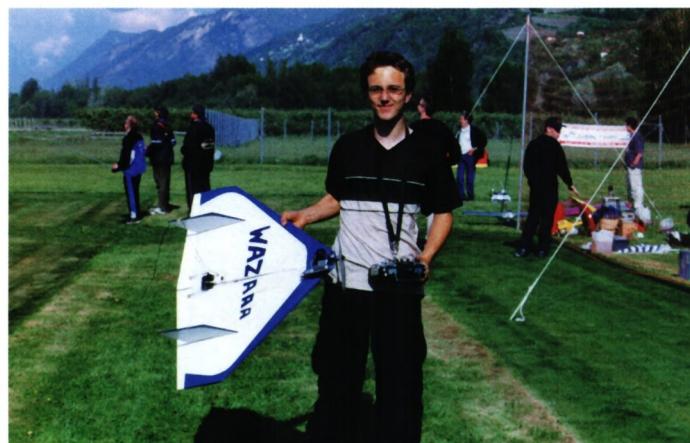
| Wingspan: | 1 m |
| Length: | 73 cm |
| Weight: | 1.2–1.4 kg |
| Motor: | 2.5–7.5 cm³ |
| Wing loading: | 26 to 30 g/dm² |
| Wing deflections: | minimum ± 1.5 cm (measured at the center of the wing) , maximum ± unlimited! |
| Exponential: | 60% on all axes |
| Ailerons: | raised by 2–3 mm for neutral flight |
| Airfoil: | Modified NACA 0006 (6.6%) |
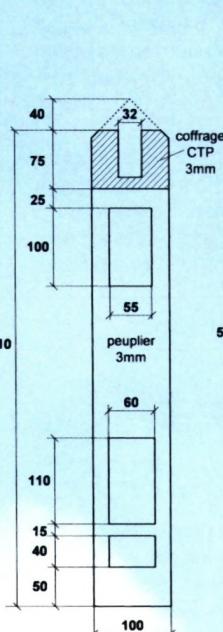
Center Plate
(Wing Key/Plate/Engine Mount)
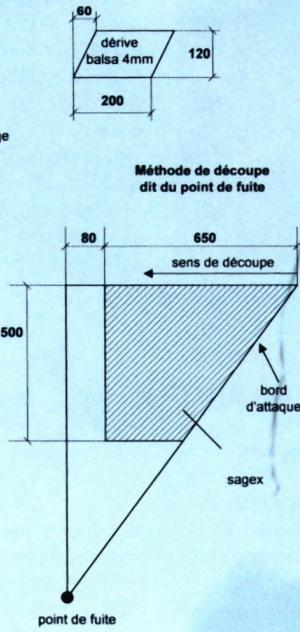
The "vanishing point" cutting
method

EURO CONTEST GLIDER ACRO TOUR AUSTRIA 2026

THE PC-21 STORY
 Emil Giezendanner

CORSAIR F4U – A WARBIRD WITH A MEMORABLE LOOK
 Jürgen Rosenberger, Jürgen Prinz

TWIN TOWN PARTNERSHIP
Wolfgang Voeller
SUMMER FUN 2026 AT MG USTER
Martin Wunderli
YOU KNOW WHAT I MEAN? 125 YEARS OF THE SWISS AERO CLUB
Emil Giezendanner
52. 2026 ALPS CUP
Emil Giezendanner
News from HEBU

ATOM, THE NEW DOUBLE-DECKER FROM CPLR
 Matthias Bosshard

TEAM MANAGER "THIS" BOSSHARD
Rodito Nussbaumer
F3A EUROPEAN CHAMPIONSHIPS IN ST-MACAIRE, FRANCE
Matthias Bosshard
INSIGHTS INTO THE HISTORY OF SEAPLANES

WELCOME, NEW MEMBER!
Andrea Bolliger
FREE FLIGHT IN THE MIDDLE OF SUMMER
Urs Muntwyler
PRIDE AND GOOD IDEAS
 Markus Nussbaumer

What's New at Leomotion.com

SMALL, MODEL-LIKE SAILBOATS
Res Dauwalder
BY YOUTH, FOR YOUTH
Lorena Betschen
HORIZON HOBBY/LEMACO NEWS: MICRO OV-10 BRONCO 645 MM BY E-FLITE

COUPE DES ALPES – OBSERVE AND LEARN
Rodito Nussbaumer
34th HAHNENMOOS ALPINE MODEL AIRPLANE CAMP
Res Dauwalder
TRY-OUT DAY AT MFV WETTINGEN
 Urs Keller

NEWS FROM HEBU
 Julia Bucher

NOS REGION – A HUB FOR ELECTRIC AVIATION
Emil Giezendanner
MEMORIES
 Wolfgang Völler

70 YEARS OF THE NIDWALDEN MODEL AIRPLANE CLUB
Martin Barmettler
A SPECTACULAR F3A WORLD CUP IN THE PRINCIPALITY OF LIECHTENSTEIN
Emil Giezendanner
FROM 0 TO 100
Markus Nussbaumer