
ATLAS F3A World Championship Model by Wolfgang Matt
Wolfgang Matt has been one of the world’s best aerobatic pilots for years. Since the “high art of model flying” has fascinated me in a very special way, so to speak, ever since I was a child, I had the opportunity to follow Wolfgang’s early career and his long but steady rise from close up, so to speak, as a fellow athlete and competitor.
But it should be noted here that all the visible aspects of a sports career—success, failure, stagnation, streaks of bad luck, and so on—are “merely” the surface. They are, so to speak, the tip of the iceberg that rises visibly from the waves. The entire underlying structure, however—the human context, the mental and physical effort—is disproportionately greater and yet remains hidden from most people. Once an athlete achieves success, there is a high risk that all the hype and commercial activity surrounding the athlete will become so overwhelming that it becomes nearly impossible for him to perform at a high level. Many have faltered because of this and lost their inner balance. In my opinion, the reigning world and European champion Wolfgang Matt has remained calm and modest; for he alone knows what really matters. Wolfgang Matt is neither a “fluke” nor a “flash in the pan.” Nothing was made easy for him, nor was anything simply handed to him. His struggle was arduous and hard. It was remarkable how he was able to bounce back from setbacks time and again. He was always able to quickly overcome discouragement, resignation, and the urge to “hang it all up.” These are all qualities that are just as much a part of being a world-class pilot as pure flying skill and an almost immeasurable wealth of experience in building and designing aerobatic models.
Wolfgang Matt is not spared the darker sides or side effects of success either. He must hold his own against unsportsmanlike attacks, envy, and resentment—as well as what is often a complex psychological battle—just as he does on the airfield. This isn’t always easy and requires a deep passion for the sport and self-confidence. His quest to defend his title next year in Klagenfurt, Austria, will likely be a test of endurance, but it is also a sporting challenge—and not an insurmountable one. I wish him the best of luck. Emil Giezendanner
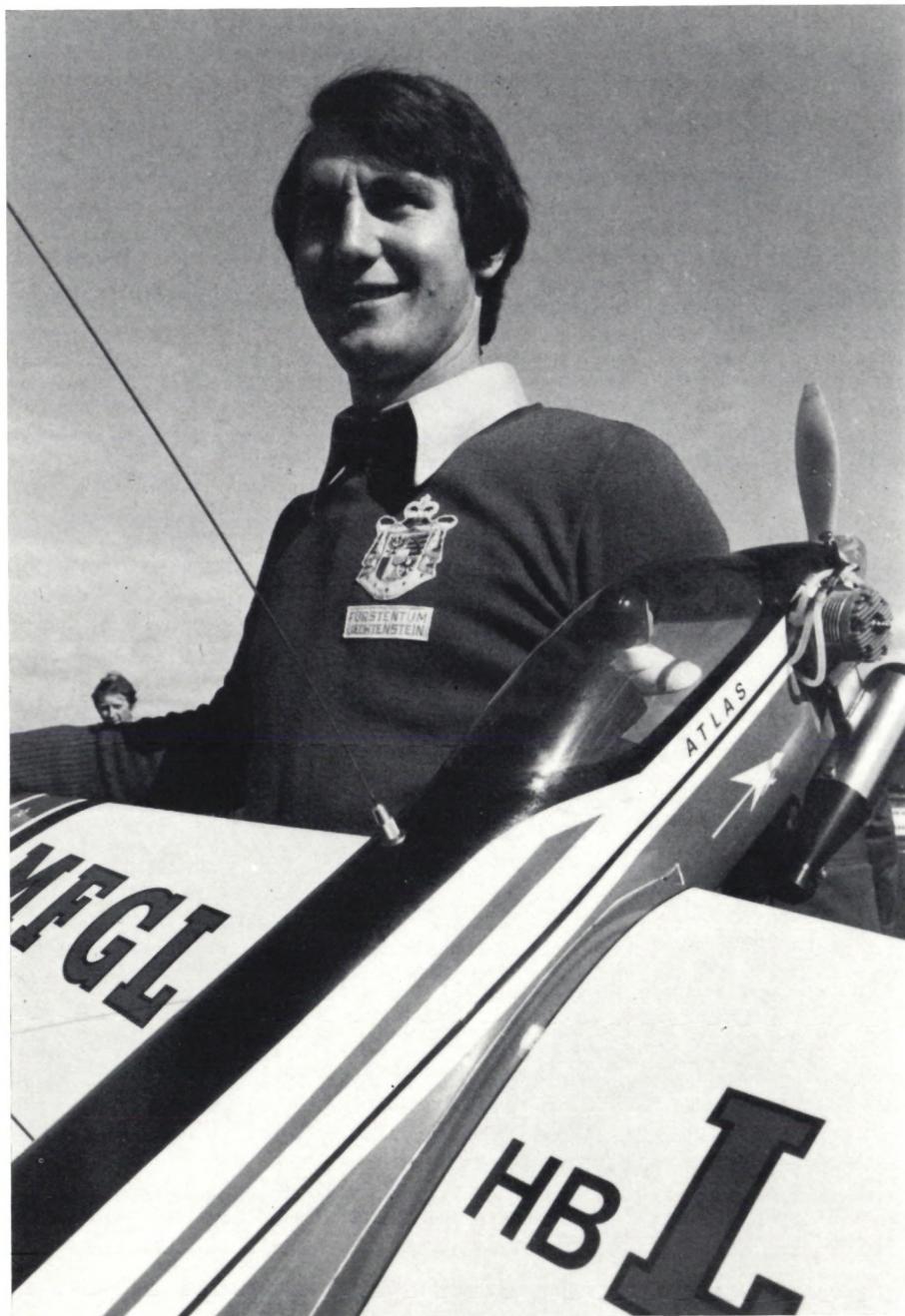
Even before the 1973 World Championship in Gorizia, Italy, my brother and I intended to design a new model, one that would not, however, deviate too much from the excellent flight characteristics and flying style of my successful “Super Star.” We wanted to implement some fundamental improvements in line with the new FAI program, with particular attention paid to the many roll maneuvers. The fuselage was given a rounded, aerodynamic shape to reduce sensitivity to crosswinds. The control arms were significantly modified. Furthermore, various changes (increased wingspan, airfoil, etc.) resulted in improved low-speed flight characteristics, which proved to be a major advantage during spins and landings.
After thoroughly testing three different prototypes, I was very satisfied with the flight characteristics of my new model. I flew this model at the 1975 World Championship in Bern. Wolfgang Matt
The ATLAS model is available in the following kit variations from KATO (Japan):
ATLAS 60 / 165 cm wingspan
—conventional wooden construction (fuselage and wings)
ATLAS 60 / 165 cm wingspan
— Styrofoam wings/elevator;
wooden fuselage ATLAS 40 / 140 cm wingspan
— conventional wooden construction
ATLAS 20 / 120 cm wingspan
— conventional wooden construction
Inquiries to:
Modellbau Günther Matt, Schaanerstr. 112,
9494 Schaan, Tel. 075 2 55 31
| Wingspan | 1,650 mm |
| Fuselage length | 1,330 mm |
| Flight weight | 3,500 g |
| Engine | 10 cc |
| Remote control | at least 4/8 channels |


News from HEBU

TEAM MANAGER "THIS" BOSSHARD
 Rodito Nussbaumer

HORIZON HOBBY/LEMACO NEWS: MICRO OV-10 BRONCO 645 MM BY E-FLITE

PRIDE AND GOOD IDEAS
 Markus Nussbaumer

YOU KNOW WHAT I MEAN? 125 YEARS OF THE SWISS AERO CLUB
 Emil Giezendanner

TRY-OUT DAY AT MFV WETTINGEN
Urs Keller
F3A EUROPEAN CHAMPIONSHIPS IN ST-MACAIRE, FRANCE
 Matthias Bosshard

ATOM, THE NEW DOUBLE-DECKER FROM CPLR
Matthias Bosshard
SUMMER FUN 2026 AT MG USTER
Martin Wunderli
What's New at Leomotion.com

52. 2026 ALPS CUP
Emil Giezendanner
TWIN TOWN PARTNERSHIP
Wolfgang Voeller
34th HAHNENMOOS ALPINE MODEL AIRPLANE CAMP
Res Dauwalder
CORSAIR F4U – A WARBIRD WITH A MEMORABLE LOOK
Jürgen Rosenberger, Jürgen Prinz
SMALL, MODEL-LIKE SAILBOATS
Res Dauwalder
WELCOME, NEW MEMBER!
Andrea Bolliger
FREE FLIGHT IN THE MIDDLE OF SUMMER
Urs Muntwyler
COUPE DES ALPES – OBSERVE AND LEARN
Rodito Nussbaumer
EURO CONTEST GLIDER ACRO TOUR AUSTRIA 2026

BY YOUTH, FOR YOUTH
Lorena Betschen
INSIGHTS INTO THE HISTORY OF SEAPLANES

THE PC-21 STORY
Emil Giezendanner
NEWS FROM HEBU
 Julia Bucher

FROM 0 TO 100
Markus Nussbaumer
MEMORIES
Wolfgang Völler
NOS REGION – A HUB FOR ELECTRIC AVIATION
Emil Giezendanner
DO YOU KNOW WHAT I MEAN IN THE LAND OF SMILES?
Emil Giezendanner
Have you almost forgotten about aircraft that take off and land vertically?
Emil Giezendanner