
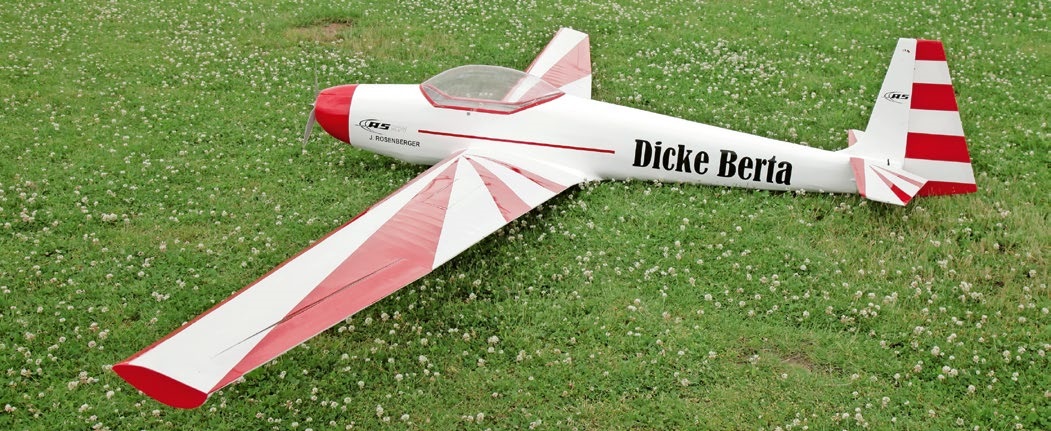
ASK 14, a motor glider from the 1960s
The hobby room is empty; as a woodworm with a passion for building, I’m looking for an “old-school construction kit”—ARF and PNP aren’t my thing—and that’s how I stumbled upon Günther Schneider’s website. An ASK 14 catches my eye—powered by an electric motor, it doesn’t need a tow plane.
A few weeks later, a heavy package is sitting on my workbench. When I open it, a warm, pleasant scent of wood wafts out. Balsa, poplar, and birch plywood boards, as well as pine strips, greet me.
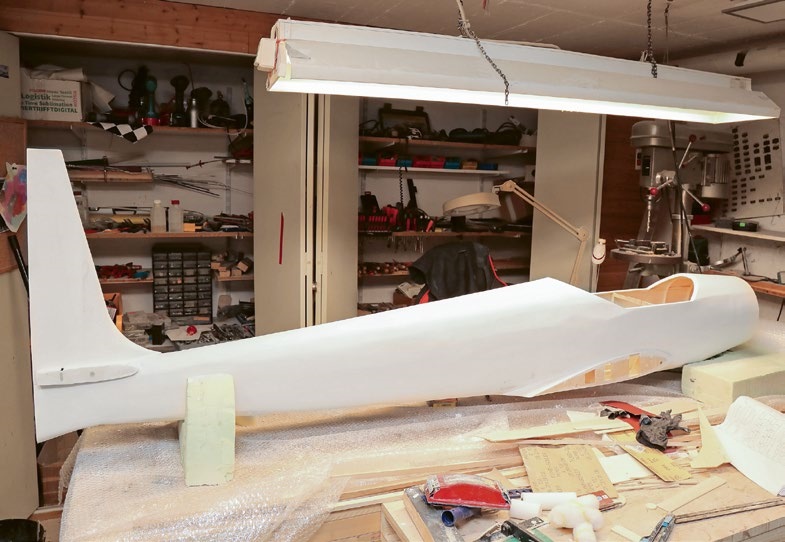
We assemble the 2.66-meter-long fuselage from two half-shells. At the top and bottom—or rather, toward the back and bottom—prefabricated plywood frames are secured to the workboard; the placement of the 14 half-frames is determined by the prefabricated notches in the aforementioned plywood frames. The framework gains stability through the insertion of pine rovings.
Left half-shell, right half-shell—it all goes quickly; you just have to be careful not to end up making two lefts or two rights in the heat of the moment. To glue the two hull halves together, we use a beam slipway, whose slats must be aligned horizontally using a level. The first step is to slide the hull halves onto the slats of the slipway. The pine strip on the side, centered on both sides—which runs along the zero line—serves as a support. This prevents twisting around the longitudinal axis. In the second step, I place pins at the beginning, in the middle, and at the end of the hull’s keel and align the workpiece using a laser beam. The frame-and-strip skeleton, aligned in this way, is secured to the slipway beams at specific points with superglue until the fuselage back is planked!
The elevator and rudder are assembled using plywood frames, into the pre-milled slots of which you
inserts the ribs. The next section covers wing construction, with a wingspan of no less than 5.72 m. For the spar construction, the designer specifies a graduated dimensioning for the arrangement of the pine battens; that is, a spar that is solidly filled with wooden battens on the fuselage side tapers inward toward the outer wing in terms of the number of battens. To avoid any unpleasant surprises, the struts should be cut to sufficient length. Schneider’s specifications: 50 mm on the inside, 30 mm on the outside. The resulting spar is glued to the front and back with 3-mm cardboard tabs
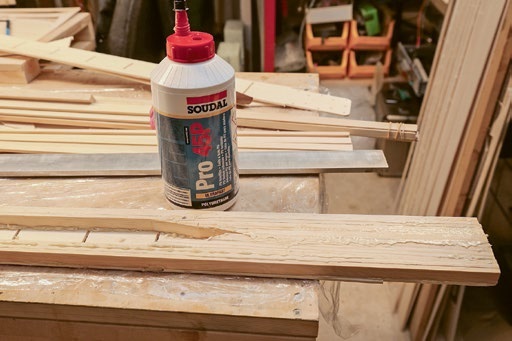
. The latter feature notches into which the ribs—divided in a ⅓ : ⅔ ratio—are subsequently inserted. First, glue the front section with 38 half-ribs and the auxiliary nose strip; then rotate the workpiece 180° on the beam jig and glue the rear sections. Let’s begin the planking work! In a personal conversation, Günther Schneider recommends using PU adhesive (Sudal) instead of white glue. According to him, PU adhesive offers better handling and greater strength. A good example is the wing planking: You secure the glue-coated balsa board with pins
Place it on the guide strip, wait 30 to 40 minutes, then moisten the small board and bend it around the curve of the rib while applying adhesive. The adhesive line, which is under tensile stress, holds without breaking; the dried glue is water-resistant. Disadvantage: The PU foam forms a bead-like ridge, but it can be easily sanded down or removed with a knife. To reinforce the pressure-
balsa planking of the hull, a 45-g glass mat is applied. Following Schneider’s recommendation, I do not use the usual resin mixture, but rather Contura, a water-based primer for wood-based materials. Advantage: Applying the mat and primer with a brush,
roller, and credit card is easier than working with resin. After 2 to 3 hours, a surface forms that is easy to sand. Disadvantage: Subsequent flight testing, including transport, shows that in terms of pressure sensitivity, this method is inferior to applying resin.
The wings and tail surfaces are covered with Oratex using an iron, and the fuselage is painted. Schneider supplies a single-leg CFRP retractable landing gear that he manufactured himself. During the first
| Scale: | 1:2.5 |
| Wingspan: | 572 cm |
| Length: | 266 cm |
| Wing area: | 201 qdm |
| Flight weight: | 15 kg |
| Wing loading: | 69.00 g/qdm |
| Center of gravity: | 134 mm behind the leading edge |
| Profile: | S2027 mod. |
| Electric motor: | Dualsky XM 6360EA-22, KV 190 |
| Lipo: | 12S |
| Propeller: | APC 20X10E |
| ESC: | Hobbywing Flyfun 130 A |
| Servos: | Spectrum A 6150 HV on ailerons and flaps ; elevator, rudder, and retractable landing gear: JX CLS 6336HV servo |
During landings, the linkage lever to the servo breaks; it is replaced with an aluminum part. The center of gravity should be set at 134 mm behind the nose strip. This is achieved by installing the motor, speed controller, and 12S LiPo battery, then adding 1.5 kg of lead.
Stowing the model in the station wagon—no matter how big it is—proves to be a nerve-wracking ordeal. Cursing, I vow never to build such a “monster” again. At the airfield, the assembly proves, as expected, to be difficult: the wings, which are floating inside the fuselage
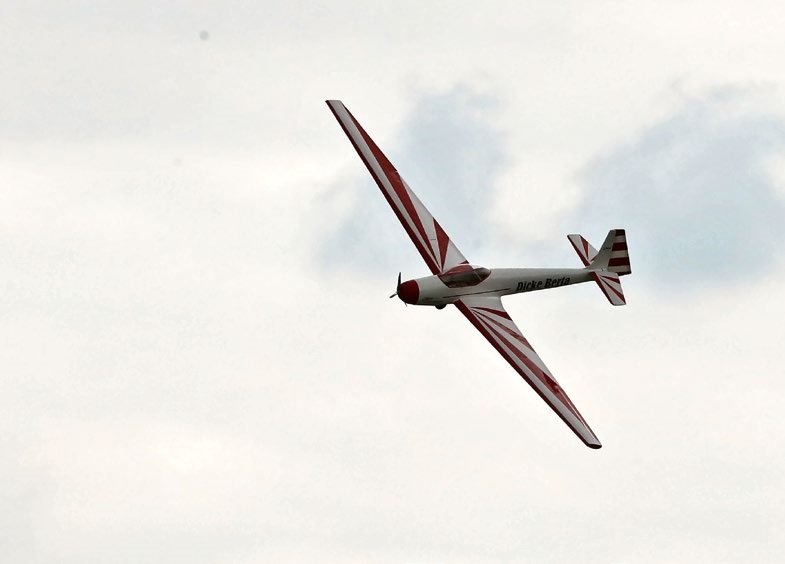
must be secured using two M6 screws, which are inserted into the holes in the wing tabs. Aligning the two screw holes on each wing requires the help of a fellow pilot, who must gently lift or lower one of the wings until the holes in both tabs line up so that the screws can be inserted. After takeoff, the aircraft accelerates with great power; there is no need to support the wings from the side, and after 30 m, Berta is “airborne.” Now a majestic flight scene unfolds. Leisurely in
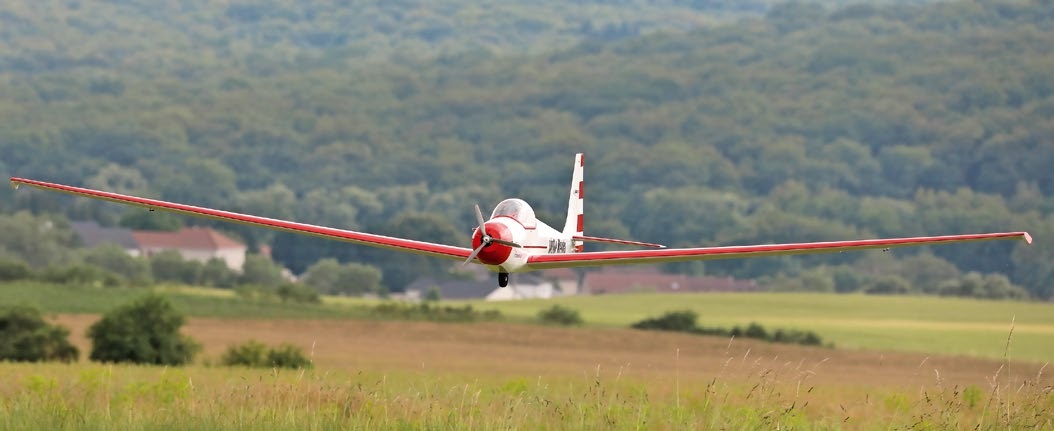
Circling like a bird, the ASK 14 traces its path across the sky. Control inputs are accepted with a certain nonchalance. It isn’t designed for aerobatics. Nearby, a few birds are circling in the thermals; drawn toward them, the plane climbs along briskly. Landings are a real treat; in a wide, shallow circle, the ASK approaches the edge of the field and touches down as soft as butter. The question remains: Will I build another model of this size? The answer: a decisive “yes and no”!
Conclusion: Schneider Modell/Kufstein delivers an old-school kit that will keep seasoned woodworking enthusiasts tied to their home workshops for the long haul. The end product is a good-natured little gem of an airplane with a 5.72-meter wingspan and an acceptable price-to-performance ratio.


News from HEBU

TEAM MANAGER "THIS" BOSSHARD
 Rodito Nussbaumer

YOU KNOW WHAT I MEAN? 125 YEARS OF THE SWISS AERO CLUB
 Emil Giezendanner

F3A EUROPEAN CHAMPIONSHIPS IN ST-MACAIRE, FRANCE
 Matthias Bosshard

HORIZON HOBBY/LEMACO NEWS: MICRO OV-10 BRONCO 645 MM BY E-FLITE

PRIDE AND GOOD IDEAS
 Markus Nussbaumer

34th HAHNENMOOS ALPINE MODEL AIRPLANE CAMP
Res Dauwalder
TRY-OUT DAY AT MFV WETTINGEN
Urs Keller
52. 2026 ALPS CUP
Emil Giezendanner
EURO CONTEST GLIDER ACRO TOUR AUSTRIA 2026

ATOM, THE NEW DOUBLE-DECKER FROM CPLR
Matthias Bosshard
CORSAIR F4U – A WARBIRD WITH A MEMORABLE LOOK
Jürgen Rosenberger, Jürgen Prinz
SUMMER FUN 2026 AT MG USTER
Martin Wunderli
What's New at Leomotion.com

THE PC-21 STORY
Emil Giezendanner
COUPE DES ALPES – OBSERVE AND LEARN
Rodito Nussbaumer
TWIN TOWN PARTNERSHIP
Wolfgang Voeller
BY YOUTH, FOR YOUTH
Lorena Betschen
SMALL, MODEL-LIKE SAILBOATS
Res Dauwalder
WELCOME, NEW MEMBER!
Andrea Bolliger
FREE FLIGHT IN THE MIDDLE OF SUMMER
Urs Muntwyler
INSIGHTS INTO THE HISTORY OF SEAPLANES

NEWS FROM HEBU
 Julia Bucher

FROM 0 TO 100
Markus Nussbaumer
MEMORIES
Wolfgang Völler
NOS REGION – A HUB FOR ELECTRIC AVIATION
Emil Giezendanner
DO YOU KNOW WHAT I MEAN IN THE LAND OF SMILES?
Emil Giezendanner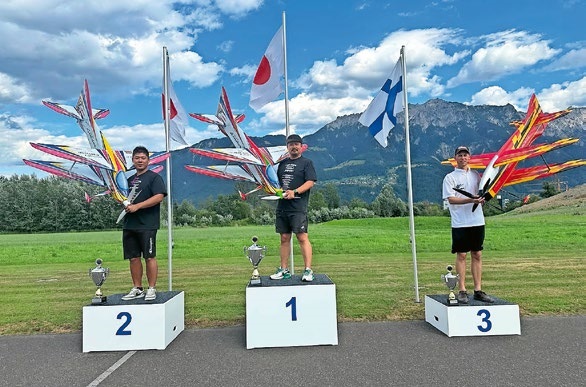
A SPECTACULAR F3A WORLD CUP IN THE PRINCIPALITY OF LIECHTENSTEIN
Emil Giezendanner