
F3A World Championships in Warwick, Australia
The world's best aerobatic pilots gathered in Australia to crown their world champion. Due to the long journey—and the significant costs involved—only 59 pilots from 19 countries participated. Fortunately, seven junior pilots were also on the starting line. Team USA won the team competition by a wide margin, ahead of France and Japan. Lassi Nurila (FIN) was crowned world champion, ahead of the Americans Andrew Jesky and Jason Shulman. Anthonin Paysant-Le Roux won the junior competition.
After a flight of about 20 hours, the Swiss F3A team—consisting of pilots Sandro Matti, Reto Schumacher, and Philipp Schürmann—arrived in Brisbane. Viktor Matti and Urs Bärtschiger served as experienced support staff, while Matthias Bosshard took on the role of team manager.
The shipping costs for the model crates are substantial. The Swiss pilots relied on multi-layered cardboard boxes to circumvent the strict import regulations for wooden crates (to prevent the spread of pests). For this reason, the pilots decided to bring only one model each.
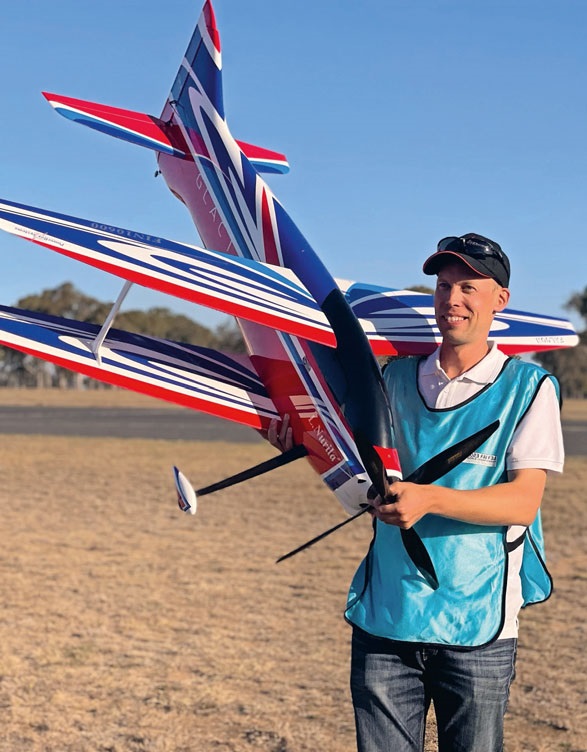
*Editor’s note: The term “assistant” is a gross oversimplification of the demands placed today on the person standing behind the pilot.
and to do without a backup model. F3A models and their technology are very reliable on the one hand, but on the other hand, damage—whether major or minor—can still occur. A member of the French team, for example, lost a model during practice. When the wind was too gusty, we therefore decided not to train in order to avoid taking unnecessary risks. Nevertheless, we had to bring several kilograms of tools and replacement parts with us.
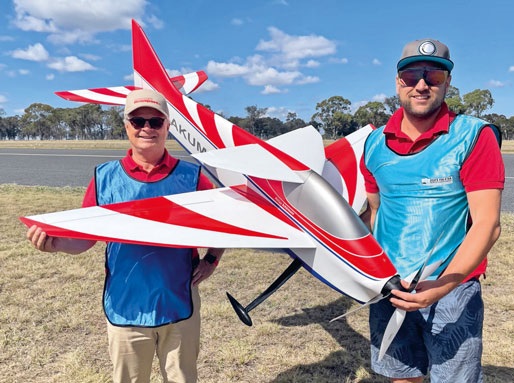
It takes about eight hours to adjust to the time difference and get used to the local wind and visibility conditions. Mid-August is the height of winter in Queensland, which means that morning temperatures are just above freezing, while during the day the sun warms things up to well over 20 °C. By 5:30 p.m., the sun has already set, and it gets dark very quickly.
The World Championship took place at a regional airfield with an asphalt runway, which was closed to other aircraft during the day. The flying conditions, along with the welcoming organization by the Australian F3A enthusiasts, created a very relaxed and
friendly atmosphere right from the start. All three Swiss pilots qualified for the semifinals featuring the top 30. Sandro Matti reached the final round of the top ten, while Reto Schumacher, finishing twelfth, narrowly missed the final. With finishes of 8th (Sandro), 12th (Reto), and 27th (Philipp), as well as 4th place in the team standings, the Swiss team can look back with pride on its performances over the past week.
In general, the models from all competitors were of a very high technical standard in terms of both build quality and the components used. Whether monoplane,
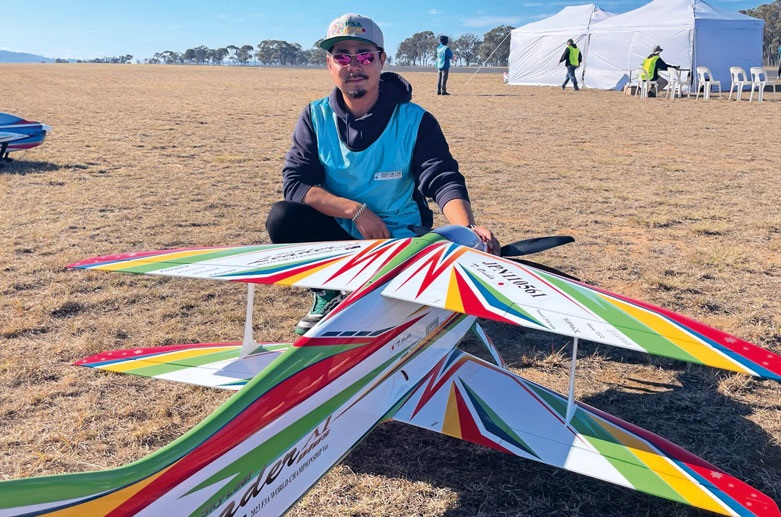
Before the World Championships officially began, we flew at a beautiful model airplane field in Toowoomba, just outside Brisbane, to—

Biplanes, electric or four-stroke propulsion, outrunner motors, or contra-propulsion systems—all model variants were used and proved their worth. It is very difficult to single out a favorite model design, as it depends on the flight programs flown. In any case, biplanes and contra-propulsions were numerically in the majority. Furthermore, the biplanes seemed to have the edge in the challenging final programs with many aerobatic maneuvers. The selection on the market is pleasingly large, and the range of options
works well. Direct-drive or contra-drive—expert opinions differ on this, and numerous pilots have tried both variants.
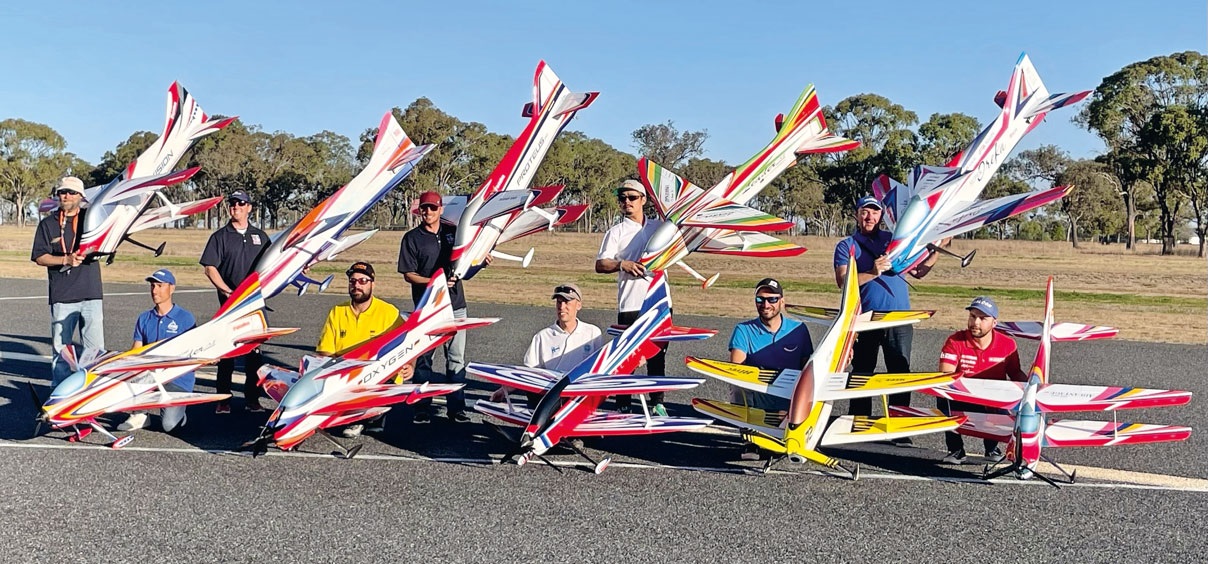
Eight biplanes, two monoplanes, one four-stroke YS engine, two Plettenberg direct-drive systems, and seven Contra-drive systems. Seven of the 10 models were produced by the Chinese manufacturer HuiYang.
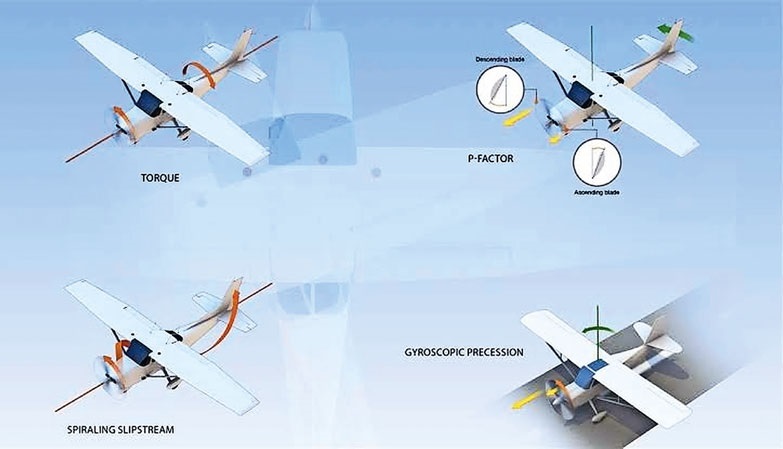
Why do F3A models with direct or gear-driven propulsion have a built-in side pull of about 3.5° to fly straight? Why is contra-propulsion supposed to be an advantage? There are mainly four forces acting on the propeller.
- Propeller torque: “For every force, there is an equal and opposite force.” (Newton) Since most aircraft propellers rotate clockwise (as viewed from the rear), they push the left wing down when throttle is applied. You can easily test this yourself by holding the model at hip height while a friend makes quick throttle movements. Those of you who “torque” your models know that when torquing, the aileron sometimes has to be held at full right deflection to prevent the model from spinning around its longitudinal axis.
- Slipstream effect: The propeller creates a rotating airflow around the fuselage. This slipstream causes asymmetry by striking one side of the vertical stabilizer, which results in a leftward rotation around the vertical axis. You’ll notice this most clearly with your models during takeoff. At very low speeds, the airflow over the fuselage and tail is still minimal. As soon as you apply throttle, the model veers to the left.
- Gyroscopic effect: Rotating gyroscopes react very slowly to changes in the direction of their axis of rotation. If the axis of rotation is nevertheless deflected with a certain force, the deflection occurs with a 90° phase shift. A propeller is a rapidly rotating gyroscope. For example, if you pull back on the elevator from level flight, this causes the model to veer to the left; pushing the elevator forward causes it to veer to the right. To counteract this, the lightest possible propellers are used to minimize gyroscopic forces.
- P-factor: Consider a two-blade propeller as an illustration: If the axis of rotation and the axis of flow align, both blades have the same angle of attack, alpha. However, if the aircraft is flying at an angle of attack (for example, during slow flight), the engine’s axis of rotation and the model’s direction of flight no longer align. As a result, the propeller blade moving downward has a greater angle of attack than the one moving upward. This, too, creates a force that tends to push the model to the left when the model has a large angle of attack.
Three of these four forces all act to the left—unfortunately, they do not cancel each other out. They depend on airspeed, propeller RPM (thrust), angle of attack, and the weight of the propeller blades. The 3.5° side pull achieved in F3A is always a compromise, typically achieved at half throttle during straight-line flight. As soon as the throttle is reduced or increased, the side pull is no longer exactly correct. Some pilots compensate for this using a throttle-rudder mixer. All other forces are controlled by an experienced pilot. The RPMs for direct-drive motors are around 6,000 rpm.
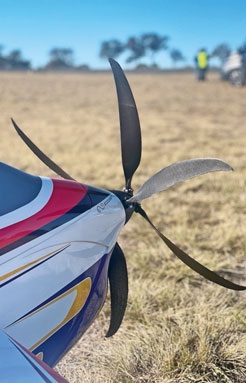
And this is where the idea of counter-rotating propellers comes into play, which
- cancel out the torque,
- neutralize the slipstream effect,
- generate two circular effects that cancel each other out,
- and although the P-factor occurs on each propeller blade, it cancels itself out.
Are you interested in trying your hand at drawing the most perfect lines in the sky? The Northeast Switzerland (NOS) region has been offering beginner courses and training sessions for several years. Beginners are mentored by experienced F3A pilots. The focus ranges from optimizing model programming—including sensible mixer settings and control travel—to progressive competition training. The competitions in the Sportflyers programs (dates listed in the MFS) are ideal for getting started in aerobatics.
M. Bosshard
Currently, various Contra systems are being used successfully. The first systems, introduced several years ago, used planetary gearboxes that had to be greased regularly and became relatively hot during flight. The propellers were not directly mechanically connected, which did not always produce the desired neutralizing effect. (Brenner, USA; CRS, Austria). The Contra propulsion systems used at the World Championships feature a reduction gearbox with two propeller shafts (one driven directly, the other via a toothed belt). The load on the gearbox—designed to be as lightweight as possible (up to 3 kW of power)—is enormous. Gears and timing belts must be replaced regularly. The motor is relatively small, which is why it must be well cooled. Drives from Adverrun, VLV, Dualsky, and Akiba are frequently
propulsion systems from Adverrun, VLV, Dualsky, and Akiba are used. The propellers rotate at a speed of approximately 4,000 rpm. (D3-Motors from Poland offers a drive system (TMCR21) that features two separate motors with two controllers. This design opens up a “huge playground for tinkerers,” who can adjust both throttle curves individually and thus directly influence the forces at work. A certain degree of safety redundancy is also achieved because the two motors with their two controllers operate independently of one another, though they draw power from a shared 10S LiPo battery. This drive system is likely very efficient because it generates no mechanical losses in a gearbox. However, it was not featured at the World Championships in Australia.)
In F3A, there is a strict weight limit of 5 kg takeoff weight, which poses a real challenge for manufacturers of powerful and finely adjustable powerplants. Incidentally, the weight limit in the F3A Sporting Code will be lifted for the 2024 season, which will likely lead to the use of larger batteries and reduce the need to save weight on the powerplants.
So much for the theory and the cold, hard facts. Experience over the past few years shows that in F3A, you can win or lose with any of the motor and propeller configurations described. Success undoubtedly lies in the perfect balance between flying style, model, and powerplant. Top pilots devote dozens, if not hundreds, of flights to breaking in and fine-tuning their models until they’re satisfied. Since they’re constantly flying with all control surfaces engaged anyway, any forces that arise are corrected as soon as they begin.
Whether the two counter-rotating propellers truly
is another question. The front propeller operates in a laminar, non-turbulent flow, whereas the rear propeller already encounters airflow with vortices and turbulence. I suspect that there are fluid dynamics experiments on this topic from the field of manned aviation.
The world's best aerobatic pilots fly the currently valid P23 and F23 routines (the routines are changed every two years) with near-perfect precision. So how can they stand out from the competition? The following tools are used in training:
Announcer
After several hundred training flights, the pilots know the program by heart; they don’t need a prompter. However, the assistant has a decisive influence on the placement of the figures within the F3A window. While the pilot, with hawk-like eyes,
at his model to detect and correct even the slightest deviation from the desired flight attitude, the assistant monitors compliance with the boundaries and ensures the maneuvers are centered. The segments before and after rolls must be exactly the same length, and the radii within each maneuver must be identical. The top ten pilots at a European or World Championship fly unknown programs that are compiled using a computer program from an Aresti maneuver catalog. These programs are highly complex, interspersed with dotted rolls, roll circles, and roll loops featuring numerous snaps (slotted rolls). Without well-coordinated teamwork between the pilot and the assistant, it is impossible to fly these programs correctly.
2. Use of geometric aids. During training, pilots use geo-triangles and figure gauges to perfect verticals, 45° angles, and the roundness of loops. This is always done in conjunction with
the perspective resulting from the judges’ positions.
3. GPS-based flight attitude detection. The use of “Flight-Coach” has further transformed the world of F3A and raised the bar for perfection. With the help of a small, lightweight box in the fuselage—equipped with GPS positioning and spatial orientation detection—the flight can be analyzed on a computer after the flight. Flight-Coach was developed and perfected by numerous F3A pilots collaborating internationally. Research is currently underway to determine whether Flight-Coach could also be used to evaluate flights. We can look forward to seeing the results of this research. In the future, will there be a kind of VAR (Video Assisted Referee) at model aircraft championships—in addition to international judges—that will incorporate the electronically recorded data into the results?


News from HEBU

TEAM MANAGER "THIS" BOSSHARD
 Rodito Nussbaumer

YOU KNOW WHAT I MEAN? 125 YEARS OF THE SWISS AERO CLUB
 Emil Giezendanner

HORIZON HOBBY/LEMACO NEWS: MICRO OV-10 BRONCO 645 MM BY E-FLITE

PRIDE AND GOOD IDEAS
 Markus Nussbaumer

34th HAHNENMOOS ALPINE MODEL AIRPLANE CAMP
Res Dauwalder
TRY-OUT DAY AT MFV WETTINGEN
Urs Keller
F3A EUROPEAN CHAMPIONSHIPS IN ST-MACAIRE, FRANCE
 Matthias Bosshard

52. 2026 ALPS CUP
Emil Giezendanner
ATOM, THE NEW DOUBLE-DECKER FROM CPLR
Matthias Bosshard
SUMMER FUN 2026 AT MG USTER
Martin Wunderli
What's New at Leomotion.com

COUPE DES ALPES – OBSERVE AND LEARN
Rodito Nussbaumer
TWIN TOWN PARTNERSHIP
Wolfgang Voeller
BY YOUTH, FOR YOUTH
Lorena Betschen
CORSAIR F4U – A WARBIRD WITH A MEMORABLE LOOK
Jürgen Rosenberger, Jürgen Prinz
SMALL, MODEL-LIKE SAILBOATS
Res Dauwalder
WELCOME, NEW MEMBER!
Andrea Bolliger
FREE FLIGHT IN THE MIDDLE OF SUMMER
Urs Muntwyler
EURO CONTEST GLIDER ACRO TOUR AUSTRIA 2026

INSIGHTS INTO THE HISTORY OF SEAPLANES

THE PC-21 STORY
Emil Giezendanner
NEWS FROM HEBU
 Julia Bucher

FROM 0 TO 100
Markus Nussbaumer
MEMORIES
Wolfgang Völler
NOS REGION – A HUB FOR ELECTRIC AVIATION
Emil Giezendanner
DO YOU KNOW WHAT I MEAN IN THE LAND OF SMILES?
Emil Giezendanner
A SPECTACULAR F3A WORLD CUP IN THE PRINCIPALITY OF LIECHTENSTEIN
Emil Giezendanner