
Frequency Monitoring at Model Airfield Sites
An idea that could become an international standard.
Ever since remote control transmitters have been available for model aircraft, one thing has remained unchanged: even the very best remote control system can be disrupted at any time by external factors. It will therefore remain of fundamental importance in the future to ensure that all necessary measures are in place to guarantee interference-free operation. Frequency and channel monitoring is therefore a must at every model flying field.
When I started building model airplanes more than 30 years ago, frequency and channel control still consisted of clothespins with more or less elaborate labels attached to them. In the meantime, magnetic boards came into use. Both systems work on the same principle; I refer to both the clothespin and the magnetic board as the “pick-up” principle.
The “pick-up” principle has one major advantage: the system is already in place; the pilot simply has to operate it.
However, there are also disadvantages, which are:
- A complete system of this kind must be available at every site. If a club operates more than one site, multiple complete systems must also be available.
- The systems are generally not weatherproof, meaning they must be stored or protected after use.
- The clips are often forgotten or lost and must then be replaced. This is actually the biggest weakness of this “pick-up” principle.
- Neither the clip system nor the magnet system allows you to identify which person occupied the lane; it is an anonymous system.
Before synthesizers came into use, it was customary for every pilot to mount a pennant displaying the color of their frequency band and the channel number in a visible location on the transmitter. With the ability to quickly change channels, the use of this pennant has been called into question.
When we ask ourselves what optimal channel control should look like, both old and new answers emerge:
- The model-making industries—and thus the major manufacturers—should be able to agree on a common, international standard. Similar to the situation with videotapes, there are several standards for frequency control despite many similarities.
- Every channel control system must provide a clear overview of the channels in use.
- The control system should be intuitive to use and function without a user manual; even beginners should be able to understand and use the system right away.
- The system should be location-independent, meaning duplication should be kept to a minimum. This results in a separation: channel keys with the pilot, control strips at the model airfields.
- It should be a “bring-your-own” system, meaning pilots bring their channel keys and can even forget them without causing any trouble for the field attendant.
- The system should be simple and inexpensive to manufacture.
- It should be possible to manufacture it from commercially available materials or semi-finished materials (commercial off-the-shelf, COTS).
- It should be simple to build and also resistant to vandalism.
- The control panel should display only those channels that are actually permitted at the field (or in that country).
- Every system should be weatherproof, meaning it should be able to withstand a full season outdoors without sustaining damage.
- If channel codes are forgotten, that should be the pilot’s concern, not the airfield manager’s.
In short, a very long list of requirements that must all be reconciled.
Here at the Schwyz Model Flying Club, we’ve had a solution to the requirements mentioned earlier for several years now. We operate more than one flying field and, most recently, an indoor facility as well. Since the introduction of synthesizer technology, the system has had to be simplified.
Materials can only be saved where they are unnecessarily duplicated. This is the case with the clamps and magnets. However, we use neither of these; instead, we work with what is known as a “channel key.” In the winter, we fly indoors in the hall; in the summer, we fly outdoors—gliding on several slopes and also flying powered aircraft on the plains. We didn’t want to set up an entire system at every location.
So we split the system. The channel keys belong to the
Pilots, the control panels are at every station.
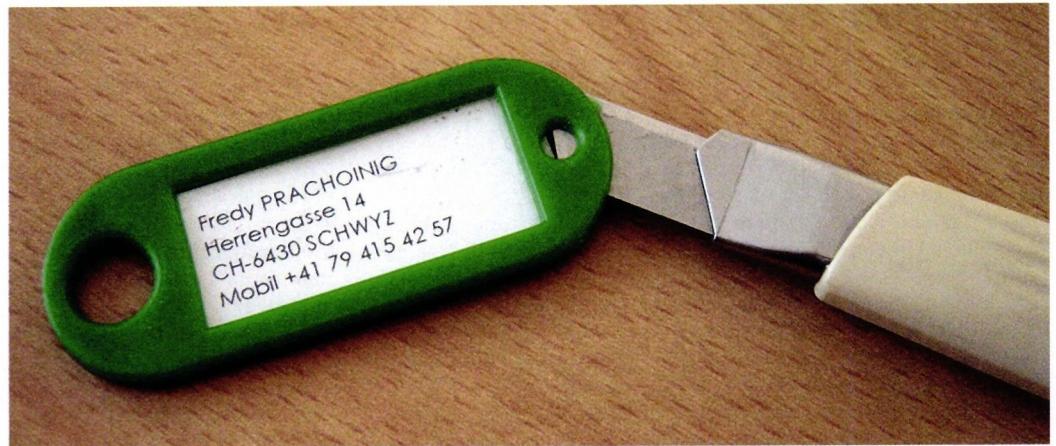
I refer to our channel control as the “bring-your-own” principle. Each pilot has a colored channel key for each frequency band. Green is the key for the 40-MHz band, and orange is the key for the 35-MHz band. Since the introduction of synthesizers, the keys no longer have the channel number printed on them. Instead, each key fob bears the pilot’s name.
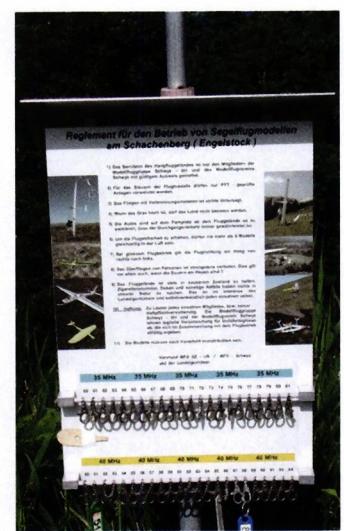
At each spot, there are two rails with carabiners. Each carabiner has a colored number that corresponds to a specific channel number.
When a pilot arrives at the spot, the first thing they do is hang their channel key on an available carabiner hook.
If the carabiner hook is already occupied, you can see the colleague’s name. This allows for a friendly conversation to begin. This means you no longer have to call out loudly, “Who has channel 51?” but can go directly to the colleague because you know their name. Or you can find the colleague more quickly by their name.
The principle is always the same: you may only operate the transmitter if your own channel key is hanging on the channel control bar. It is prohibited to have two channel keys on
to make the same mistake; with the indoor control panel, this is technically impossible.
This probably sounds like an exaggeration. But unfortunately, it’s not that far-fetched—a beginner needs to have this vital control explained to them slowly and unambiguously. Nothing can be taken for granted by a beginner. In my career so far, three models have been brought down from the sky because of a mistake like this.
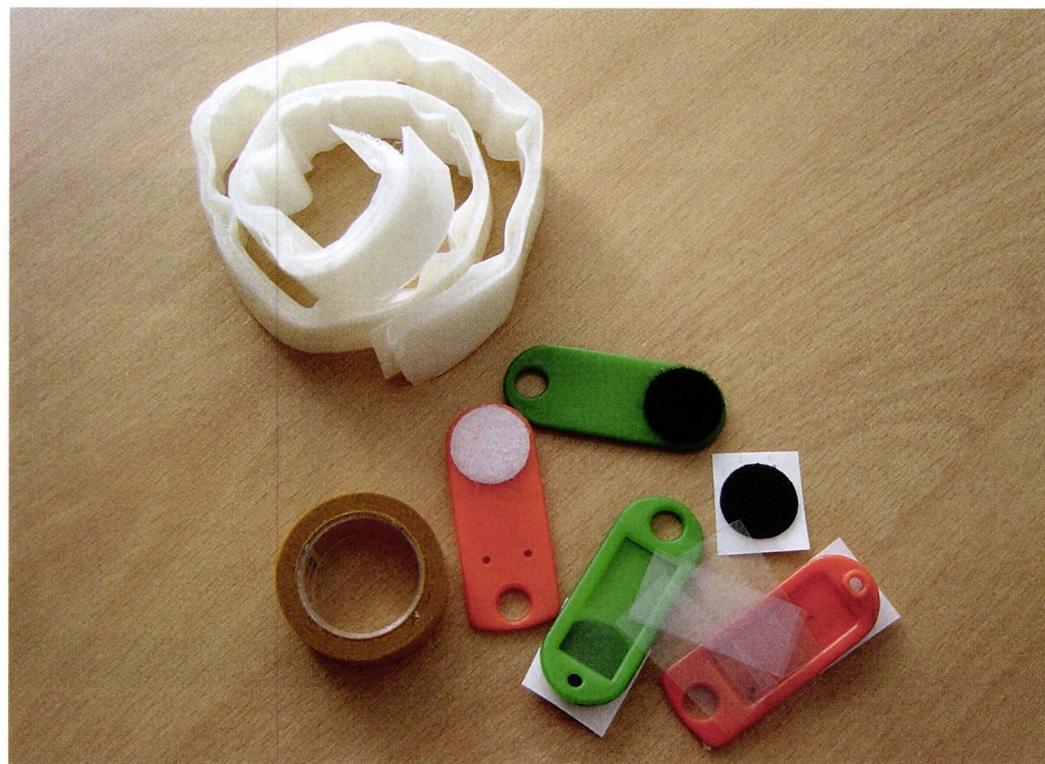
You use off-the-shelf components—or, as they’re called these days, COTS (commercial off-the-shelf)! Pick up a pack of keychains in the right color at the hardware store: green for the 40-MHz band, orange for the 35-MHz band. You’ll also need some self-adhesive Velcro dots so the channel keys can be attached to the transmitter. All the parts are very inexpensive to buy.
On the computer, print out an address label for each club member in a size that fits the key chain. The key hook can be removed since it’s not needed. The address label must be attached to the plastic part along with the plastic tag using double-sided tape. Finally, attach a Velcro dot to the channel key—specifically, the loop side of the tape on the key. Attach the counterpart to the Velcro dot somewhere on the transmitter—logically, the hook side—and the key will always stay attached.
On the course, a weatherproof system is required. This consists of a rod made of spring steel wire, on which the carabiners are positioned using spacer rings. The rod is secured in place by two brackets. The entire assembly is mounted on an aluminum plate, and the channel labels are visible in the background. The plate is approximately 35 cm wide and 20 cm high. These control bars remain on the course throughout the season. The entire plate is taken home only during the winter.
| Channel Channel Number | Each frequency is assigned a specific channel number. Each channel number is unique and therefore cannot be confused with any other. |
|---|---|
| Frequency band | A standardized sequence of specific frequencies, or channels, referred to collectively as a frequency band. The individual frequencies are typically separated by the minimum required frequency spacing, e.g., 10 kHz spacing. |
| Channel Key | A key fob in a color matching the frequency band, which belongs to the pilot. The pilot’s name is marked on the channel key. |
| On-Site System | A complete, comprehensive system on site that is made available to pilots. |
| Bring-Your-Own Principle (new standard?) | A separate system that helps conserve materials. The channel keys remain with the pilot. The control panel is located at the airfield. The “bring” principle provides greater clarity because the pilots’ names are visible on the channel keys. If standardized, the “bring” principle would function without any problems at all model airfields (both national and international). |
As an alternative, you can also attach a strip of Velcro to the sheet metal instead of using snap hooks. This is primarily an option for indoor use. The channel wrenches are then pressed onto the Velcro strip, and they stay in place immediately.
Dreamers come up with the ideas; doers make the dreams a reality. Wouldn’t it be great if this simple system—which has more advantages than disadvantages compared to any other control system—were adopted as an international standard? The model-making industry would have to take the decisive step. It would first have to define the standard as such and then offer the system at an affordable price, either as a kit or as a complete system. I see a major gap in the market here and an opportunity to combine sponsorship with safety.
The channel key would be included with every transmitter upon delivery, and every pilot would automatically be in possession of a channel key.
In the future, model airplane pilots will be able to use their channel keys at any field equipped with the standardized channel control system. The same key—the one you use at your club—can also be used at external hang gliding fields, in indoor flying halls, and at any other external location where channel control is essential.
And how did this story begin again? Even the very best remote control can be disrupted at any time by external factors. In my view, a standard for controlling channel allocation at model airfields—one that works across all airfields and clubs—has been long overdue for decades!
P.S. I’m happy to share this idea without copyright restrictions. The main thing is that it helps prevent accidents and makes life easier for model aircraft pilots at every flying field.
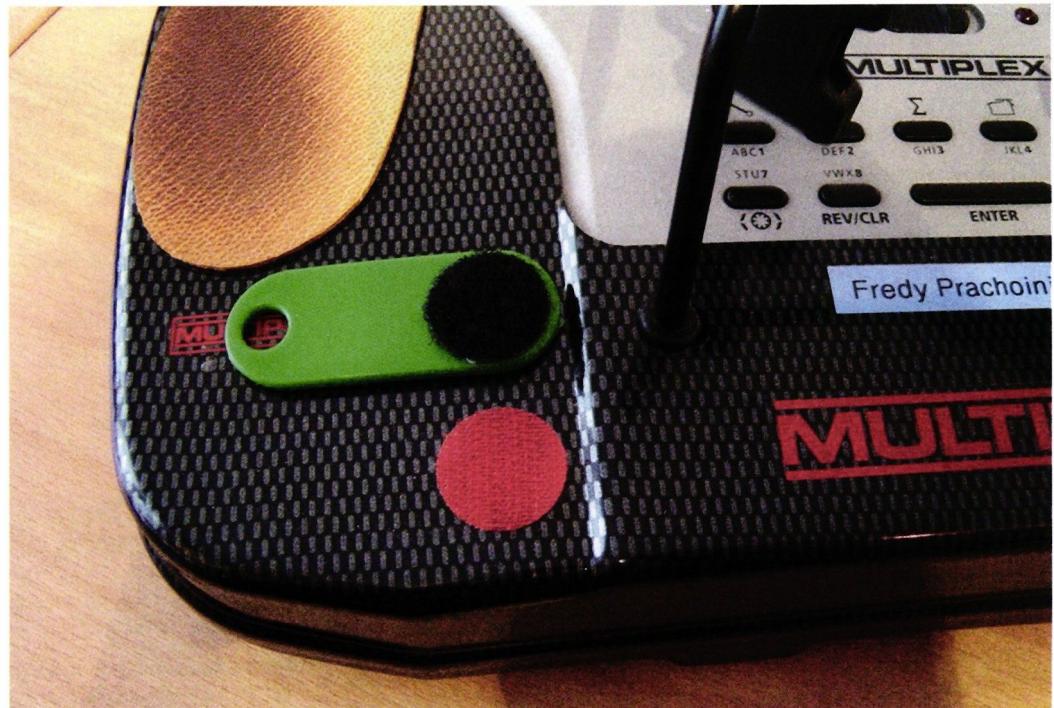
We use these panels for indoor frequency control. The channel keys are attached to the panels with Velcro.

EURO CONTEST GLIDER ACRO TOUR AUSTRIA 2026

THE PC-21 STORY
 Emil Giezendanner

TWIN TOWN PARTNERSHIP
 Wolfgang Voeller

SUMMER FUN 2026 AT MG USTER
Martin Wunderli
CORSAIR F4U – A WARBIRD WITH A MEMORABLE LOOK
Jürgen Rosenberger, Jürgen Prinz
52. 2026 ALPS CUP
Emil Giezendanner
YOU KNOW WHAT I MEAN? 125 YEARS OF THE SWISS AERO CLUB
Emil Giezendanner
News from HEBU

TEAM MANAGER "THIS" BOSSHARD
Rodito Nussbaumer
ATOM, THE NEW DOUBLE-DECKER FROM CPLR
 Matthias Bosshard

F3A EUROPEAN CHAMPIONSHIPS IN ST-MACAIRE, FRANCE
Matthias Bosshard
INSIGHTS INTO THE HISTORY OF SEAPLANES

WELCOME, NEW MEMBER!
Andrea Bolliger
What's New at Leomotion.com

PRIDE AND GOOD IDEAS
 Markus Nussbaumer

SMALL, MODEL-LIKE SAILBOATS
Res Dauwalder
FREE FLIGHT IN THE MIDDLE OF SUMMER
Urs Muntwyler
BY YOUTH, FOR YOUTH
Lorena Betschen
HORIZON HOBBY/LEMACO NEWS: MICRO OV-10 BRONCO 645 MM BY E-FLITE

34th HAHNENMOOS ALPINE MODEL AIRPLANE CAMP
Res Dauwalder
COUPE DES ALPES – OBSERVE AND LEARN
Rodito Nussbaumer
TRY-OUT DAY AT MFV WETTINGEN
 Urs Keller

NEWS FROM HEBU
 Julia Bucher

NOS REGION – A HUB FOR ELECTRIC AVIATION
Emil Giezendanner
MEMORIES
 Wolfgang Völler

70 YEARS OF THE NIDWALDEN MODEL AIRPLANE CLUB
Martin Barmettler
A SPECTACULAR F3A WORLD CUP IN THE PRINCIPALITY OF LIECHTENSTEIN
Emil Giezendanner
FROM 0 TO 100
Markus Nussbaumer