
Lo 100 – an aerobatic glider with a rich history
The history of this aerobatic glider has been marked by widespread acclaim throughout Europe for several decades now. Despite several attempts by leading manufacturers to develop a new design with equivalent performance, all pilots have returned to the Lo 100. Just take a look at the standings from the World Aerobatic Championships over the past few years!
Following several design successes in the model aircraft sector, Hager-Modellbau has now also turned its attention to this model. Almost all of the Lo’s model designs almost always exhibited the same shortcomings; glide angle and weight were the main flaws. But now I’ve seen that it’s possible to bring this machine—which I consider to be very elegantly designed—to an unprecedented level of performance in scale model construction.
The 1:3 scale, which at first glance makes it appear to be a veritable monster, is deceptive. It’s worth noting that the flaps and aileron servos are built into the wings, so an extension cable is needed for this control system. Regarding flight testing, it’s important to strictly adhere to the specified center of gravity, as a tail-heavy configuration in particular can lead to major difficulties. Otherwise, this model can be described as particularly good-natured—a real “Riesenamigo.” The fuselage, with its great height, provides extreme directional stability, yet this does not affect its maneuverability during aerobatics. You can fly any aerobatic maneuver that’s possible, provided the speed matches the model’s capabilities. This large glider is very well suited for slope soaring—it’s simply a model with a wealth of possibilities. Take-off—
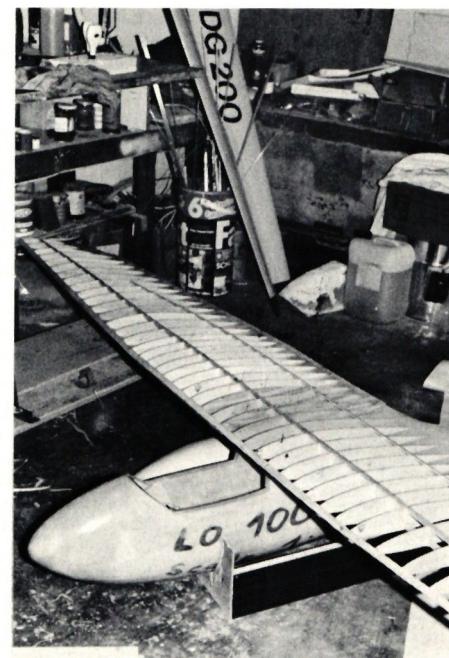
This model is sure to turn heads wherever it goes. Since I’ve been able to follow the development of this Lo 100 and have heard the opinions of both skeptics and colleagues, I believe that all of them will give it a positive review once they’ve seen it in flight.
As for the technical specifications, some model builders will likely exclaim in alarm: “It’s way too big.” The 1:3 scale results in a wingspan of 3.33 m with a chord depth of 43.5 cm, a total length of 2.07 m, and an ideal takeoff weight of 8 kg. The ribs can be made from 2.5 mm poplar plywood or another type of wood in the same weight class (it doesn’t always have to be balsa). For the skin, you can use 2-mm Apache peel veneer or hard balsa. Otherwise, there’s nothing special to report about the construction, except that one servo is definitely sufficient for both ailerons and flaps. One point deserves to be emphasized once more: An aerobatic glider always remains what it was designed to be. Everyone can customize the cockpit layout according to their own ideas.
P.S. Wing plan for the Lo 150 is in the works.
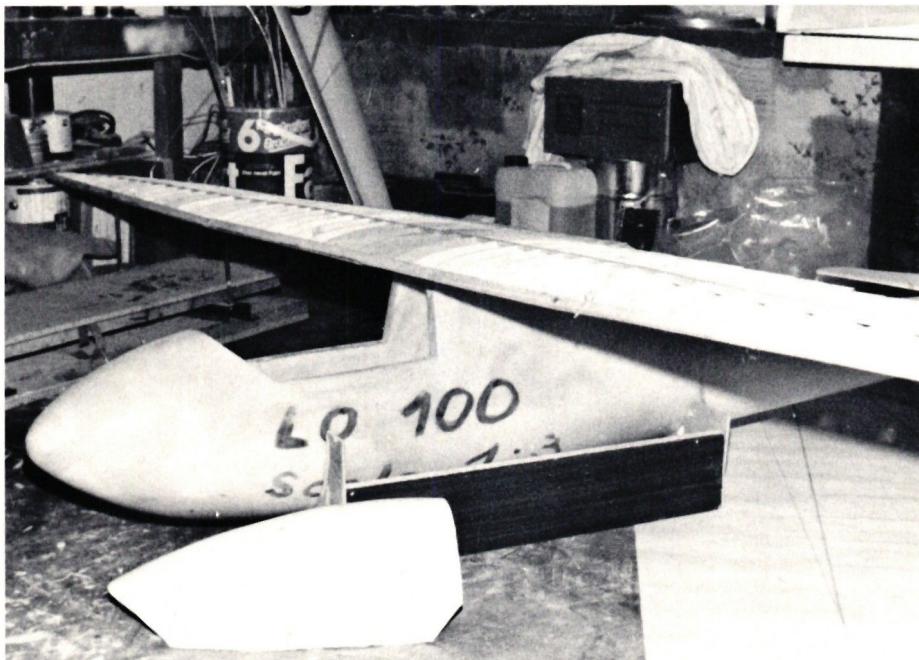
The Lo 100 from Hager is a real treat for enthusiasts of scale models of vintage gliders. The wing features a “standard” rib construction—it’s nice to see that again!
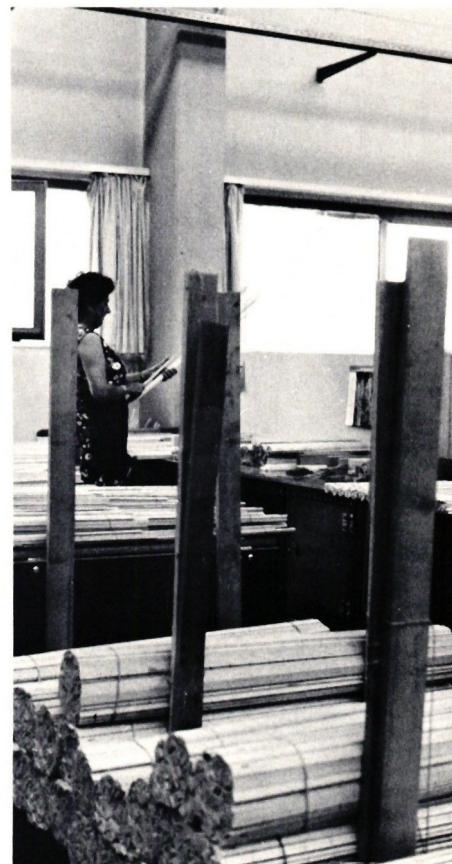
Below: Here, the balsa spars, strips, and small boards are assembled into complete model kits.


News from HEBU

HORIZON HOBBY/LEMACO NEWS: MICRO OV-10 BRONCO 645 MM BY E-FLITE

PRIDE AND GOOD IDEAS
 Markus Nussbaumer

TEAM MANAGER "THIS" BOSSHARD
 Rodito Nussbaumer

YOU KNOW WHAT I MEAN? 125 YEARS OF THE SWISS AERO CLUB
 Emil Giezendanner

F3A EUROPEAN CHAMPIONSHIPS IN ST-MACAIRE, FRANCE
 Matthias Bosshard

ATOM, THE NEW DOUBLE-DECKER FROM CPLR
Matthias Bosshard
SUMMER FUN 2026 AT MG USTER
Martin Wunderli
What's New at Leomotion.com

52. 2026 ALPS CUP
Emil Giezendanner
TWIN TOWN PARTNERSHIP
Wolfgang Voeller
CORSAIR F4U – A WARBIRD WITH A MEMORABLE LOOK
Jürgen Rosenberger, Jürgen Prinz
SMALL, MODEL-LIKE SAILBOATS
Res Dauwalder
TRY-OUT DAY AT MFV WETTINGEN
Urs Keller
WELCOME, NEW MEMBER!
Andrea Bolliger
COUPE DES ALPES – OBSERVE AND LEARN
Rodito Nussbaumer
EURO CONTEST GLIDER ACRO TOUR AUSTRIA 2026

BY YOUTH, FOR YOUTH
Lorena Betschen
INSIGHTS INTO THE HISTORY OF SEAPLANES

34th HAHNENMOOS ALPINE MODEL AIRPLANE CAMP
Res Dauwalder
THE PC-21 STORY
Emil Giezendanner
FREE FLIGHT IN THE MIDDLE OF SUMMER
Urs Muntwyler
NEWS FROM HEBU
 Julia Bucher

FROM 0 TO 100
Markus Nussbaumer
MEMORIES
Wolfgang Völler
NOS REGION – A HUB FOR ELECTRIC AVIATION
Emil Giezendanner
DO YOU KNOW WHAT I MEAN IN THE LAND OF SMILES?
Emil Giezendanner
Have you almost forgotten about aircraft that take off and land vertically?
Emil Giezendanner