
A South African from the platinum mine
The AgustaWestland AW139 is a helicopter manufactured by Agusta-Westland in Italy and, since November 2012, also in Russia. Using a fuselage kit from Vario Helicopter, Gery Bieri from Rupperswil in the canton of Aargau built a semi-scale model with turbine propulsion. The model uses Jakadofsky PRO 5000 turbines in a Python mechanism. He chose as his model the AW139 operated by the South African company Rustenburg Platinum Mines, which is in service there under the registration ZS-RPM.
The AgustaWestland AW139 is a twin-engine medium helicopter with 15 seats. It was initially developed in the 1990s as a joint project between the Italian manufacturer Agusta and the U.S. manufacturer Bell Helicopter under the designation AB139. After Bell withdrew from the project, Agusta continued it independently under the name Agusta-Westland AW139 following its merger with the British company Westland. The maiden flight of the AW139 prototype took place on February 3, 2001, in Vergiate, northern Italy; the first production helicopter flew on June 24, 2004, and the first unit was delivered one year later. By the end of 2008, over 430 orders had been received from more than 40 countries. An de-icing system has been available as an option since May 2010.
Rustenburg Platinum Mines Limited owns and operates platinum mines in South Africa. It crushes, refines, and smelts platinum. The company was founded in 1931 and is headquartered in Johannesburg, South Africa. Rustenburg Platinum Mines Limited is a subsidiary of Anglo American Platinum Limited. The fleet operated in South Africa includes several AgustaWestland AW139 helicopters. These helicopters are used to transport
employees and visitors between the mines, as well as for medical evacuations.
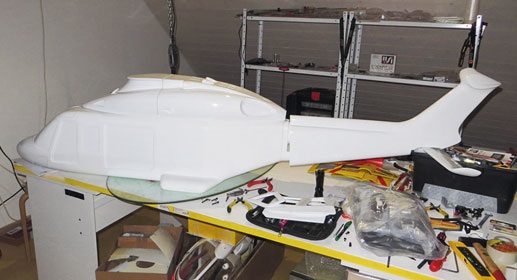
The model was built from a kit by Vario Helicopter. However, Gery Bieri knew from the start that certain internal components—and even the majority of the parts to be used—would have to come from other manufacturers because they better matched his vision.
One significant modification was that the three-liter fuel tank was to be positioned directly beneath the turbine at the center of gravity. To achieve this, the frame set had to be modified and expanded with new, custom-made parts. As a result of this change, the mechanical assembly, including the turbine, now sits on a platform with the fuel tank positioned beneath it. With this solution, the center of gravity remains constant during flight as the fuel level decreases.
This modification also allowed for the rotor shaft’s 4.7° forward camber to be accounted for. The goal was not only to get as close as possible to the original with this implementation but also to improve the flight characteristics and handling.
You’ll find out toward the end of this report whether that was actually the case.
Another weak point for Gery was the landing gear included with the kit. For one thing, the retractable—
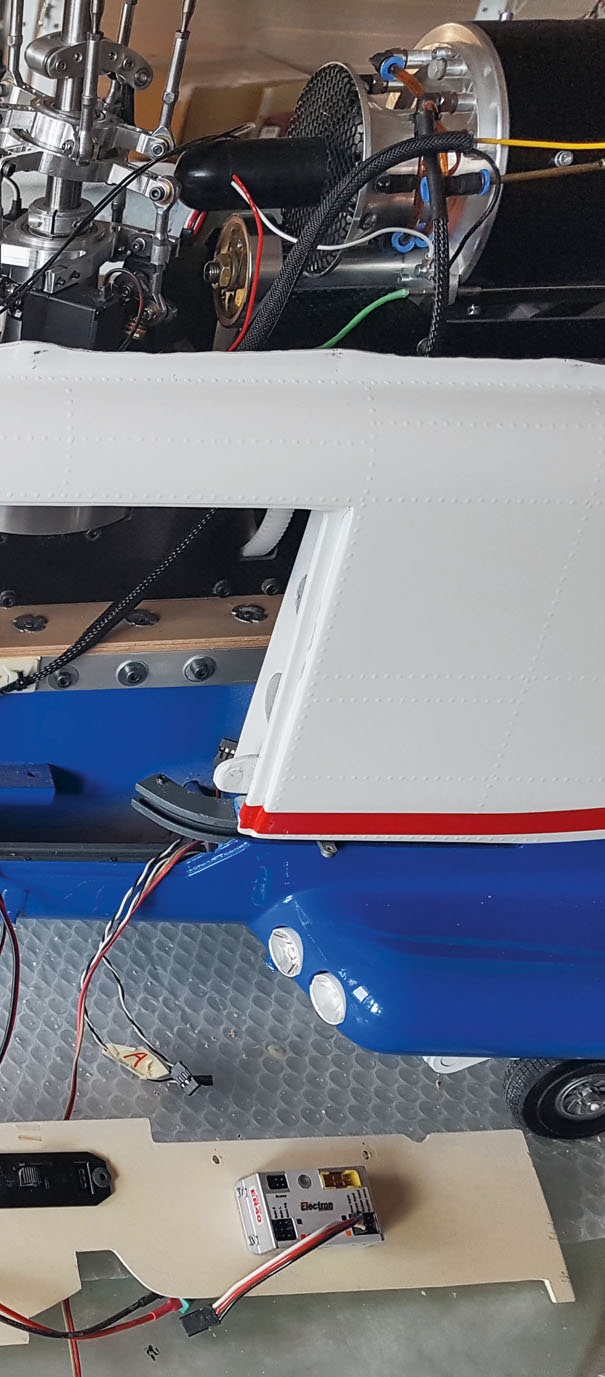
On the one hand, the main landing gear mechanism—which is operated by a central servo—is very complex; on the other hand, it also adds a significant amount of weight. The nose landing gear is also controlled by a servo. By chance, while working on a colleague’s Puma project, he noticed that the colleague was using an electric landing gear system. After some thought and weighing the pros and cons, he ordered the corresponding electric jet landing gear. These electric landing gear units are from electron-retracts.com; the exact model is the ER-40eVo. The three landing gear units are powered by a 2S LiPo battery with a capacity of 6200 mAh.
Installation was carried out without any problems by simply screwing them onto the existing mounting points. By eliminating the two servos and the complex retraction mechanism, over 500 grams were saved here alone.
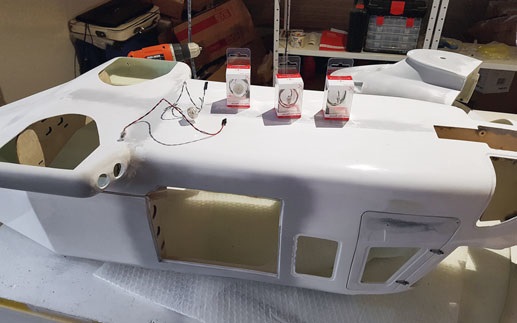
Unfortunately, the two side sliding doors on this model are held in place by only four magnets. However, it was clear to Gery Bieri from the very beginning that this had to be done with a door that actually worked. He soon realized that, thanks to the Internet, this is no longer a problem. He was thus able to find the appropriate models from countless suppliers with their—
| AW 139 | Prototype | Model |
| Crew | 2 (crew) + 15 passengers | – |
| Overall Length | 16.65 m | 2.82 m |
| Hull length | 13.52 m | 1.97 m |
| Rotor diameter | 13.80 m | 2.06 m |
| Fuselage width | 3.50 m | 0.45 m |
| Height | 4.94 m | 0.56 |
| Curb weight | 4,819 kg | – |
| Maximum payload | 2,778 kg | – |
| Max. takeoff weight | 6,400 kg/6,800 kg | 24.8 kg |
| Engine | 2 × Pratt & Whitney Canada | PT6C-67C Jakadofsky PRO 5000 |
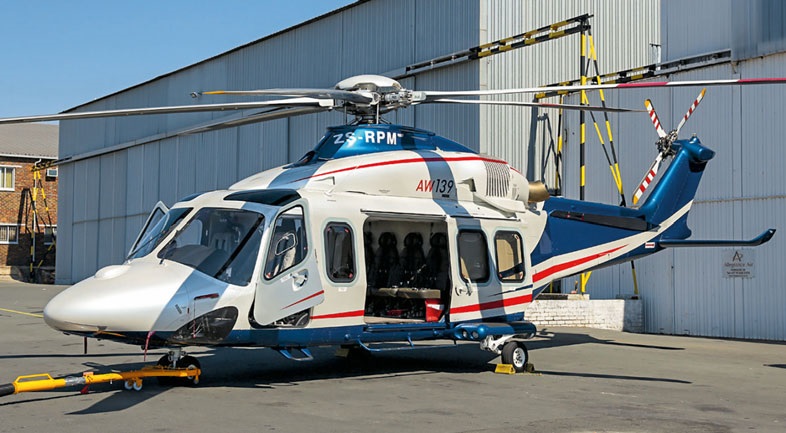
He searched for sliding doors and studied their mechanisms. The mechanism of the 2.5-meter Super Puma from Helikopter Baumann came closest
to meeting his needs and requirements. With minor modifications, it could be easily installed along with the doors so that the doors functioned as sliding doors. In newer helicopter models such as the AW139,
usually the biggest challenge for model builders when creating replicas. Many design elements optimized for the tail rotor’s noise level and efficiency are incorporated into today’s models.
The AW139 is no exception. The upward-facing four-blade tail rotor is particularly striking. It was precisely this detail that Gery was determined to—and had to—incorporate.
However, to make this design work, the tail rotor had to be driven via an 8-mm flexible shaft running inside a Teflon tube. The opening in the vertical stabilizer and the connection point of the flexible shaft to the tail rotor thus allowed for a 13° angled installation. Not quite the same as the original by a few degrees, but still quite close.
installed at an angle greater than 90° to the main rotor, as specified for this model. The tail servo, a Futaba BLS 452, is mounted directly beneath the tail rotor. This allows for direct control of the tail rotor.
The swashplate servos are absolute mechanical masterpieces. Four GDW BLS-992 HV servos were installed as swashplate servos, and a Futaba BLS 452 was mounted for the tail. A bavarianDEMON-AXON provides attitude stabilization.
From the very beginning, it was clear to Gery that his AW139 would be powered by a Jakadofsky PRO 5000. After an extensive search, he came across Alterbaum’s Python turbine mechanism. After inquiring about dimensions and installation options via swiss-scale-helikopter.ch, it was essentially a given that this powerplant was the one he needed.
Just three weeks later, the mechanism—with the turbine already attached—was sitting on the workbench in front of the model. Not only the mechanism, but also the swashplate included in the package
With this mechanism and installation, the exhaust pipe also runs straight out of the fuselage in a very short path and does not need to be insulated. This also prevents the fuselage from being excessively heated by a long exhaust pipe. The pipe was constructed using individual segments of Zimmermann silencers and fully welded by Jettech. The 5-blade rotor head was selected from the new series by SK-Rotorkopf.de, as was the 4-blade tail rotor. These components are designed for models with rotor diameters ranging from 2.0 to 2.6 meters. The matching blades for the front and rear are aluminum blades from M-Blades.
To complete the assembly, the appropriate lighting from Innoflyer was installed. Modern, bright light sources and innovative electronics for all settings of the lighting and strobe sequences are what set this manufacturer apart.
After attaching the scale parts—which are actually quite straightforward—the model underwent its first static test run. This went off without a hitch, and there were no issues with vibration or overheating. However, without flying the model, Gery disassembled it again so that preparations for the painting work could be made.
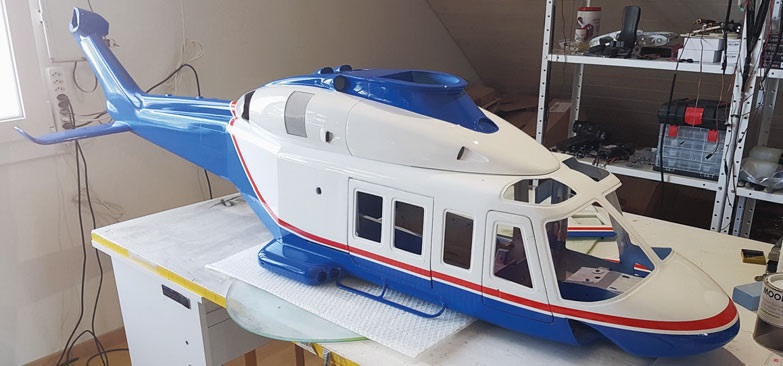
The subsequent painting work was carried out by Heli-Kopter Baumann. Unfortunately, it took a while for the model to be returned, but the result more than made up for the delay.
Back on the workbench in all its colorful glory, work could begin on the final assembly of the model. Thanks to the thorough preparations during the shell-building phase, this was completed in just one day.
However, when Gery Bieri first checked the center of gravity, he was in for a rude awakening. The model was so tail-heavy that he first tried to correct it by repositioning the batteries. But in the end, he still had to add over two kilograms of lead to the nose.
After programming the electronic components and the turbine, the first ground runs were conducted at the airfield. Minimal vibrations at the nose were noticeable, but Gery didn’t want to miss out on that first flight. The model was very stable in the air right from the start. Despite minor concerns about the tail rotor, which is mounted at an angle, and even though there was no prior experience with other models, the tail was also very stable and the control response was very precise and direct. “A complete success in every respect”—that’s how Gery titled a Facebook post about his AW139 after a few flights.
But then there were still the vibrations at the rotor head. Several possible causes were investigated but were subsequently ruled out by the model’s builder
. In the end, the only remaining possibility was the rotor head. Although the manufacturer, SK-Rotorkopf.de, advertises on its website that it uses only high-quality materials, After completely disassembling the head, however, it turned out that the bearings installed were not high-quality German ones, but rather no-name bearings. Additionally, screws of varying lengths had been used during the assembly of the head. In addition, one bearing had been installed at a slight angle, causing it to almost seize up. As a trained and meticulous machine mechanic, Gery replaced all bearings and screws with brand-name, high-quality parts. Meticulously balancing the components before reassembly was expected to lead to success.
After these “repairs” to the head, the vibrations were gone. After about six hours of flight time, the model was nearly lost due to an uncontrollable tail, which was prevented only by the pilot’s experience. A jammed blade holder on the tail rotor was the cause. Here, too,
, after completely disassembling the tail rotor, similar issues were identified as those found in the rotor head.
“It is irresponsible for a manufacturer to supply such products, which the consumer only assembles on the model under the assumption that precise assembly and balancing will be performed. In many cases, however, model builders are also overwhelmed when it comes to correctly interpreting these signs on a model and taking appropriate action. One dare not even imagine the consequences of what could happen,” said Gery Bieri regarding these incidents.
The issues with the rotor head and tail rotor kept the builder up at night. He could no longer fly the model with confidence. The tail rotor’s control response also left much to be desired. Even with just a little wind, relaxed flying was out of the question. The Phyton mechanism has a gear ratio of 1:4, which is a bit too low at 940 RPM for the main rotor.
Swiss-scale-helikopter.ch offers a speed-up gearbox that can be used to increase the RPM. This allowed the tail rotor speed to be increased from just under 4,000 to approximately 5,500 RPM. As part of the same modification, the rigid drive shaft was replaced with a 6-mm flexible shaft. The rotor head and tail rotor were also replaced with products from Helifactory. Gery also had trouble adjusting the bavarianDEMON-AXON. It wasn’t the programming, but rather the rapid control response during flight that prompted a switch to the bavarianDEMON-3X. Since these issues were resolved, the AW139 has been flying to the builder’s complete satisfaction. “It’s a joy to fly this model—a unique and highly visible silhouette and ample turbine power—those are the hallmarks of my AgustaWestland AW139. This makes all the setbacks in this project a thing of the past,” said Bieri at the end of our conversation about his fantastic model.
Photos: Gery Bieri


News from HEBU

HORIZON HOBBY/LEMACO NEWS: MICRO OV-10 BRONCO 645 MM BY E-FLITE

PRIDE AND GOOD IDEAS
 Markus Nussbaumer

TEAM MANAGER "THIS" BOSSHARD
 Rodito Nussbaumer

YOU KNOW WHAT I MEAN? 125 YEARS OF THE SWISS AERO CLUB
 Emil Giezendanner

F3A EUROPEAN CHAMPIONSHIPS IN ST-MACAIRE, FRANCE
 Matthias Bosshard

ATOM, THE NEW DOUBLE-DECKER FROM CPLR
Matthias Bosshard
SUMMER FUN 2026 AT MG USTER
Martin Wunderli
What's New at Leomotion.com

52. 2026 ALPS CUP
Emil Giezendanner
TWIN TOWN PARTNERSHIP
Wolfgang Voeller
CORSAIR F4U – A WARBIRD WITH A MEMORABLE LOOK
Jürgen Rosenberger, Jürgen Prinz
SMALL, MODEL-LIKE SAILBOATS
Res Dauwalder
TRY-OUT DAY AT MFV WETTINGEN
Urs Keller
WELCOME, NEW MEMBER!
Andrea Bolliger
COUPE DES ALPES – OBSERVE AND LEARN
Rodito Nussbaumer
EURO CONTEST GLIDER ACRO TOUR AUSTRIA 2026

BY YOUTH, FOR YOUTH
Lorena Betschen
INSIGHTS INTO THE HISTORY OF SEAPLANES

34th HAHNENMOOS ALPINE MODEL AIRPLANE CAMP
Res Dauwalder
THE PC-21 STORY
Emil Giezendanner
FREE FLIGHT IN THE MIDDLE OF SUMMER
Urs Muntwyler
NEWS FROM HEBU
 Julia Bucher

FROM 0 TO 100
Markus Nussbaumer
MEMORIES
Wolfgang Völler
NOS REGION – A HUB FOR ELECTRIC AVIATION
Emil Giezendanner
DO YOU KNOW WHAT I MEAN IN THE LAND OF SMILES?
Emil Giezendanner
Have you almost forgotten about aircraft that take off and land vertically?
Emil Giezendanner