
Noise Control in Model Aviation
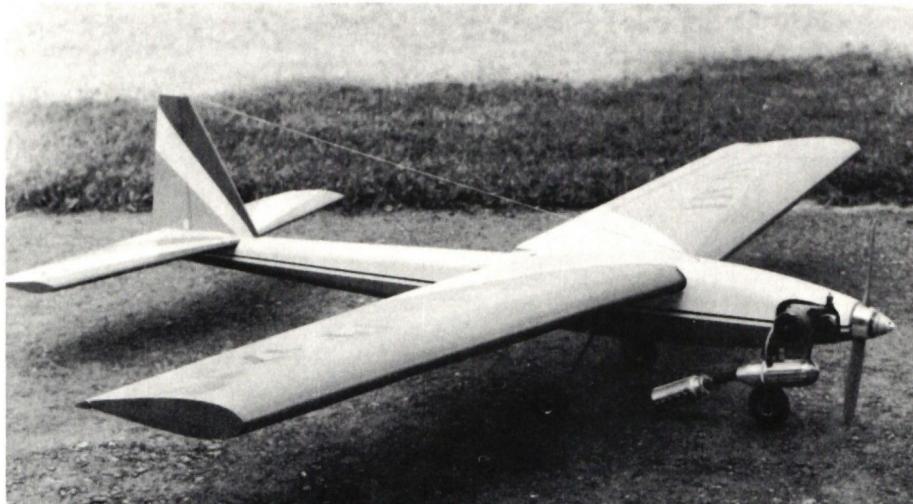
That would be nice. These days, however, they produce a rather piercing screech that, as experience has shown, slowly but surely provokes the affected airfield residents to take restrictive countermeasures.
Even as a dedicated model aircraft enthusiast, one must acknowledge that, to an outsider, the noise typically produced by model engines today is out of all proportion to the personal satisfaction of the model pilot. What else does the outsider see but model airplanes—all looking more or less the same—constantly flying through maneuvers of varying success or, to put it another way, tearing through the sky? Unfortunately, motorized model flying has today come to be viewed as little more than a gimmick, not least thanks to increasingly reliable control systems and the wide range of pre-assembled models available, which spare beginners, in particular, many setbacks.
As the performance of model engines has increased, so too has their noise level, which is fueling growing opposition to model aviation. However, it’s pointless to accept this situation as a given and wait passively for some miracle—such as an engine manufacturer suddenly offering a super-quiet engine on its own initiative. Why should they, when in the meantime people are happily buying ever more powerful and louder engines? For their part, model shops will be just as happy to sell you only gliders (at slightly higher prices) down the road, should powered model flying be completely banned by then.
Consequently, I urge the model-building community to exert appropriate influence on the industry—though this would require a shift in the general public sentiment. We should develop more ambition to compete with the quietest model rather than trying to impress with endless vertical climbs. (Who, exactly?)
Of course, in this regard, the dedicated competition pilots are not to be envied; they not only need extra power to compensate for piloting shortcomings but also have to train frequently. Here, excessive noise is compounded by a high number of flights, leading to a nuisance that is generally not well-received.
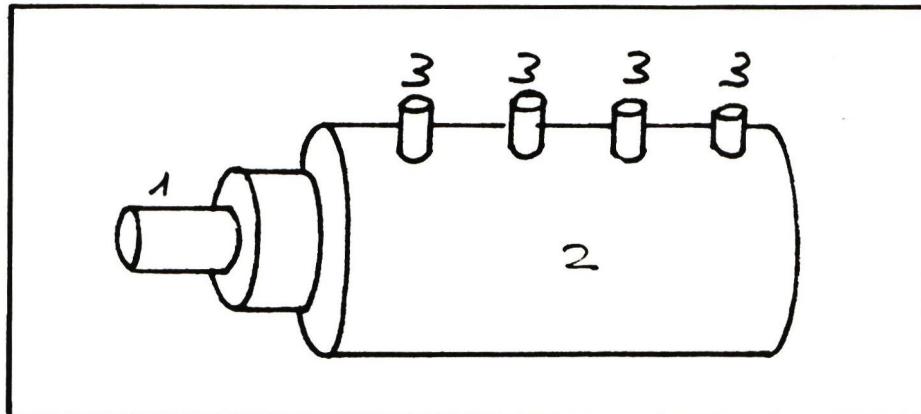
To make a constructive contribution to noise control, we will describe an auxiliary muffler that, with minimal effort, at least eliminates exhaust noise and causes only a negligible loss of power. This auxiliary silencer essentially consists of a slim aluminum canister (2) with a volume of about 50 cm³ and a screw-on cap that supports the inlet pipe (1). The exhaust gases exit the silencer through 4–7 short tubes (3), the number of which depends on the engine size and the desired level of noise reduction. The sketch illustrates the silencer’s design.
The secret here lies in the sound-absorbing lining made of a completely heat-resistant and self-supporting material that is resistant to fuel and solvents. This lining, which can be easily replaced if necessary, turns the interior into an anechoic chamber and absorbs the exhaust noise without creating any additional resistance to the gas flow.
Measurements on models at a distance of 4 m outdoors showed noise level reductions of 10 to 17 dB(A) (no misprint!) with a barely noticeable drop in RPM; for most engines between 6 and 10 cm³, the noise reduction compared to the original muffler alone was around 12 dB(A). Keep in mind that a reduction of 3 dB corresponds roughly to halving the sound pressure level. In other words, four models silenced in this way, when operated simultaneously, produce just as much noise as a single model equipped only with the original muffler.
If one is willing to accept a certain loss of power and uses a smaller number of longer exhaust tubes, operation becomes almost unbelievably quiet. For example, two such models—equipped with a 6 cm³ and a 10 cm³ engine, respectively—produce a mere 75 dB(A) at 10,000 rpm from a distance of 4 m, which corresponds to the noise level of a busy restaurant.
The easiest way to install the silencer is using a short rubber hose and small clamps immediately behind the original silencer. Incidentally, it remains practically cool and can therefore also be installed inside the fuselage.
Note: As part of a promotional campaign, we plan to make the materials needed for the silencer described here—namely, the sleeve, lining material, small tube, and a portion of Durmetall cold-weld adhesive—available at a reasonable price through specialty stores. Since the noise problem at some airfields is becoming increasingly serious, it is strongly recommended that affected model builders give this a try. H. St.


News from HEBU

TEAM MANAGER "THIS" BOSSHARD
 Rodito Nussbaumer

YOU KNOW WHAT I MEAN? 125 YEARS OF THE SWISS AERO CLUB
 Emil Giezendanner

F3A EUROPEAN CHAMPIONSHIPS IN ST-MACAIRE, FRANCE
 Matthias Bosshard

HORIZON HOBBY/LEMACO NEWS: MICRO OV-10 BRONCO 645 MM BY E-FLITE

PRIDE AND GOOD IDEAS
 Markus Nussbaumer

34th HAHNENMOOS ALPINE MODEL AIRPLANE CAMP
Res Dauwalder
TRY-OUT DAY AT MFV WETTINGEN
Urs Keller
52. 2026 ALPS CUP
Emil Giezendanner
ATOM, THE NEW DOUBLE-DECKER FROM CPLR
Matthias Bosshard
CORSAIR F4U – A WARBIRD WITH A MEMORABLE LOOK
Jürgen Rosenberger, Jürgen Prinz
SUMMER FUN 2026 AT MG USTER
Martin Wunderli
What's New at Leomotion.com

THE PC-21 STORY
Emil Giezendanner
COUPE DES ALPES – OBSERVE AND LEARN
Rodito Nussbaumer
TWIN TOWN PARTNERSHIP
Wolfgang Voeller
EURO CONTEST GLIDER ACRO TOUR AUSTRIA 2026

BY YOUTH, FOR YOUTH
Lorena Betschen
SMALL, MODEL-LIKE SAILBOATS
Res Dauwalder
WELCOME, NEW MEMBER!
Andrea Bolliger
FREE FLIGHT IN THE MIDDLE OF SUMMER
Urs Muntwyler
INSIGHTS INTO THE HISTORY OF SEAPLANES

NEWS FROM HEBU
 Julia Bucher

FROM 0 TO 100
Markus Nussbaumer
MEMORIES
Wolfgang Völler
NOS REGION – A HUB FOR ELECTRIC AVIATION
Emil Giezendanner
DO YOU KNOW WHAT I MEAN IN THE LAND OF SMILES?
Emil Giezendanner
A SPECTACULAR F3A WORLD CUP IN THE PRINCIPALITY OF LIECHTENSTEIN
Emil Giezendanner