
Antique – Pilot 4 Model Airplane
A Swiss classic car with modern technology!
In 1940, Arnold Degen designed this free-flight glider model, which remains particularly popular in Switzerland to this day.
A free-flight glider model with a one-piece wing spanning 2.24 m;—today we wonder: How did our colleagues back then transport this behemoth? A tall fuselage with a large lateral surface area provided the longitudinal stability needed to handle the slope. A massive 4-mm plywood skid running from the nose to just below the wing ensured landing stability—a feature that’s still very useful today! The airfoil, with a thickness of about 15% and a slight S-curve, didn’t necessarily follow the conventions of the time, but it demonstrated very good flight performance in practice. So much for the original.
Since the initial version of my CNC design was released, over 25 sets of milled parts have been delivered to colleagues in Switzerland, Germany, and Austria, in some cases through the company G. Kirchert in Vienna (www.kirchert.com). Based on feedback from colleagues and my own experience, I have now made several changes in the second edition; among other things, the enlargement of the rudder was particularly well received. The HLW is now designed as a pendulum rudder, and the wing sections are constructed to be attached to the fuselage. By eliminating the “wing trough” in the fuselage, the fuselage’s structural strength has been significantly increased and transportability improved.
What must a model builder or CNC designer keep in mind when replicating an ANTIK model aircraft to ensure that the character of the ANTIK model aircraft is preserved? – There has already been a great deal of discussion and many suggestions on this topic. In Germany, the AMD (ANTIK-Modellflugfreunde Deutschland e.V.) has created a set of rules that is applied in the relevant competitions. For more details, see www.antikmodellflugfreunde.de. In Austria, the ANTIK Model Flying Interest Group is currently in the process of transforming into the association “Österreichische ANTIK-Modellflugfreunde.” The rules and regulations of the Austrian Aero Club’s Model Flying Section document the construction specifications and competition rules in the MSO (Model Sports Regulations); these can be found at www.prop.at, MSO, ANTIK.
Both sets of regulations are very similar, allowing for participation in competitions under either system. The primary shared goal is for ANTIK model aircraft to be recognized and accepted as such, ensuring the continued existence of this category in the future. Milled parts kits, which can save up to ¾ of the construction time for such a model, are certainly welcome here. After all, mastery of the fretsaw should not be the criterion for building replicas of ANTIK model airplanes.
As a CNC designer, the following points are crucial to me when creating milling part kits:
- Sufficient structural strength of the model to increase its chances of survival even during “aerobatics” and “violent descents from thermals”
- Unrestricted use of RC systems
- Accessibility to the RC components within the model
- Assembly of wings and tail surfaces that is easy to transport
- In CNC design for the
The latest version of the milled parts set includes the following features:
- The pendulum HLW is removable and can be secured with block clamps; pivot holes are provided for three different configurations; the edge arch with end strip is milled from a single piece of 1.5-mm plywood.
- SLW; except for the main spar, all other parts are milled from 1.5-mm plywood.
- Wing struts are an integral part of the fuselage; wing spars consist of 10×1 mm strip steel with MS square tubing; MS tubing is incorporated into a 3-part spherical sandwich with a specified V-shape, including 3 adjustment dowels.
- Milled holes in the root connecting rib for a 6-pin MPX connector or a Graupner connector for 2 servos; ballast mount for MPX tube and lead rods; mounting for MPX Multilock; 2×5 mm dowels; antenna connector possible.
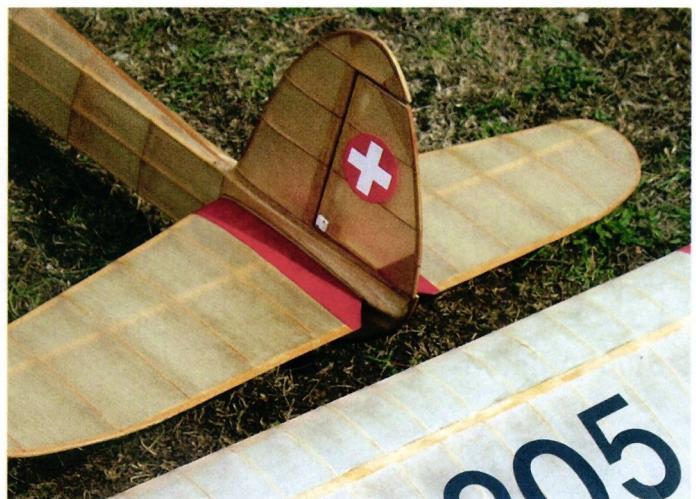
Vintage glider model “Pilot 4.” Designed in 1940 by Arnold Degen, senior expert in model aviation at the Aero Club of Switzerland.
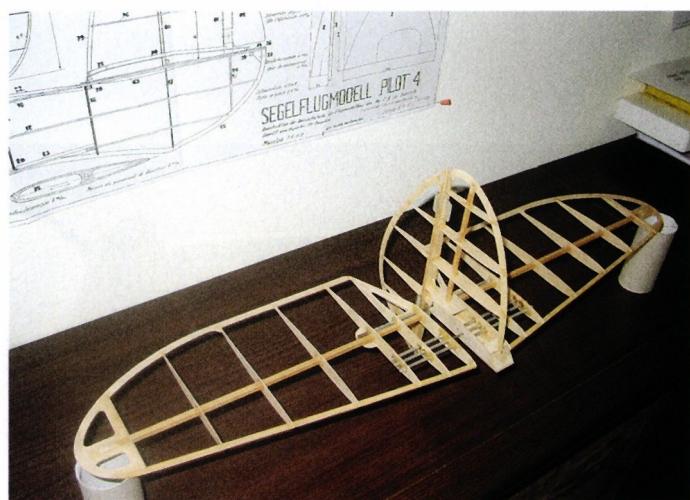
Wing connection.
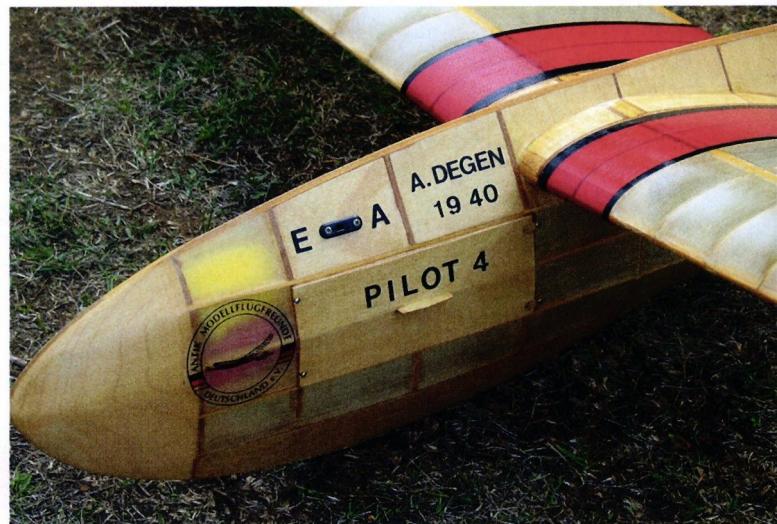
Classic fuselage nose.
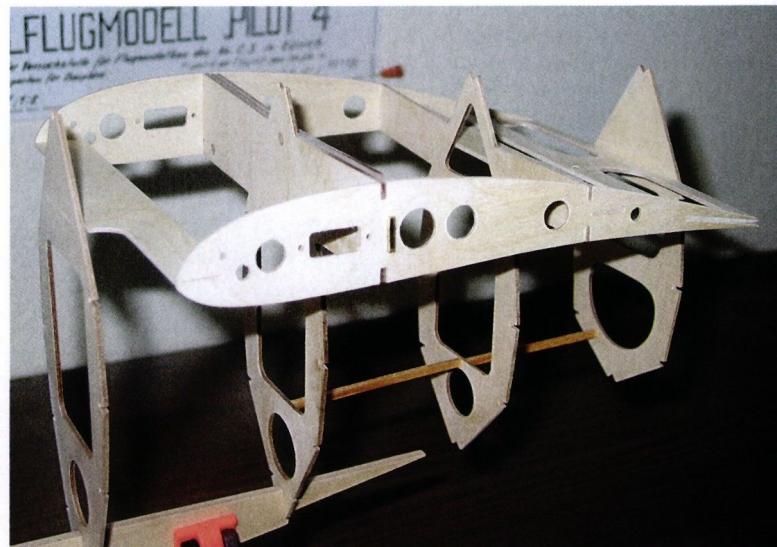
View of the CNC-machined plywood structure.
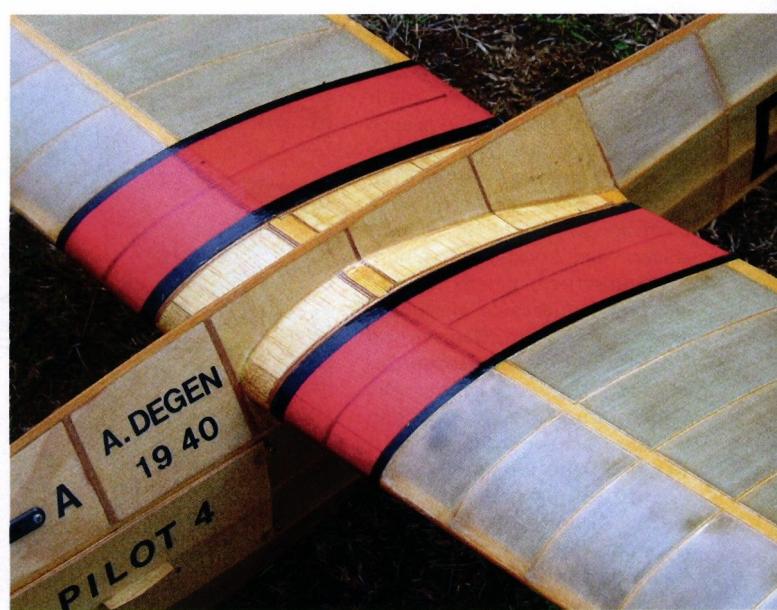
Wing-fuselage junction.
For more information, contact:
G. Kirchert, A-1140 Vienna, Linzerstrasse 65, Tel. +43 1 982 44 63, Email: office@kirchert.com. Available model airplane milling part sets: Eagle by F. Reiss; Austria Meise II by DI R. Salzmann; Large Albatross by H. Münch; Great Egret by V. Darmann; Strolch & Baby by H. Kirschke; Woodpecker by E. Jedelsky; Motorized models: Goldhahn by E. Goldhahn; Simplex by A. Kafka.
Adolf Helfert, Brunnenstrasse 9, A-3433 Königstetten, Tel. +43 2273 2034, Email: a.helfert@aon.at

EURO CONTEST GLIDER ACRO TOUR AUSTRIA 2026

THE PC-21 STORY
 Emil Giezendanner

TWIN TOWN PARTNERSHIP
 Wolfgang Voeller

SUMMER FUN 2026 AT MG USTER
Martin Wunderli
CORSAIR F4U – A WARBIRD WITH A MEMORABLE LOOK
Jürgen Rosenberger, Jürgen Prinz
52. 2026 ALPS CUP
Emil Giezendanner
YOU KNOW WHAT I MEAN? 125 YEARS OF THE SWISS AERO CLUB
Emil Giezendanner
News from HEBU

TEAM MANAGER "THIS" BOSSHARD
Rodito Nussbaumer
ATOM, THE NEW DOUBLE-DECKER FROM CPLR
 Matthias Bosshard

F3A EUROPEAN CHAMPIONSHIPS IN ST-MACAIRE, FRANCE
Matthias Bosshard
INSIGHTS INTO THE HISTORY OF SEAPLANES

WELCOME, NEW MEMBER!
Andrea Bolliger
What's New at Leomotion.com

PRIDE AND GOOD IDEAS
 Markus Nussbaumer

SMALL, MODEL-LIKE SAILBOATS
Res Dauwalder
FREE FLIGHT IN THE MIDDLE OF SUMMER
Urs Muntwyler
BY YOUTH, FOR YOUTH
Lorena Betschen
HORIZON HOBBY/LEMACO NEWS: MICRO OV-10 BRONCO 645 MM BY E-FLITE

34th HAHNENMOOS ALPINE MODEL AIRPLANE CAMP
Res Dauwalder
COUPE DES ALPES – OBSERVE AND LEARN
Rodito Nussbaumer
TRY-OUT DAY AT MFV WETTINGEN
 Urs Keller

NEWS FROM HEBU
 Julia Bucher

NOS REGION – A HUB FOR ELECTRIC AVIATION
Emil Giezendanner
MEMORIES
 Wolfgang Völler

70 YEARS OF THE NIDWALDEN MODEL AIRPLANE CLUB
Martin Barmettler
A SPECTACULAR F3A WORLD CUP IN THE PRINCIPALITY OF LIECHTENSTEIN
Emil Giezendanner
FROM 0 TO 100
Markus Nussbaumer